

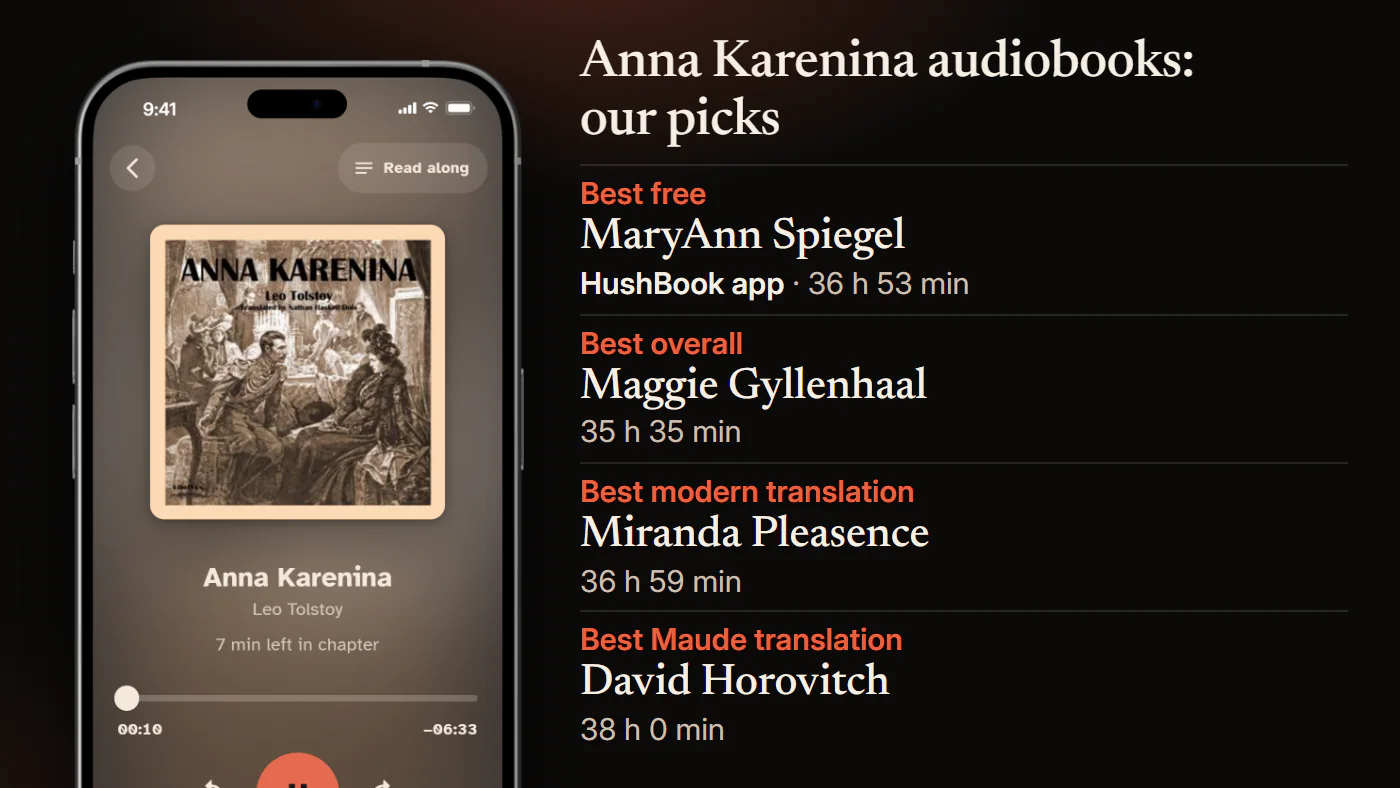
Key takeaways
- The best free Anna Karenina audiobook is MaryAnn Spiegel's solo LibriVox reading, 36 hours 53 minutes, free in the HushBook app; it reads Nathan Haskell Dole's translation, not Garnett's.
- Maggie Gyllenhaal's 2016 Audible Studios recording, 35 hours 35 minutes, is our best overall pick, with 4.5 stars from 14,664 Audible US ratings; her sample matches Constance Garnett's translation.
- Miranda Pleasence's 2020 Penguin Classics recording, 36 hours 59 minutes, is the only Pevear and Volokhonsky audiobook we found, and David Horovitch's 38 hour recording is the pick for Maude.
- Garnett's translation has 350,021 words in 239 chapters by our count: 38 hours 38 minutes at 1x, 30 hours 54 minutes at 1.25x and 25 hours 45 minutes at 1.5x.
- By our count of names, Levin's circle leads 112 of the 239 chapters, 45.3% of the words, and Anna herself steps on stage only in Part One, Chapter 18.
The best Anna Karenina audiobook is Maggie Gyllenhaal's Audible Studios recording, 35 hours 35 minutes long. It has 4.5 stars from 14,664 Audible US ratings as of November 15, 2026, more than four times the next most rated. The best free one is MaryAnn Spiegel's solo LibriVox reading (36 hours 53 minutes) of Nathan Haskell Dole's translation. Miranda Pleasence's Penguin Classics recording (36 hours 59 minutes) is the best modern translation, and David Horovitch's (38 hours) is the pick for the Maude translation.
Anna Karenina is Leo Tolstoy's novel of the 1870s, serialised in The Russian Messenger from 1875 to 1877 and published as a book in 1878. It has more than a dozen English translations, four of them on audio, and 13 of the 19 complete recordings on Audible US read Constance Garnett's. Below: every complete recording with the translation it reads, checked against its Audible sample, the matching print editions, the length at each speed, Levin's share of the book, the free and abridged versions, and a spoiler-free list of names. Every edition fact was read from the publisher's or store's own page on November 15, 2026.
Which Anna Karenina audiobook is best?
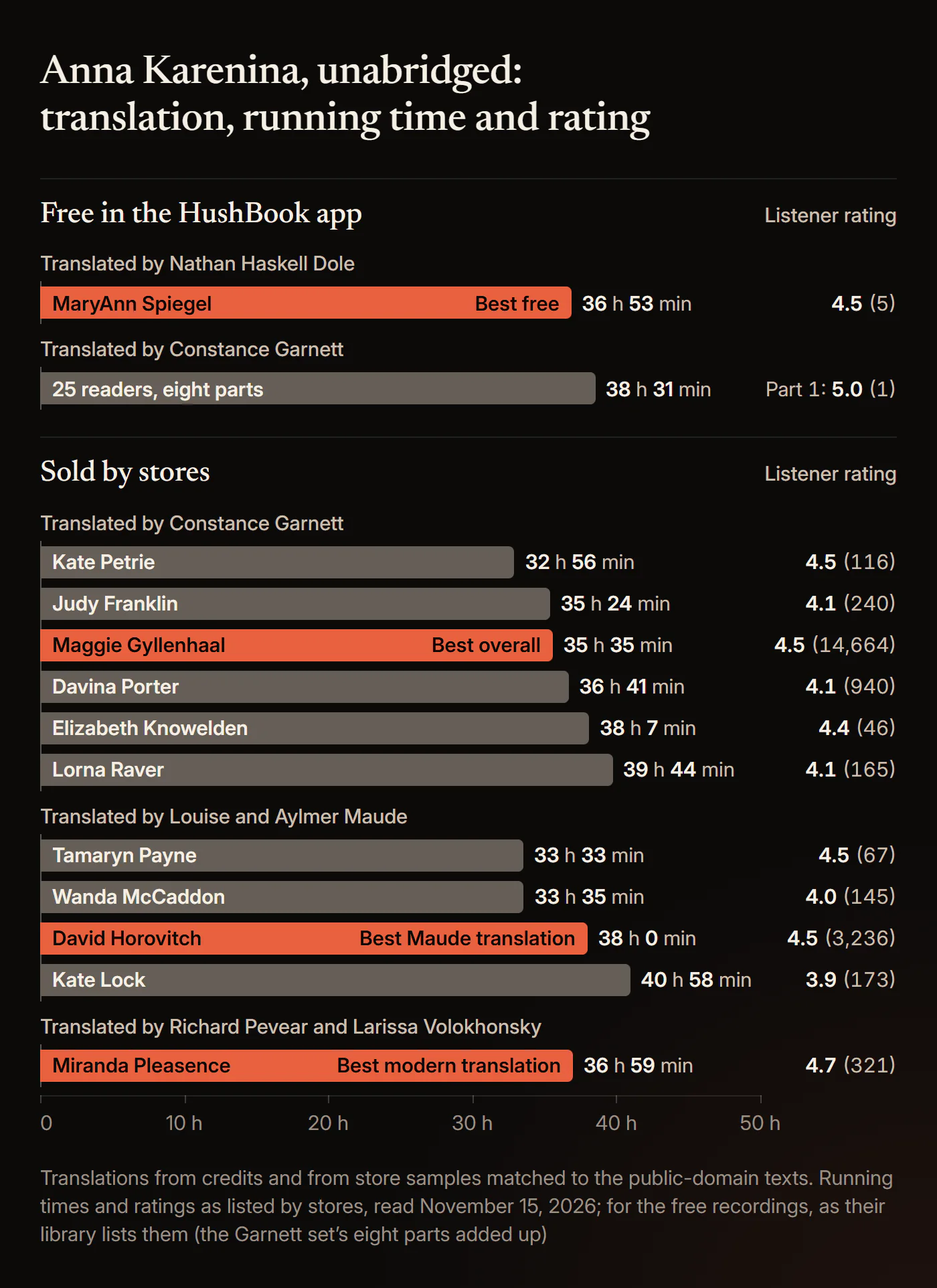
MaryAnn Spiegel's LibriVox reading for free, Maggie Gyllenhaal for most listeners, Miranda Pleasence for a modern translation, and David Horovitch for the Maude translation.
Best free: MaryAnn Spiegel, LibriVox (2012)
MaryAnn Spiegel reads all 238 chapters alone in LibriVox's Dole recording, catalogued on February 16, 2012, at 36:52:39. It is free and in the public domain, and it is free in the HushBook app too: in Discover, search Anna Karenina and pick the "Anna Karenina" card that reads 36h 53m, a 1014 MB download with 238 chapters.
Know which text you are getting. This recording reads Nathan Haskell Dole's translation, first published in 1886, in his 1899 revised text, not Constance Garnett's; what critics say about each translation is in the translation section below. If you want Garnett's text for free, LibriVox recorded it as eight separate projects, Books 1 to 8, 38 hours 31 minutes in all, and Spiegel reads three of them.
Her reading had 869,051 downloads on the Internet Archive on November 15, 2026. A 2016 review there calls it "something of a new gold standard in audiobooks", and a 2013 one says "Every word is clearly pronounced".
Best overall: Maggie Gyllenhaal (Audible Studios, 2016)
Maggie Gyllenhaal's Audible Studios recording has 4.5 stars from 14,664 ratings on Audible US, with 4.7 for performance, as of November 15, 2026. That is 4.5 times the 3,236 ratings of the next most rated, David Horovitch's. Audible named it a winner of its own Best of 2016 awards, in the classics category.
It reads Constance Garnett's translation, though Audible names no translator. We checked by ear: her Audible sample, transcribed by speech recognition, matched Garnett's text in Project Gutenberg eBook #1399 on 92.4% of its six-word runs and the Maude translation on 5.6%. The three recordings whose stores or opening credits name Garnett matched 80 to 91%. Some pages credit Gyllenhaal with Pevear and Volokhonsky's translation; her sample plays Garnett's sentences, and the only Pevear and Volokhonsky recording we found is Miranda Pleasence's.
One Audible review calls it "a brilliant narration for this timeless work of art", and a 2021 r/audiobooks comment said "Even the farming chats are just a delight coming from her." A minority dislike her delivery; one Audible reviewer found the characters' lines "superfluously sensual". It listed at $28.54 on Audible US and $22.99 on Apple Books. Libby and hoopla did not carry it at the library systems we checked.
Best modern translation: Miranda Pleasence (Penguin Classics, 2020)
Miranda Pleasence's Penguin Classics recording reads Richard Pevear and Larissa Volokhonsky's 2000 translation, 36 hours 59 minutes, and Audible's page says it "includes an introduction by Richard Pevear." Its copyright line reads "Translation copyright © Richard Pevear and Larissa Volokhonsky 2003 (P) Penguin Audio 2020", and its sample matched none of the three public-domain texts we tested. It is the only unabridged recording of that translation we found. Some guides list it as the Maude translation; Penguin's credit says otherwise.
It has the highest overall score of the main editions: 4.7 stars from 321 Audible US ratings, with 4.8 for performance, on November 15, 2026. One reviewer wrote that Pleasence "keeps the pace brisk". It listed at $19.32 on Audible US and $12.99 on Apple Books.
It is also the one to borrow. On Libby the same day, the King County Library System had 4 copies with no holds, the New York Public Library 5 copies with 11 holds, the San Francisco Public Library 4 with 2 holds, and the Los Angeles Public Library 3 with 19.
Best Maude translation: David Horovitch (BBC recording, 1994)
David Horovitch's recording on Audible reads Louise and Aylmer Maude's translation, and Audible's summary says so: "Translated by Louise and Aylmer Maude." His sample opens on their first line, "All happy families resemble one another", and matched the Maude text on 86.5% of its six-word runs. It runs 38 hours. The copyright line is "©1994 BBC Audiobooks Ltd", and Audible Studios has sold it since 2008.
It has 4.5 stars from 3,236 ratings on Audible US and 4.5 from 2,070 on Audible UK, both with 4.7 for performance, as of November 15, 2026. A 2019 r/audiobooks reply put it simply: "the Horovitch version is brilliant". A 2019 reply in another thread said Horovitch reads Marian Schwartz's translation. That cannot be: Schwartz's translation came out in 2014, 20 years after this recording. It listed at $27.49 on Audible US and $17.99 on Apple Books.
Also worth knowing. Davina Porter's Recorded Books reading of Garnett (36 hours 41 minutes, 4.1 from 940) is the Garnett to borrow: hoopla carries it, and the Los Angeles Public Library had 4 copies on Libby. Tamaryn Payne's 2020 Vintage recording is the newest Maude (33 hours 33 minutes, 4.5 from 67, 4.8 for performance).
Every unabridged recording compared
Our table has 18 of the 19 complete recordings on Audible US, plus the two free LibriVox versions. The 19th is covered with the free recordings below. Ratings are Audible US stars with the number of ratings in brackets, as of November 15, 2026.
| Narrator | Translation | Runtime | Publisher | Year | Audible US rating | Where we found it |
|---|---|---|---|---|---|---|
| MaryAnn Spiegel, LibriVox | Nathan Haskell Dole | 36 h 53 min | LibriVox | 2012 | Free | LibriVox, Internet Archive, HushBook Discover |
| Maggie Gyllenhaal | Constance Garnett | 35 h 35 min | Audible Studios | 2016 | 4.5 (14,664) | Audible, Apple Books |
| Miranda Pleasence | Pevear and Volokhonsky | 36 h 59 min | Penguin Classics | 2020 | 4.7 (321) | Audible, Apple Books, Libby |
| David Horovitch | Louise and Aylmer Maude | 38 h 0 min | Audible Studios (BBC recording) | 1994 | 4.5 (3,236) | Audible, Apple Books |
| Davina Porter | Constance Garnett | 36 h 41 min | Recorded Books | 1990 | 4.1 (940) | Audible, Apple Books, Libby, hoopla |
| Judy Franklin | Constance Garnett | 35 h 24 min | RNIB | 2009 | 4.1 (240) | Audible, Apple Books |
| Kate Lock | Louise and Aylmer Maude | 40 h 58 min | Naxos AudioBooks | 2010 | 3.9 (173) | Audible, Apple Books, hoopla |
| Lorna Raver | Constance Garnett | 39 h 44 min | Tantor Audio | 2010 | 4.1 (165) | Audible, Apple Books, Libby, hoopla |
| Wanda McCaddon | Louise and Aylmer Maude | 33 h 35 min | Blackstone | 1993 | 4.0 (145) | Audible, Apple Books, Libby |
| Kate Petrie | Constance Garnett | 32 h 56 min | A.R.N. Publications | 2018 | 4.5 (116) | Audible, Apple Books |
| Tamaryn Payne | Louise and Aylmer Maude | 33 h 33 min | Vintage (Penguin) | 2020 | 4.5 (67) | Audible, Apple Books |
| Elizabeth Knowelden | Constance Garnett | 38 h 7 min | Brilliance Audio (AmazonClassics) | 2020 | 4.4 (46) | Audible, Apple Books |
| Frankie Porter and five other narrators | Constance Garnett | 39 h 54 min | Spotify Audiobooks | 2024 | 4.2 (5) | Audible, Apple Books, hoopla |
| Harrie Dobby | Constance Garnett | 36 h 24 min | Bookstream | 2022 | 5.0 (1) | Audible, Apple Books |
| Jonathan Keeble | Constance Garnett | 35 h 44 min | SNR Audio | 2023 | 2.0 (1) | Audible, Apple Books |
| Johann Zeiger | Constance Garnett | 33 h 13 min | MuseumAudiobooks.com | 2021 | No ratings | Audible, Apple Books |
| Christopher Preece | Constance Garnett | 30 h 27 min | Montgomery Providence | 2023 | No ratings | Audible, Apple Books |
| John Lowell | Constance Garnett | 30 h 17 min | Simply Media | 2024 | No ratings | Audible, Apple Books |
| Sam Kusi | Constance Garnett | 39 h 30 min | Lauscher Audiobooks | 2024 | No ratings | Audible |
| LibriVox Books 1 to 8, 25 readers | Constance Garnett | 38 h 31 min | LibriVox | 2009 to 2010 | Free | LibriVox, Internet Archive, HushBook Discover |
Runtimes are Audible's for the paid editions and LibriVox's for the free ones. Years follow each recording's copyright line where it has one: Porter's is "(P)1990", though Audible lists it from 2003, and McCaddon's "(P)1993". Libby holdings are from the New York, Los Angeles, San Francisco and Chicago public libraries and the King County Library System.
Listings we left out. Smaller Apple Books and hoopla recordings whose translation we did not test, among them Mary Gillis and Noel Jarmaine, plus part-by-part listings, collections, retellings and machine-voiced or "adapted" listings.
Which translation does each Anna Karenina audiobook use?
Constance Garnett's 1901 translation, on 13 of the 19 complete recordings on Audible US and on LibriVox's eight-part set; four read Louise and Aylmer Maude's, Miranda Pleasence reads Pevear and Volokhonsky's, and MaryAnn Spiegel's free solo reading is Nathan Haskell Dole's.
How we know. Many store pages name no translator, so we checked by ear. We transcribed the opening of each Audible sample with speech recognition and compared it, six words at a time, with three public-domain texts: Garnett's in Project Gutenberg eBook #1399, and Internet Archive scans of the Maudes' and of Dole's. Each of the 18 recordings of a public-domain translation matched its text on 74 to 94% of its six-word runs and the other two texts on under 12%, except Jonathan Keeble's, whose transcript repeated lines; his opening paragraph matched Garnett's at 96%. Pleasence's matched none of the three, which fits Penguin's credit to Pevear and Volokhonsky.
| Translation | Unabridged audiobook |
|---|---|
| Nathan Haskell Dole, 1886, revised 1899 | MaryAnn Spiegel, free on LibriVox |
| Constance Garnett, 1901 | Gyllenhaal, Porter, Raver, Franklin, Petrie, Knowelden and seven more; free LibriVox Books 1 to 8 |
| Louise and Aylmer Maude, 1918 | Horovitch, Payne, McCaddon, Lock |
| Rosemary Edmonds, 1954 | None found |
| Joel Carmichael, 1960 | None found |
| David Magarshack, 1961 | None found |
| Garnett revised by Leonard J. Kent and Nina Berberova, 1965 | None found |
| Margaret Wettlin, 1978 | None found |
| Richard Pevear and Larissa Volokhonsky, 2000 | Miranda Pleasence (Penguin Classics, 2020) |
| Kyril Zinovieff and Jenny Hughes, 2008 | None found |
| Rosamund Bartlett, 2014 | None found |
| Marian Schwartz, 2014 | None found |
"None found" means we searched Audible's US, UK, Canadian and Australian catalogues, Apple Books, Libby at five library systems and hoopla on November 15, 2026, and found no recording. People search for a Bartlett audiobook in particular; there is none. The 19th Audible recording, which reads Dole's translation, is covered with the free recordings below.
Lorna Raver reads Garnett: her recording opens "translated by Constance Garnett", though a 2026 r/tolstoy post guessed Maude.
The Maudes' Anna Karenina appeared in 1918, eight years after Tolstoy died, so it is not a translation he read or approved.
What critics say about the translations you can hear:
- Nathan Haskell Dole (1886, revised 1899). Rosamund Bartlett, who made her own translation in 2014, called it "the first woefully inadequate English translation" of the novel in The Guardian.
- Constance Garnett (1901). Vladimir Nabokov called her Anna Karenina "a complete disaster", David Remnick reported in The New Yorker in 2005. Janet Malcolm, in The New York Review of Books in 2016, praised "Garnett's fine English, her urgent forward-moving sentences, her feeling for words".
- Louise and Aylmer Maude (1918). Malcolm noted that "some readers prefer their version of the novel to Garnett's". Apollonio wrote in Tolstoy in Context (Cambridge University Press, 2022) that the Maudes "produced the most sustained and authoritative body of Tolstoy translations."
- Pevear and Volokhonsky (2000). James Wood, in The New Yorker in 2001, called their version a "superb rendering". Malcolm called their English "flat, awkward". Oprah Winfrey chose it for her book club in 2004, and Viking Penguin printed 800,000 more copies in a single month, Remnick reported.
Apollonio's verdict on all of them: "The diversity of the English Tolstoy corpus makes it impossible to come up with a clear ranking of translations based on quality."
Which audiobook matches your print edition?
Match the translator, not the cover: Penguin Classics is Pevear and Volokhonsky and Miranda Pleasence, the Maude editions match David Horovitch, and any Garnett edition matches Maggie Gyllenhaal or the free LibriVox Books 1 to 8.
- Penguin Classics, including the 2004 Penguin Classics Deluxe edition chosen by Oprah's book club: Miranda Pleasence.
- Oxford World's Classics (the older Maude edition), Everyman's Library, Vintage Classics, Wordsworth, Dover: the Maude translation, so David Horovitch, Tamaryn Payne, Wanda McCaddon or Kate Lock.
- Norton Critical Edition: George Gibian's 1970 revision of the Maude. Kate Lock's first line has its "but each unhappy family".
- Project Gutenberg, Standard Ebooks, Barnes and Noble Classics, AmazonClassics: Garnett, so Gyllenhaal, Porter, Raver, Franklin, Petrie, Knowelden or the free LibriVox Books 1 to 8.
- Modern Library: Garnett as revised by Kent and Berberova. We found no recording of the revision: the four Garnett samples that reach the opening, Knowelden's, Zeiger's, Preece's and Keeble's, all read "Everything was in confusion in the Oblonskys' house", where the revision has "the Oblonsky household". Any Garnett recording is the closest.
- Oxford World's Classics since 2014 (Bartlett), Yale (Schwartz), Alma (Zinovieff and Hughes), Signet (Magarshack), Bantam (Carmichael): no matching audiobook found.
Apart from Penguin and the Modern Library, these publisher matches follow We Love Translations.
Hear the difference
The famous first sentence alone does not tell the translations apart by ear; the second sentence does. Here are the first two as the narrators read them, transcribed from the Audible samples:
| Translation (narrators) | The opening |
|---|---|
| Garnett (Knowelden, Zeiger, Preece) | "Happy families are all alike; every unhappy family is unhappy in its own way. Everything was in confusion in the Oblonskys' house." |
| Maude (Horovitch, Payne) | "All happy families resemble one another, each unhappy family is unhappy in its own way. Everything was upset in the Oblonskys' house." |
| Dole, 1899 text (MaryAnn Spiegel) | "All happy families resemble one another; every unhappy family is unhappy in its own way. All was confusion in the house of the Oblonskys." |
| Pevear and Volokhonsky (printed text) | "All happy families are alike; each unhappy family is unhappy in its own way. All was confusion in the Oblonskys' house." |
Pleasence's sample does not reach the opening, so her row is the printed text as We Love Translations quotes it. Later in the chapter the two part clearly: Gyllenhaal's Garnett reads "it's all my fault", Pleasence's Pevear and Volokhonsky "I'm the guilty one in it all."
How long is the Anna Karenina audiobook?
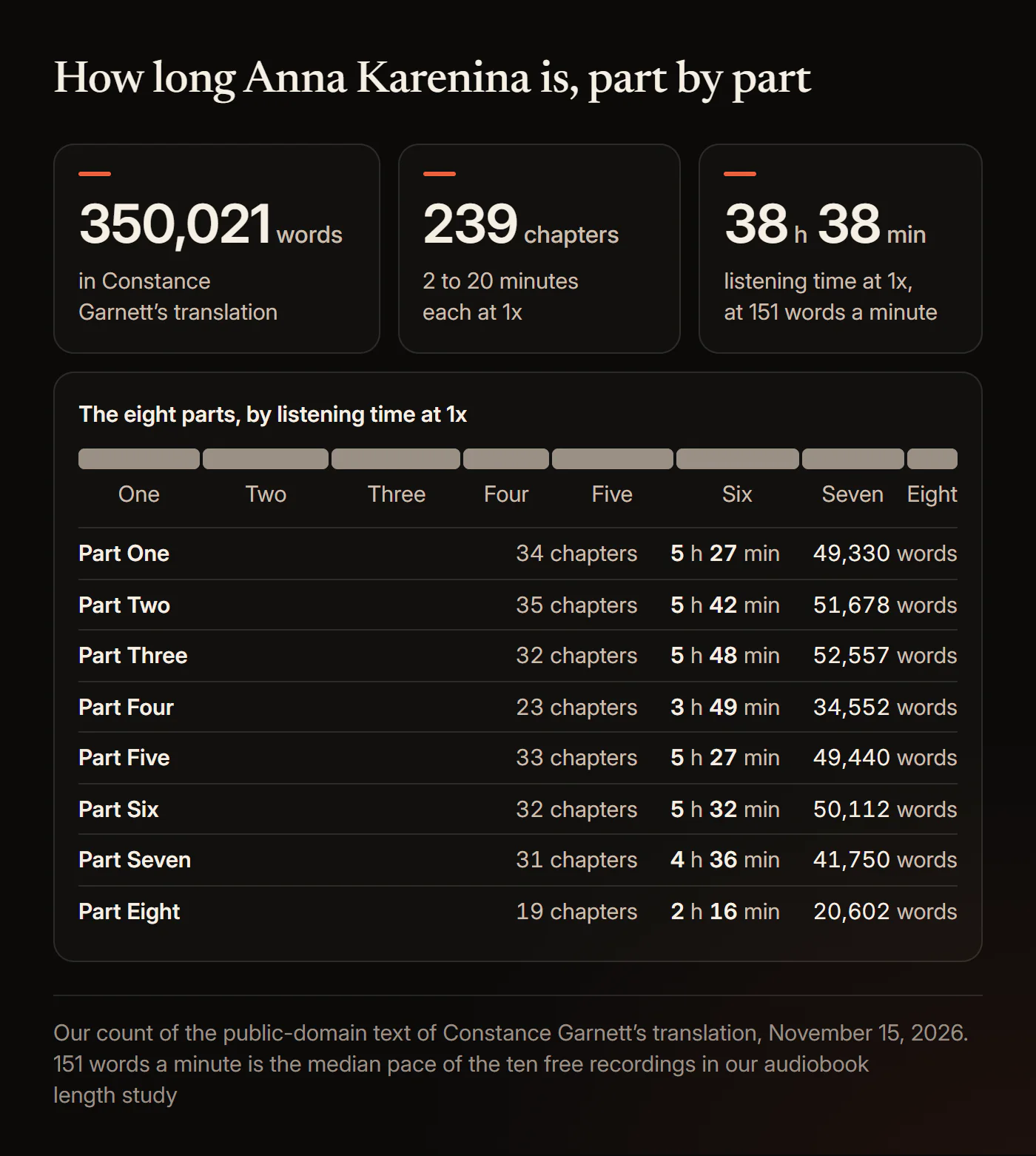
About 38 hours 38 minutes at 1x: Garnett's translation has 350,021 words, and complete recordings run from 30 hours 17 minutes to 40 hours 58 minutes.
We counted the words ourselves. Project Gutenberg eBook #1399, Garnett's translation, downloaded on November 15, 2026, has 350,021 words in the novel without the part and chapter headings. A second count from Gutenberg's HTML edition, with a different parser, gave exactly the same figure. We used 151 words a minute, the median pace we measured for LibriVox solo readers in our guide to how long audiobooks run. The recordings at speed are each runtime divided by the speed.
| Speed | The novel at 151 words a minute | MaryAnn Spiegel (free) | Maggie Gyllenhaal | Miranda Pleasence | David Horovitch |
|---|---|---|---|---|---|
| 1x | 38 h 38 min | 36 h 53 min | 35 h 35 min | 36 h 59 min | 38 h 0 min |
| 1.25x | 30 h 54 min | 29 h 30 min | 28 h 28 min | 29 h 35 min | 30 h 24 min |
| 1.5x | 25 h 45 min | 24 h 35 min | 23 h 43 min | 24 h 39 min | 25 h 20 min |
| 2x | 19 h 19 min | 18 h 26 min | 17 h 48 min | 18 h 30 min | 19 h 0 min |
The real range. Complete recordings on Audible run from 30 hours 17 minutes (John Lowell) to 40 hours 58 minutes (Kate Lock), and the five most rated from 35 hours 24 minutes (Judy Franklin) to 38 hours (David Horovitch). A figure of about 19.5 hours that circulates online is not the whole novel. Across the 14 Garnett recordings, the free LibriVox set included, narrators read at 146 to 193 words a minute, median 162; Gyllenhaal reads at 164.
Days to finish, our calculation at 151 words a minute, rounded up to whole days:
| Speed | 30 min a day | 60 min a day |
|---|---|---|
| 1x | 78 days | 39 days |
| 1.25x | 62 days | 31 days |
| 1.5x | 52 days | 26 days |
| 2x | 39 days | 20 days |
How many parts and chapters are in Anna Karenina?
Eight parts and 239 chapters, numbered from 1 again in each part.
| Part | Chapters | Words (our count) | At 1x | Starts at |
|---|---|---|---|---|
| One | 34 | 49,330 | 5 h 27 min | 0 h 0 min |
| Two | 35 | 51,678 | 5 h 42 min | 5 h 27 min |
| Three | 32 | 52,557 | 5 h 48 min | 11 h 9 min |
| Four | 23 | 34,552 | 3 h 49 min | 16 h 57 min |
| Five | 33 | 49,440 | 5 h 27 min | 20 h 46 min |
| Six | 32 | 50,112 | 5 h 32 min | 26 h 13 min |
| Seven | 31 | 41,750 | 4 h 36 min | 31 h 45 min |
| Eight | 19 | 20,602 | 2 h 16 min | 36 h 22 min |
The chapters are short: by our count the median is 1,427 words, about 9.5 minutes at 1x, and 133 of the 239 take under 10 minutes. Only one runs about 20 minutes: Part One, Chapter 5, 3,084 words. The shortest, Part Two, Chapter 10, has 246 words and takes under 2 minutes.
MaryAnn Spiegel's free reading has 238 files, one per chapter, because Dole's translation gives Part Three 31 chapters where Garnett's has 32. Her files carry the part and chapter in their titles, from "Part 1 Chapter 1" to "Part 8 Chapter 19".
Is Anna Karenina longer than War and Peace?
No: Anna Karenina is 0.62 times as long, 350,021 words in Garnett's translation against 561,870 in the Maude War and Peace.
At 151 words a minute, War and Peace takes about 62 hours, as our War and Peace audiobook comparison shows. Anna Karenina is almost exactly as long as The Brothers Karamazov: 233 words longer than its 349,788, both in Garnett's translation and counted with the same rules, as our Brothers Karamazov audiobook comparison records. It is 1.72 times as long as Crime and Punishment (203,197 words).
Is Levin the main character in Anna Karenina?
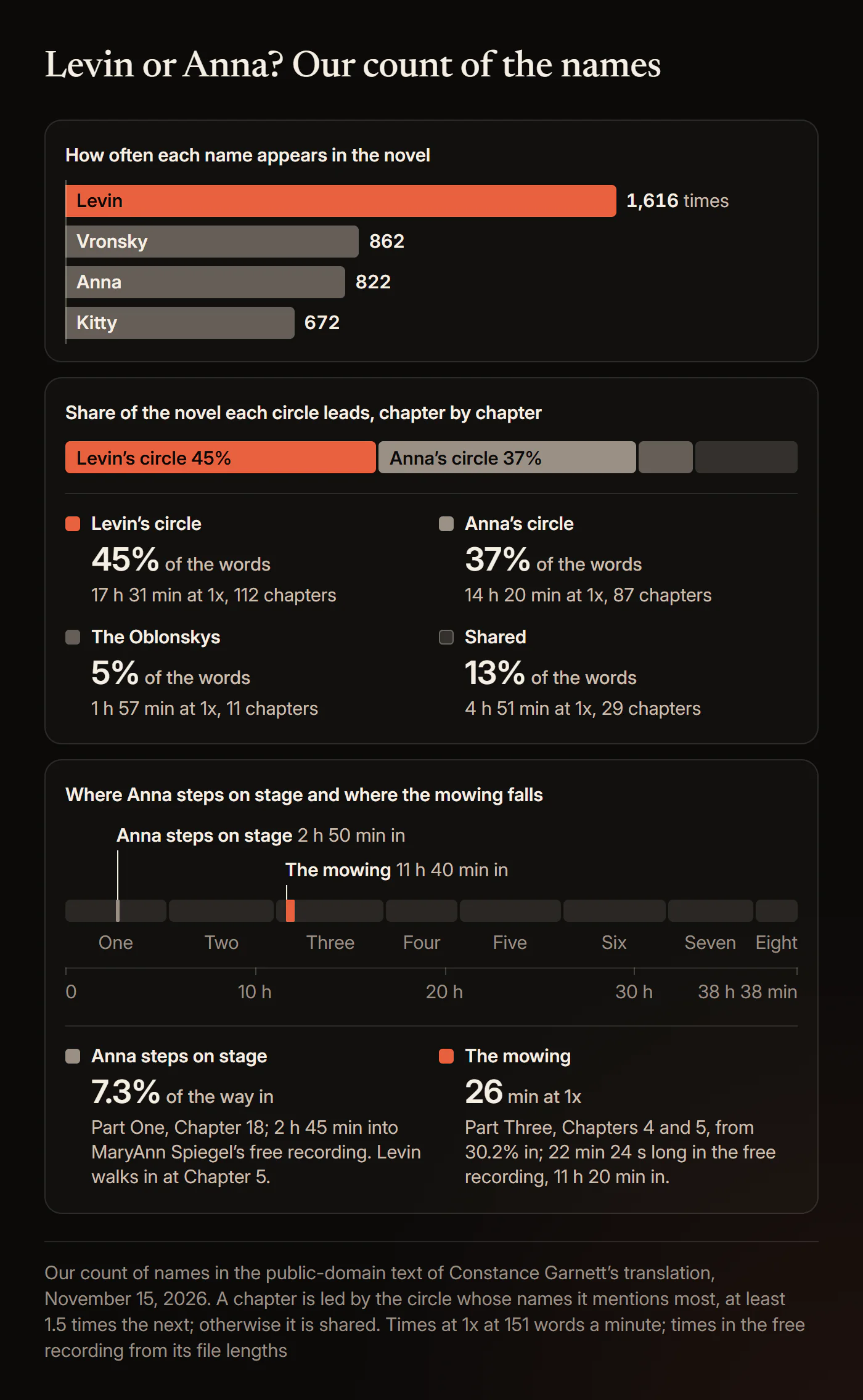
The title is Anna's, but by our count of names Levin is the most present character: "Levin" appears 1,616 times in Garnett's translation, almost twice as often as "Anna" (822).
"Vronsky" appears 862 times. Levin's name is in 123 of the 239 chapters, Vronsky's in 117 and Anna's in 113.
We also asked whose story each chapter follows. For every chapter we counted three groups of names: Levin's circle (Levin, Kitty, Konstantin, Kostya, Sergey Ivanovitch, Koznishev, Agafea Mihalovna), Anna's (Anna, Karenina, Vronsky, Alexey Alexandrovitch, Karenin, Seryozha, Lidia Ivanovna) and the Oblonskys (Stepan Arkadyevitch, Oblonsky, Stiva, Dolly, Darya Alexandrovna). A chapter goes to a circle when its names are the most frequent and at least 1.5 times the next; otherwise it counts as shared. This counts names, not scenes, so treat it as a measure, not a reading.
| Circle | Chapters it leads | Share of the words | At 1x |
|---|---|---|---|
| Levin's | 112 | 45.3% | 17 h 31 min |
| Anna and Vronsky's | 87 | 37.1% | 14 h 20 min |
| The Oblonskys' | 11 | 5.0% | 1 h 57 min |
| Shared | 29 | 12.6% | 4 h 51 min |
The order holds under other rules: with a plain majority of names, Levin's circle leads 120 chapters to Anna's 96, and with a 2 to 1 rule, 101 to 79.
By part, the balance swings. Levin's circle leads 35% of Part One's words, 37% of Part Two's, 52% of Part Three's and 25% of Part Four's; Anna's leads 24%, 54%, 37% and 53%.
Anna arrives late. Her brother first mentions her in Part One, Chapter 2. Levin walks in at Chapter 5, 1.6% of the way in. Anna herself steps on stage in Part One, Chapter 18, after 25,601 words: 7.3% of the novel, about 2 hours 50 minutes at 151 words a minute, and 2 hours 45 minutes into MaryAnn Spiegel's free reading. Of Part One's first 16 chapters, our count gives 9 to Levin's circle, 4 to the Oblonskys and 3 shared.
Tolstoy put himself into Levin. Of all his characters, Aylmer Maude wrote in his 1918 preface, "in none of them has he so frankly depicted himself as in Levin, the hero of this story." Listeners notice the share too: "I was surprised by how much of the novel focuses on him," a 2021 r/audiobooks reply said. James Wood, in The New Yorker in 2001, reported that "the great scything scenes" are often called "tedious or unnecessary", and then argued against that view.
Where is the mowing scene in Anna Karenina?
Part Three, Chapters 4 and 5: it starts 30.2% of the way in, about 11 hours 40 minutes into a complete recording, and runs about 26 minutes at 1x.
The two chapters have 3,961 words by our count. They are the only chapters with dozens of words about scythes and mowing, 49 and 38. With Chapter 6, which opens on the mown upland, the passage runs 5,168 words, about 34 minutes. In MaryAnn Spiegel's free recording the mowing is files 73 and 74, starting at 11:19:56 and lasting 22 minutes 24 seconds.
Why was Part Eight published separately?
Because Mikhail Katkov, editor of The Russian Messenger, refused to print it over its treatment of the Russian volunteers for the Serbian war.
Susanne Fusso gives that reason in a 2021 Cornell University Press essay. Part Eight came out separately in 1877, and the novel appeared as a book in 1878. It is the shortest part: 19 chapters, 20,602 words, about 2 hours 16 minutes.
Is there a free Anna Karenina audiobook?
Yes: LibriVox has two complete free versions, MaryAnn Spiegel's solo reading of Nathan Haskell Dole's translation (36 hours 53 minutes) and Constance Garnett's translation in eight parts (38 hours 31 minutes).
| MaryAnn Spiegel (Dole) | Garnett, Books 1 to 8 | |
|---|---|---|
| Read by | MaryAnn Spiegel | 25 readers: Books 1, 4, 5, 7 and 8 solo, Books 2, 3 and 6 by groups |
| Title on the Internet Archive | Anna Karenina | Anna Karenina, Book 1, to Anna Karenina Book 8 |
| Running time | 36:52:39 | 38:31:27 in all |
| Files | 238 | 239, in eight downloads |
| Catalog dates | February 16, 2012 | June 13, 2009 to October 18, 2010 |
| Internet Archive downloads | 869,051 | 632,672 for Book 1 to 61,000 for Book 8 |
| 64 kbps MP3 download | 1014 MB | about 1,058 MB in all |
| Text read | Dole's 1899 revised text, matched to Wikisource | Project Gutenberg eBook #1399 |
Running times and dates come from the LibriVox catalog and API; downloads and file sizes from the Internet Archive on November 15, 2026. Our guide to whether LibriVox is free and legal explains why these recordings cost nothing.
Audible also sells a 36 hour 7 minute recording credited to "Mary Ann Spiegel" (Hexagon Tech); by our timing check of its sample, the 432 four-word sequences it shares with MaryAnn Spiegel's free LibriVox reading fall in the same order and all but one line up within 0.3 seconds, and public domain recordings may be resold, so you can have the same reading free.
Which LibriVox Anna Karenina should you pick?
MaryAnn Spiegel's, for one voice and one download; the Garnett books, if you want the translation most recordings and Project Gutenberg use.
- MaryAnn Spiegel, Dole translation. One voice for all 238 chapters, one file per chapter. Four of the five entries on its Internet Archive page are reviews of three stars or more, and the fifth is her own reply. At one hour a day it takes 37 days at 1x, 30 at 1.25x, 25 at 1.5x and 19 at 2x.
- Garnett, Books 1 to 8. The text of Project Gutenberg eBook #1399, in the translation most recordings read. Kirsten Ferreri reads Book 1 alone (4:25:30), Phil Griffiths Book 5, and MaryAnn Spiegel Books 4, 7 and 8; Books 2, 3 and 6 are group readings, with 11, 9 and 7 readers. Download all eight and play them in order.
Three recordings share the plain title "Anna Karenina": Spiegel's English Dole reading, a German reading by Eva K. (47:34:26) and a Dutch one by Marcel Coenders (38:22:09). Tell them apart by length.
Is the YouTube Anna Karenina audiobook free?
Full uploads are free to play, but we did not check which recording each one plays or who holds the rights; the LibriVox recordings are the free route with a named reader.
LibriVox recordings are in the public domain, so anyone may re-upload them.
Which Anna Karenina audiobooks are abridged or dramatised?
Nine listings we found are cut, retold or dramatised, from 25 minutes to 5 hours 6 minutes; every complete recording runs at least 30 hours 17 minutes.
| Version | Publisher, year | Runtime | What it is |
|---|---|---|---|
| BBC Radio 4: Kate Phillips, Alfred Enoch, Rory Kinnear, Sacha Dhawan | BBC Audio, 2023 | 2 h 50 min | Radio drama |
| BBC full cast with Teresa Gallagher and Toby Stephens | BBC Digital Audio, on Audible since 2012 | 3 h 30 min | Radio drama |
| Laura Paton | Naxos AudioBooks, on Audible since 2000 | 5 h 6 min | Abridged |
| Alfred Molina | HighBridge, on Audible since 2001 | 2 h 56 min | Abridged |
| Diana Quick | The Copyright Group, 2012 | 2 h 24 min | Abridged |
| Listener's Digest, Katrina Rosati Kross | 2008 | 45 min | Abridged |
| Ingrid Bergman and Gregory Peck | Saland Publishing, 2010 | 25 min | Abridged radio play |
| Real Reads, Hattie Briggs | Real Reads, 2020 | 34 min | Retelling |
| Sweet Cherry Publishing, Dan Bottomley | Sweet Cherry, 2026 | 54 min | Children's retelling |
Runtimes are Audible's, read November 15, 2026.
The two BBC versions are dramatisations, not readings of the novel. The 2023 production was "Dramatised by Linda Marshall Griffiths" and first broadcast on BBC Radio 4 from April 30 to May 14, 2023, according to its Audible listing. The earlier production, with Teresa Gallagher and Toby Stephens, has 4.4 stars from 31 Audible US ratings. It is also inside The Leo Tolstoy BBC Radio Drama Collection, 18 hours 35 minutes for War and Peace, Anna Karenina, Resurrection and more.
Laura Paton's Naxos abridgement is on Libby and hoopla. We found no complete full-cast recording of the novel on sale.
Our guide to abridged and unabridged audiobooks explains how to tell them apart in any store.
How do you keep track of the names in Anna Karenina?
Learn the two men called Alexey by their patronymics, expect Anna's brother to answer to three names, and keep every form on one list.
Russian characters go by a first name with a patronymic (the father's name), a surname, and short or pet forms. The table gives each form Garnett uses, with our count from Project Gutenberg eBook #1399, and the chapter that tells you who the person is. It carries no spoilers: every fact in it is told by the chapter shown, all in Part One, about the first 14% of the novel.
| Character | Names in Garnett's translation (our count) | Who | Told in | Say it |
|---|---|---|---|---|
| Anna's brother | Stepan Arkadyevitch 548, Oblonsky 115, Stiva 67 | Prince Stepan Arkadyevitch Oblonsky, "Stiva, as he was called in the fashionable world" | Part One, Ch. 1 | ob-LON-skee |
| His wife | Dolly 307, Darya Alexandrovna 205 | Stiva's wife; Kitty's elder sister | Part One, Ch. 1, 2 and 6 | |
| Anna | Anna 822, Anna Arkadyevna 57, Karenina 38 (with Madame Karenina) | Stiva's sister, coming from Petersburg: "my sister Anna Arkadyevna will be here tomorrow" | Part One, Ch. 2 | ka-RYE-ni-na |
| Anna's husband | Alexey Alexandrovitch 571, Karenin 51 | "Alexey Alexandrovitch Karenin, who held one of the most important positions in the ministry" | Part One, Ch. 5 | ka-RYE-nin |
| An officer | Vronsky 862, Count Vronsky 15, Alexey Kirillovitch 5 | Count Alexey Kirillovitch Vronsky | Part One, Ch. 11 and 14 | VRON-skee |
| Levin | Levin 1,616, Konstantin 112, Kostya 35, Konstantin Dmitrievitch 32 | Oblonsky's friend from the country; "Kostya" is what his brother calls him | Part One, Ch. 5 and 24 | LEV-in |
| Kitty | Kitty 672, Katerina Alexandrovna 9, Katya 9, Katinka 1 | Dolly's younger sister, "The young Princess Kitty Shtcherbatskaya", eighteen | Part One, Ch. 5 and 12 | |
| Levin's half-brother | Sergey Ivanovitch 291, Koznishev 23 | Half-brother of Konstantin and Nikolay Levin | Part One, Ch. 5 and 8 | |
| Levin's elder brother | Nikolay 96 (Nikolay Levin 18) | "the elder brother of Konstantin Levin, and half-brother of Sergey Ivanovitch" | Part One, Ch. 8 | |
| Anna's son | Seryozha 122 | "You're the same age as my Seryozha" | Part One, Ch. 19 | se-RYO-zha |
| Levin's old nurse | Agafea Mihalovna 74 | "his old nurse, Agafea Mihalovna, who performed the duties of housekeeper" | Part One, Ch. 26 |
The counts are whole words, case-sensitive; a second count with a different method agrees within one. The "Say it" column follows the stress marks in the list of characters the Maudes printed with their 1918 translation, and Wikipedia for Karenina.
The traps.
- Two men called Alexey. Anna's husband is "Alexey Alexandrovitch" 571 times. The officer is almost always "Vronsky", 862 times, and only 5 times "Alexey Kirillovitch". In Garnett's translation a plain "Alexey Alexandrovitch" is always the husband.
- One man, three names. Anna's brother is "Stepan Arkadyevitch" 548 times, "Oblonsky" 115 and "Stiva" 67. Dolly is also "Darya Alexandrovna" 205 times; Kitty is "Katerina Alexandrovna" only 9.
- Shared patronymics. Anna and Stiva are both children of Arkady: Arkadyevna and Arkadyevitch. Dolly and Kitty are both Alexandrovna, daughters of Prince Alexander Shtcherbatsky.
- Brothers with different surnames. Levin and Sergey Ivanovitch Koznishev share a mother, not a father, so Part One, Chapter 8 calls them half-brothers.
- The translation changes the names you hear. Garnett uses first name and patronymic; the Maudes mostly use surnames and English first names. By a rough count of a scanned Maude edition, "Oblonsky" appears about 650 times, and the Maudes write "Stephen", "Alexis", "Constantine" and "Catherine" for Stepan, Alexey, Konstantin and Katerina.
By ear, a name you last heard hours ago is hard to place, and here two men answer to Alexey. Seeing each word highlighted as the narrator says it puts the name in front of you, and that is why we built HushBook. Its free character map keeps every name a person goes by on one card: add Stiva once and keep Stepan Arkadyevitch and Oblonsky in his card's notes. Our guide on how to keep track of characters has methods that work for any book.
How do you pronounce Karenina, Vronsky and Levin?
Karenina is ka-RYE-ni-na, Vronsky is VRON-skee and Levin is LEV-in, and Tolstoy is TOHL-stoy in English.
Wikipedia gives the Russian title, Анна Каренина, as [ˈanːə kɐˈrʲenʲɪnə], with the stress on "re". For Levin, Mozharova and Sin (2022) report that Tolstoy and his family said "Lévin"; some readers say Lyovin, following Nabokov, who traced the name to "Lyov", the way Tolstoy said his own first name. In Russian, Tolstoy is tal-STOY, per Wikipedia. The respellings are ours.
Is Anna Karenina hard to read?
Not sentence by sentence (Project Gutenberg rates Garnett's text 79.4, "Fairly easy to read"); the length, the names and the long stretches of narration are the hard part.
We measured it with the same script we used for the other Russian novels in this series:
| Anna Karenina | The Brothers Karamazov | War and Peace | |
|---|---|---|---|
| Translation | Garnett | Garnett | Maude |
| Words | 350,021 | 349,788 | 561,870 |
| Words inside quotation marks | 29.8% | 55.5% | 21.8% |
| Project Gutenberg reading ease | 79.4 | 82.0 | 78.3 |
So the sentences are plain, but the talk is thin. Only 29.8% of Garnett's words sit inside quotation marks, against 55.4% in Crime and Punishment, so one narrator carries long stretches of narration and inner thought alone. Sentences average 16.2 words by our count, against 14.0 in The Brothers Karamazov. Rosamund Bartlett pointed to "the many sentences in the book which are over 100 words long". French is rare: by our rough count, 57 italic passages that look French, 404 words, 0.12% of Garnett's text.
Should you read or listen to Anna Karenina?
Either works for following the story, but minds wander most when people only listen, and this novel gives the narrator long stretches without dialogue.
Across 46 studies with 4,687 people, Clinton-Lisell's 2022 meta-analysis found no reliable overall difference between understanding a text by reading it and by listening to it. Varao Sousa, Carriere and Smilek (2013) found that listening produced the most mind wandering of three ways of taking in a passage.
Neither study used a novel or tested Russian names by ear. A narrator does give you the stress on every name, which the Maudes' 1918 list of characters was printed to supply. So listen when it fits your day, and have the text in front of you for Levin's long chapters and when the two Alexeys blur.
What we could not verify
- Sound. We did not rank the recordings by listening. No Audible sample reaches most of the names, so we could not hear how each narrator says "Karenina", "Levin" or "Vronsky".
- Gyllenhaal's exact text. Her sample matches Gutenberg's Garnett as closely as the credited Garnett recordings, but it does not reach the opening paragraph, so we cannot say whether she reads the 1901 text word for word or a lightly revised one.
- Some stores. We did not check Spotify (it needs a login), Libro.fm, Kobo, Chirp, Google Play, Scribd, Everand or BBC Sounds.
- Smaller listings. The translations of the Apple Books and hoopla recordings we did not sample.
- Your country. Availability and prices vary by region. Prices, ratings and library holds above are a snapshot of November 15, 2026.
Is there an Anna Karenina audiobook with text?
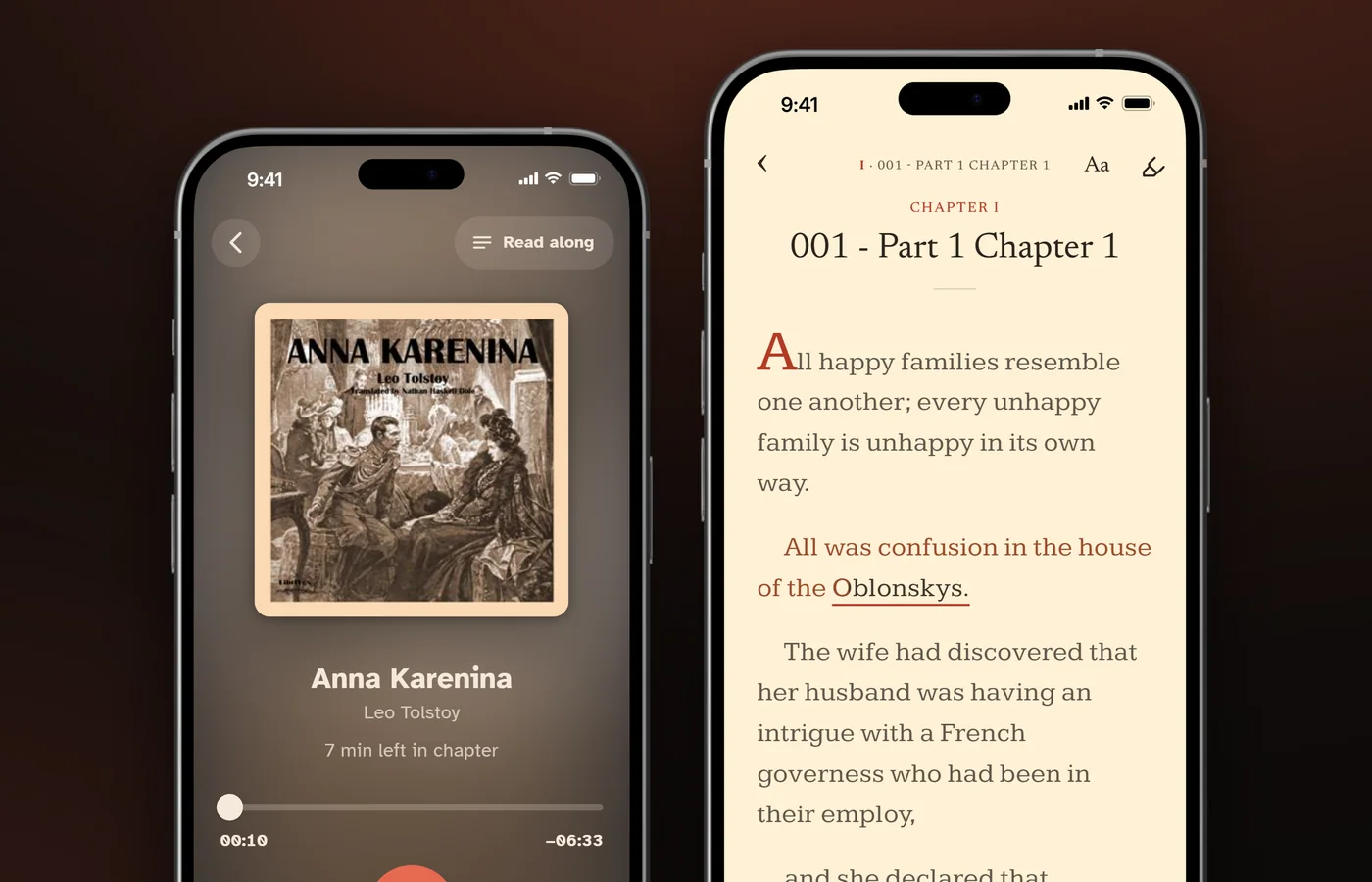
Yes: HushBook, the app we built, plays an audiobook and shows its words in time with the voice, on iPhone, Android, Windows and Mac.
HushBook is free, with no account, and transcription runs on your own device. In Discover, search Anna Karenina and pick the "Anna Karenina" card that reads 36h 53m: that is MaryAnn Spiegel's LibriVox reading of the Dole translation, 238 chapters in a 1014 MB download. The other two cards with the plain title are the German reading (47h 34m) and the Dutch one, so pick by length. For Garnett's translation, download "Anna Karenina, Book 1" to "Anna Karenina Book 8" and play them in order. Play a sample first if you like. HushBook queues the transcription on your phone as soon as the book is added.
Words fill in as the narrator reads them, with a red underline on the current one. Long-press any line to play from there. In Spiegel's recording the mowing is the 73rd and 74th files, so HushBook shows them as Chapters LXXIII and LXXIV, with "Part 3 Chapter 4" and "Part 3 Chapter 5" in their titles: 22 minutes of Levin in the fields, with every word on screen as it is said. Mark a passage to keep it as a highlight, note or quote, and set the speed anywhere from 0.5x to 3x.
For Garnett's own text, pair a Garnett book with a matching DRM-free EPUB, PDF or TXT, such as Project Gutenberg's eBook #1399, the text LibriVox's Books 1 to 8 read: e-book sync (first sync free) aligns the book's text to the audio word by word. For Spiegel's Dole reading, the words come from HushBook's own transcript of her voice. For the names, add each person to the character map once, keep Stiva, Stepan Arkadyevitch and Oblonsky in the notes on one card, and see the chapter and time you first heard each person.
For a paid edition, read along with a DRM-free MP3 or M4B copy you own. HushBook imports MP3, M4A, M4B and more, and detects the chapters inside M4B files. The desktop app is free on Windows 10 or 11 (64-bit) and macOS 14 or later, and imports MP3 and M4B files or whole folders.
HushBook works with free public domain recordings and audio files you own without DRM.
Read Levin's chapters along with the free recording
HushBook finds MaryAnn Spiegel's free LibriVox reading of Anna Karenina and shows each word in time with her voice, through all 238 chapters. Free on iPhone, Android, Windows and Mac, no account.
Sources
- LibriVox, "Anna Karenina (Dole translation)", read by MaryAnn
- LibriVox, "Anna Karenina, Book 1" (Garnett translation)
- LibriVox, API feed for "Anna Karenina"
- Internet Archive, LibriVox "Anna Karenina" (Dole translation, MaryAnn Spiegel)
- Internet Archive, LibriVox "Anna Karenina, Book 1"
- Audible, Anna Karenina (Maggie Gyllenhaal, Audible Studios)
- Audible, Anna Karenina (Miranda Pleasence, Penguin Classics)
- Audible, Anna Karenina (David Horovitch)
- Audible, Anna Karenina (Davina Porter, Recorded Books)
- Audible, Anna Karenina (Tamaryn Payne, Vintage)
- Audible, Anna Karenina (Wanda McCaddon, Blackstone)
- Audible, Anna Karenina (Judy Franklin, RNIB)
- Audible, Anna Karenina (Kate Lock, Naxos AudioBooks)
- Audible, Anna Karenina (Lorna Raver, Tantor Audio)
- Audible, Anna Karenina (Kate Petrie, A.R.N. Publications)
- Audible, Anna Karenina (Elizabeth Knowelden, AmazonClassics)
- Audible, Anna Karenina (Spotify Audiobooks, six narrators)
- Audible, Anna Karenina (Harrie Dobby, Bookstream)
- Audible, Anna Karenina (Jonathan Keeble, SNR Audio)
- Audible, Anna Karenina (Johann Zeiger, MuseumAudiobooks.com)
- Audible, Anna Karenina (Christopher Preece, Montgomery Providence)
- Audible, Anna Karenina (John Lowell, Simply Media)
- Audible, Anna Karenina (Sam Kusi, Lauscher Audiobooks)
- Audible, Anna Karenina (credited to Mary Ann Spiegel, Hexagon Tech)
- Audible, Anna Karenina (BBC Radio 4 dramatisation, 2023)
- Audible, Anna Karenina (BBC full cast, Teresa Gallagher and Toby Stephens)
- Audible, The Leo Tolstoy BBC Radio Drama Collection
- Audible, Anna Karenina (Laura Paton, Naxos AudioBooks, abridged)
- Audible, Anna Karenina (Alfred Molina, HighBridge, abridged)
- Audible, Anna Karenina (Diana Quick, abridged)
- Audible, Anna Karenina (Listener's Digest, abridged)
- Audible, Anna Karenina, dramatised (Ingrid Bergman and Gregory Peck)
- Audible, Anna Karenina (Real Reads)
- Audible, Anna Karenina (Sweet Cherry Publishing)
- Audible, catalogue API results for "anna karenina"
- Apple, iTunes Search API, audiobook results for "anna karenina"
- Apple Books, Anna Karenina (Maggie Gyllenhaal)
- Apple Books, Anna Karenina (Miranda Pleasence)
- Apple Books, Anna Karenina (David Horovitch)
- OverDrive, catalogue API for the New York Public Library
- OverDrive, catalogue API for the Los Angeles Public Library
- OverDrive, catalogue API for the King County Library System
- OverDrive, catalogue API for the San Francisco Public Library
- OverDrive, catalogue API for the Chicago Public Library
- hoopla, Anna Karenina (Davina Porter)
- hoopla, Anna Karenina (Laura Paton, abridged)
- Project Gutenberg, "Anna Karenina by graf Leo Tolstoy" (eBook #1399, translated by Constance Garnett)
- Project Gutenberg, plain text of eBook #1399
- Project Gutenberg, "War and Peace" (eBook #2600)
- Project Gutenberg, "The Brothers Karamazov" (eBook #28054)
- Wikisource, "Anna Karenina (Dole)")
- Internet Archive, "Anna Karenina (Maude)" (Oxford World's Classics edition, OCR text)
- Internet Archive, "Anna Karénina: in eight parts" (Nathan Haskell Dole, Crowell)
- Wikipedia, "Anna Karenina"
- Wikipedia, "Leo Tolstoy"
- We Love Translations, "Anna Karenina: Compare Translations"
- We Love Translations, "What's the best translation of Anna Karenina?"
- Janet Malcolm, "Socks", The New York Review of Books, June 23, 2016
- David Remnick, "The Translation Wars", The New Yorker (2005)
- James Wood, "At Home in the World", The New Yorker (2001)
- Rosamund Bartlett, "Anna Karenina: the devil in the details", The Guardian (2014)
- Apollonio (2022), "Tolstoy in English Translation", in Tolstoy in Context, Cambridge University Press
- Mozharova and Sin (2022), "'In Our Home Everyone Said Lévin': on the Pronunciation of the Surname of Anna Karenina's Character in L. N. Tolstoy's Family", Two centuries of the Russian classics
- Susanne Fusso, "Mikhail Katkov, the Publisher of the Great Russian Novel", Cornell University Press (2021)
- Reddit r/audiobooks, "Classic literature as audiobook: Anna Karenina by Leo Tolstoy, read by Maggie Gyllenhaal" (2021)
- Reddit r/audiobooks, "Audio: Anna Karenina. So Choice." (2019)
- Reddit r/audiobooks, "Specific Anna Karenina translation" (2019)
- Reddit r/tolstoy, "Anna Karenina, is this a good audiobook version?" (2026)
- Clinton-Lisell (2022), "Listening Ears or Reading Eyes: A Meta-Analysis of Reading and Listening Comprehension Comparisons", Review of Educational Research
- Varao Sousa, Carriere and Smilek (2013), "The way we encounter reading material influences how frequently we mind wander", Frontiers in Psychology
Frequently asked questions
What is the best Anna Karenina audiobook?
Maggie Gyllenhaal's Audible Studios recording, 35 hours 35 minutes, with 4.5 stars from 14,664 Audible US ratings on November 15, 2026. MaryAnn Spiegel's LibriVox reading, 36 hours 53 minutes, is the best free one.
Which translation does Maggie Gyllenhaal read?
Constance Garnett's. Audible names no translator, but her sample matched Garnett's text on 92.4% of its six-word runs and the Maude translation on 5.6%, by our check on November 15, 2026.
How long is the Anna Karenina audiobook?
38 hours 38 minutes at 1x for Garnett's 350,021 words, by our count at 151 words a minute. Complete recordings run 30 hours 17 minutes to 40 hours 58 minutes.
Is there a Pevear and Volokhonsky Anna Karenina audiobook?
Yes. Miranda Pleasence reads it unabridged for Penguin Classics (2020), 36 hours 59 minutes, with Richard Pevear's introduction. It is the only recording of that translation we found, and Libby lends it.
Is there a free Anna Karenina audiobook?
Yes. LibriVox has MaryAnn Spiegel's complete solo reading of Nathan Haskell Dole's translation, 36 hours 53 minutes, and Constance Garnett's translation in eight separate parts, 38 hours 31 minutes in all.
Is there an audiobook of the Bartlett or Schwartz translation?
No. On November 15, 2026 we found none on Audible in four countries, Apple Books, Libby or hoopla. The modern translation on audio is Pevear and Volokhonsky's, read by Miranda Pleasence.
Is there a BBC Anna Karenina audiobook?
Yes. Two BBC radio dramatisations are on Audible: Radio 4's 2023 version with Kate Phillips, Alfred Enoch and Rory Kinnear, 2 hours 50 minutes, and one with Teresa Gallagher and Toby Stephens, 3 hours 30 minutes.