

Key takeaways
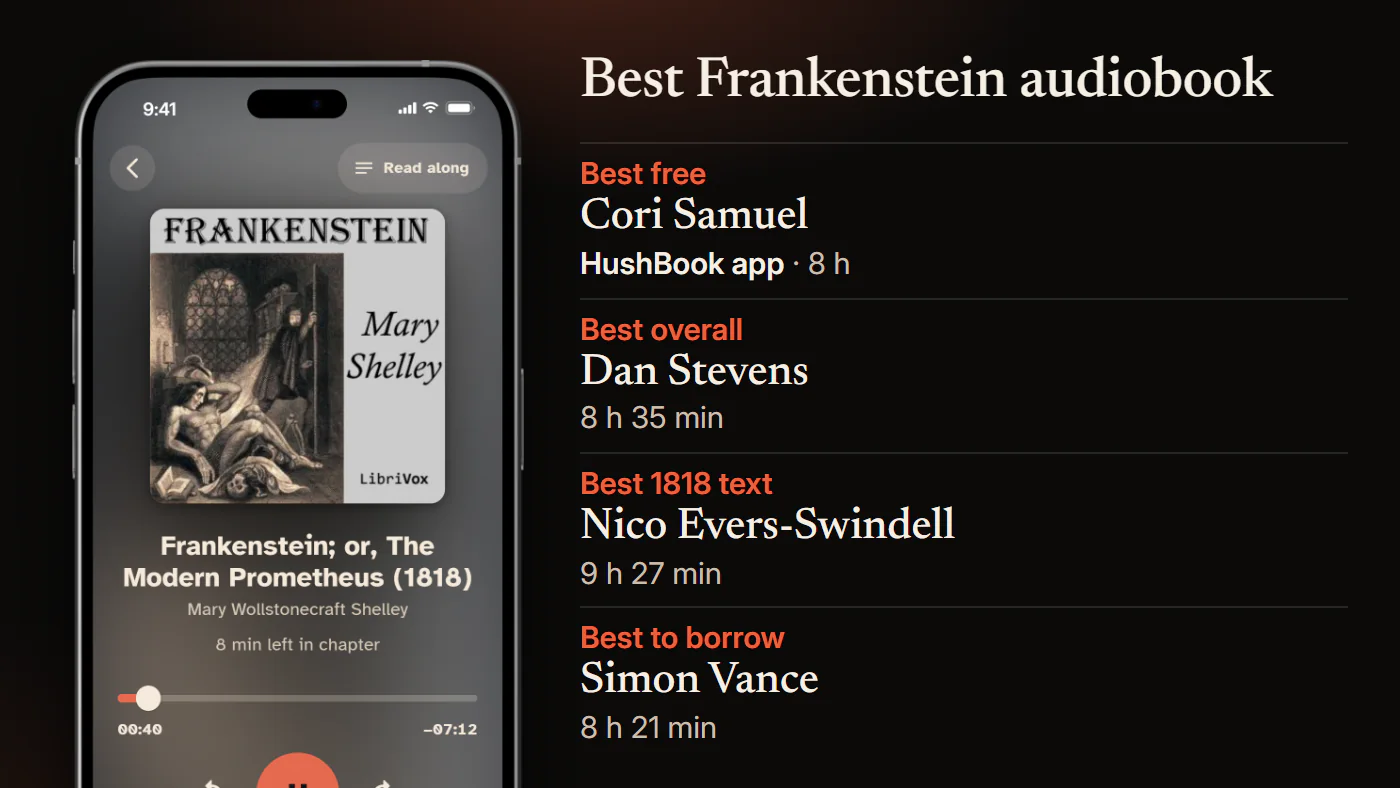
- Dan Stevens's 2013 Audible Studios recording, 8 hours 35 minutes, is our best overall pick, with 23,571 Audible US ratings; its chapter lengths show it reads the revised 1831 text.
- Cori Samuel's free LibriVox reading, 8 hours, is the best free recording and the only free one of Mary Shelley's original 1818 text, and it is in the HushBook app.
- Of 60 complete Audible US recordings we checked through store previews and chapter lengths, 44 read the 1831 text, 11 read the 1818 text and five stayed undecided.
- By our count the 1831 text is 3,071 words longer than the 1818 text, and 77% of its new or reworded words fall in the letters and Chapters 1 to 10.
- The 1818 edition restarts its chapter numbers in each of three volumes: add 8 to a Volume 2 chapter and 17 to a Volume 3 chapter to find the 1831 chapter.
The best Frankenstein audiobook is Dan Stevens's 2013 recording for Audible Studios, 8 hours 35 minutes long, and it reads Mary Shelley's revised 1831 text. When we checked Audible US on November 18, 2026, it had 23,571 ratings, about 25 times as many as any other complete recording.
Three others each win a category. Cori Samuel's free LibriVox reading, 8 hours long, is the one for Shelley's original 1818 text. Nico Evers-Swindell's, 9 hours 27 minutes, is the 1818 reading with the most ratings. Simon Vance's, 8 hours 21 minutes, is the one to borrow from a library.
The text matters more than the label. Dan Stevens's tracks are named Volume 1, 2 and 3, the layout of the 1818 edition, yet his chapter lengths match the 1831 text. Only seven of the 60 Audible pages we read name the year of the text they use. So we listened to the stores' short free previews and compared chapter lengths for all 60.
A few phrases in the opening letters give the answer away, and we list them below.
Which Frankenstein audiobook is best?
Dan Stevens for most listeners, Cori Samuel for free and for the 1818 text, and Simon Vance to borrow.
Best overall: Dan Stevens. Dan Stevens's recording for Audible Studios came out in 2013 and runs 8 hours 35 minutes. On November 18, 2026 it had 4.5 stars on Audible US and 4.7 for performance. It was a finalist in the Classic category of the 2014 Audie Awards, the audiobook industry's prizes. By our calculation he reads at about 146 words a minute, an unhurried pace for a book of long sentences. His recording reads the 1831 text, a verdict that rests on his chapter lengths: his Chapter I runs 13.0 minutes and his Chapter II 16.3, an order only the 1831 text produces.
Best free: Cori Samuel. Cori Samuel recorded the novel alone for LibriVox in 2011, in 8 hours. LibriVox names an 1818 text as her source, and her chapter lengths agree. Her recording had 1,177,030 downloads on the Internet Archive on November 18, 2026. One listener wrote there in 2016 that they "could nearly imagine it were Mary Shelley herself reading this aloud." She reads at 150 words a minute, and our page for her recording lists all 29 of its chapters with their lengths.
Best 1818 text to buy: Nico Evers-Swindell. Nico Evers-Swindell's AmazonClassics edition, published by Brilliance Audio in 2017, runs 9 hours 27 minutes. It had 4.4 stars from 580 ratings, and its preview plays Chapter I in the 1818 wording, so this verdict was heard rather than inferred from timing. At 127 words a minute by our calculation, it is the slowest of the well-known readings.
Best to borrow: Simon Vance. Simon Vance's Tantor recording runs 8 hours 21 minutes and has 4.2 stars from 938 ratings, the second most on Audible US. Libby showed 6 copies at the New York Public Library and 5 at the Los Angeles Public Library on November 18, 2026. Its chapter lengths show the 1831 text. If a class needs the first edition, Joseph Kent's "The Original 1818 Text" had 55 copies in Los Angeles, all available, though listeners give its performance only 2.5 stars.
Two actors. Jamie Bell's recording runs 8 hours 10 minutes and has 4.5 stars from 796 ratings. Derek Jacobi's runs 9 hours 7 minutes, and its 4.7 for performance ties Dan Stevens's. Both read the 1831 text: we heard it in Jacobi's preview of Letter 2, and Bell's chapter lengths show it.
Guillermo del Toro's Frankenstein has been on Netflix since November 2025, but Oscar Isaac, Jacob Elordi and Mia Goth do not narrate any Frankenstein audiobook on Audible US or UK. The film tie-in edition is Edoardo Ballerini's reading for Simon & Schuster Audio, 8 hours 9 minutes, with an introduction by Stephen King. Its publisher's note and its chapter lengths both point to the 1831 text.
Our pick for a first listen is still Dan Stevens.
Every complete recording compared
The table holds every complete recording with more than 30 ratings on Audible US, plus Joseph Kent's and Edoardo Ballerini's. We checked 60 complete listings with a named narrator; the other 41 have few or no ratings. Ratings are Audible US stars with the number of ratings in brackets, read on November 18, 2026. "Chapter lengths" means the verdict rests on timing alone; "preview" means we heard wording that exists in only one text.
| Narrator | Publisher, year | Runtime | Audible US rating | Text | How we know |
|---|---|---|---|---|---|
| Dan Stevens | Audible Studios, 2013 | 8 h 35 min | 4.5 (23,571) | 1831 | Chapter lengths |
| Simon Vance | Tantor Audio, 2008 | 8 h 21 min | 4.2 (938) | 1831 | Chapter lengths |
| Jim Donaldson | Trout Lake Media, 2011 | 8 h 35 min | 4.2 (808) | 1831 | Chapter lengths and publisher's note |
| Jamie Bell | Audible Studios, 2021 | 8 h 10 min | 4.5 (796) | 1831 | Chapter lengths |
| Nico Evers-Swindell | Brilliance Audio, 2017 | 9 h 27 min | 4.4 (580) | 1818 | Preview and chapter lengths |
| Colin Salmon and Peter Noble | Penguin Classics, 2019 | 11 h 43 min | 4.5 (294) | 1831 | Chapter lengths and the print edition |
| Derek Jacobi | silksoundbooks, 2015 | 9 h 7 min | 4.5 (269) | 1831 | Preview and chapter lengths |
| Anthony Heald, Stefan Rudnicki, Simon Templeman | Blackstone, 2008 | 8 h 42 min | 4.1 (244) | 1831 | Chapter lengths |
| George Guidall | Recorded Books, 1999 | 10 h 1 min | 4.2 (145) | Undecided | Preview plays the 1831 Introduction |
| Dick Hill | Alpha DVD, 2008 | 8 h 35 min | 4.0 (95) | 1831 | Chapter lengths |
| B. J. Harrison | B.J. Harrison, 2012 | 8 h 19 min | 4.2 (72) | 1831 | Preview and chapter lengths |
| Daniel Philpott and cast | Naxos AudioBooks, 2011 | 9 h 8 min | 4.2 (58) | 1831 | Preview and chapter lengths |
| Mark Nelson | Trout Lake Media, 2011 | 8 h 25 min | 4.1 (54) | 1831 | Chapter lengths |
| Flo Gibson | Audio Book Contractors, 2007 | 6 h 54 min | 3.8 (51) | 1818 | Chapter lengths |
| David McCallion | A.R.N. Publications, 2015 | 7 h 39 min | 4.4 (47) | 1831 | Preview and chapter lengths |
| Gildart Jackson | Dreamscape Media, 2015 | 10 h 25 min | 4.4 (31) | 1831 | Chapter lengths |
| Daniela Acitelli | Spoken Realms, 2017 | 9 h 18 min | 4.7 (31) | 1831 | Chapter lengths |
| Joseph Kent | Quill Publishing, 2025 | 8 h 6 min | 3.4 (22) | 1818 | Preview, chapter lengths and publisher's note |
| Edoardo Ballerini | Simon & Schuster Audio, 2025 | 8 h 9 min | 4.8 (14) | 1831 | Chapter lengths and publisher's note |
Penguin's recording is made from its Classics edition edited by Maurice Hindle, which the publisher says is "Based on the third edition of 1831". Joseph Kent's reading is listed twice on Audible; the other listing has 3.5 stars from 29 ratings.
Outside Audible, Jim Weiss's complete reading for Books on Tape, 9 hours 56 minutes, is in Libby and on Apple Books. Its previews on both play the Preface in the 1831 wording, down to its closing date line, "Marlow, September, 1817." That is a thin sample, but it points one way.
Is there a Frankenstein audiobook with a female narrator?
Yes: Cori Samuel and Flo Gibson read the 1818 text, and Daniela Acitelli, Karen Allen and Cathy Dobson read the 1831.
Daniela Acitelli's recording for Spoken Realms runs 9 hours 18 minutes. Its 4.7 stars are the highest average of any recording with more than 30 ratings, though only 31 people had rated it. Its chapter lengths show the 1831 text.
Karen Allen's 2020 recording for Chronos Publishing runs 8 hours 44 minutes and opens with about 22 minutes of extras: a historical introduction, an overview, a talk on themes and a few famous quotes. Cathy Dobson's 2013 reading for Red Door Audiobooks runs 8 hours 9 minutes. We heard the 1831 wording in both previews.
Flo Gibson's 1818 reading is the shortest complete one we found, at 6 hours 54 minutes. Among the women's readings we would start with Cori Samuel's, which costs nothing, or Acitelli's to buy.
Is the Frankenstein audiobook the 1818 or the 1831 text?
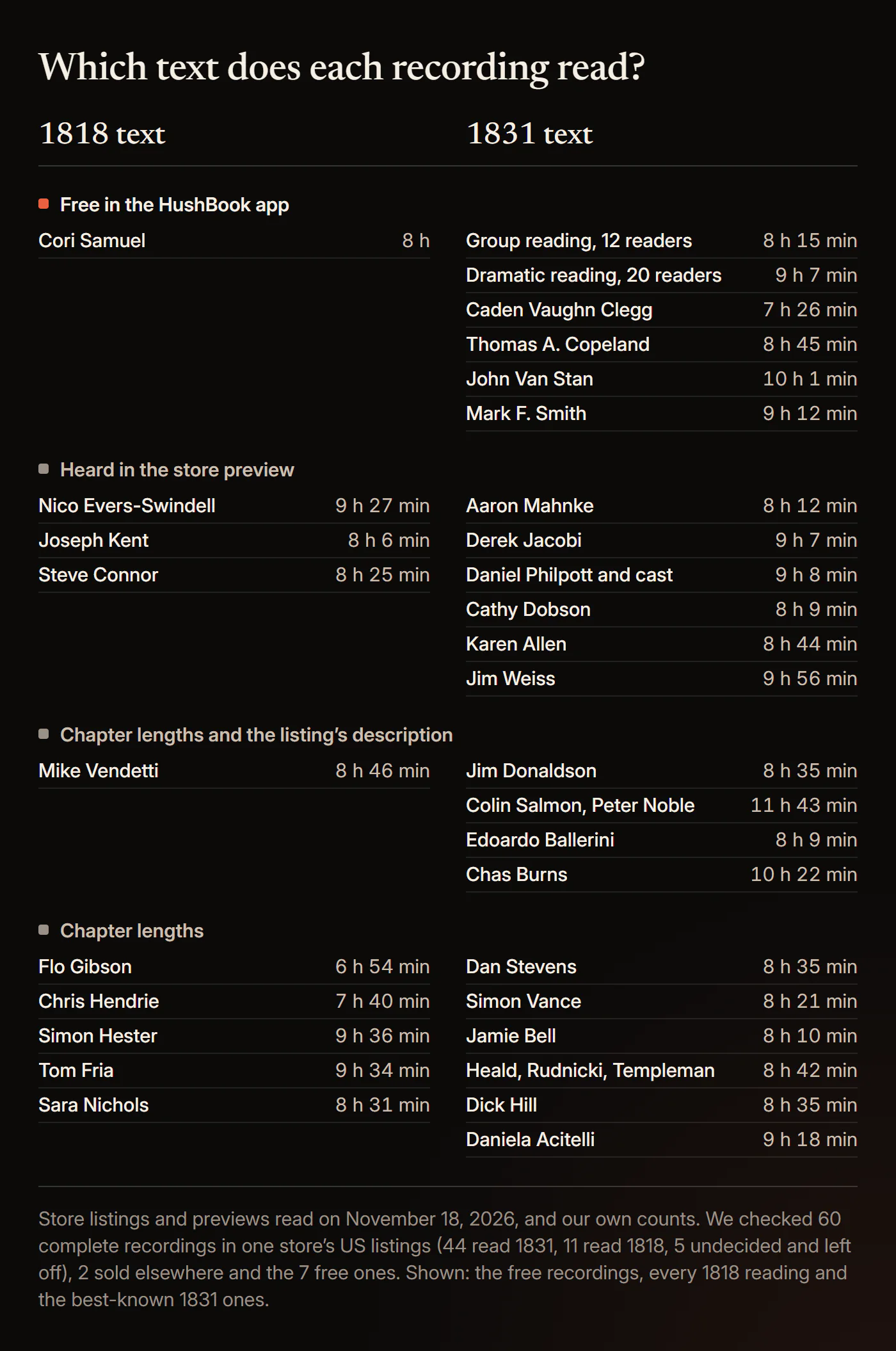
Usually the revised 1831 text, which 44 of the 60 complete recordings we checked on Audible US read.
Eleven read the 1818 text, and five stayed undecided. Among the most rated recordings, those with more than 30 ratings, only two read 1818: Nico Evers-Swindell's and Flo Gibson's. The 1818 readings we found are by Nico Evers-Swindell, Cori Samuel (free, and a 2017 paid edition), Joseph Kent, Steve Connor, Mike Vendetti, Flo Gibson, Chris Hendrie, Simon Hester, Tom Fria and Sara Nichols. Mike Vendetti's publisher calls his a "lightly modernized edition" drawn on the 1818 text.
We used three tests, and none needed more than a few minutes of any recording. First, we listened to each store's short free preview, 2 to 5 minutes long, and matched it against wording found in only one text. Most previews play Letter 1 or the Preface, which read the same in both, so the preview settled only some recordings.
Second, we compared chapter lengths from the stores' track lists. Because the revised edition splits the original first chapter in two, the first chapter track of a recording of it is shorter than the second, about 0.8 times as long. In an 1818 recording it is about a third longer. Third, a few publishers say which text they used.
A verdict from the preview rests on the words themselves. A verdict from chapter lengths rests on timing alone, and that is how we decided 29 of the recordings of 1831, Dan Stevens's among them.
Could the chapter test be wrong? In one way, yes. A narrator who skipped or added a page in the first chapters would shift the ratio, and recordings cut into parts of equal length cannot be timed at all. That is why George Guidall's reading stays undecided: his preview plays Mary Shelley's 1831 Introduction, but his tracks do not follow chapters.
Treat our chapter-length verdicts as strong evidence, not as a reading.
How can you tell which text you are hearing?
Wait for Letter 2, about eight minutes in: these phrases occur in one text only, and each was checked against both.
| Where | Only in the 1831 text | Only in the 1818 text |
|---|---|---|
| Before Letter 1 | Mary Shelley's Introduction: "The Publishers of the Standard Novels..." | A dedication to William Godwin, "author of Political Justice, Caleb Williams, &c." |
| Letter 2 | "he is as silent as a Turk"; "as worn and woful as the 'Ancient Mariner'" | "he will not hunt"; "scarcely an idea beyond the rope and the shroud" |
| Letter 3 | "the springing of a leak"; "But success shall crown my endeavours. Wherefore not?" | "the breaking of a mast"; "Remember me to all my English friends." |
| Letter 4 | "Will you smile at the enthusiasm"; "Strange and harrowing must be his story" | "Will you laugh at the enthusiasm"; "I have related my little history frankly to him." |
| Chapter 1 | "She was not her child, but the daughter of a Milanese nobleman." | "My father had a sister, whom he tenderly loved" |
| Chapter 2 opens | "We were brought up together; there was not quite a year difference in our ages." | No new chapter here: the first chapter runs on |
| The lightning lesson | "a man of great research in natural philosophy" explains it | Victor's father: "He replied, 'Electricity;'" |
Letter 1 is no help. Apart from four spellings, it is word for word the same in both texts. Volume announcements are no help either: Dan Stevens's and Simon Darwen's recordings both announce Volumes 1, 2 and 3 and read the 1831 text.
An opening Introduction by Mary Shelley points to 1831, but a modern 1818 edition can print it too. So the surest tell is Letter 2, where the 1831 text adds Walton's "Ancient Mariner" passage.
What is the difference between the 1818 and 1831 Frankenstein?
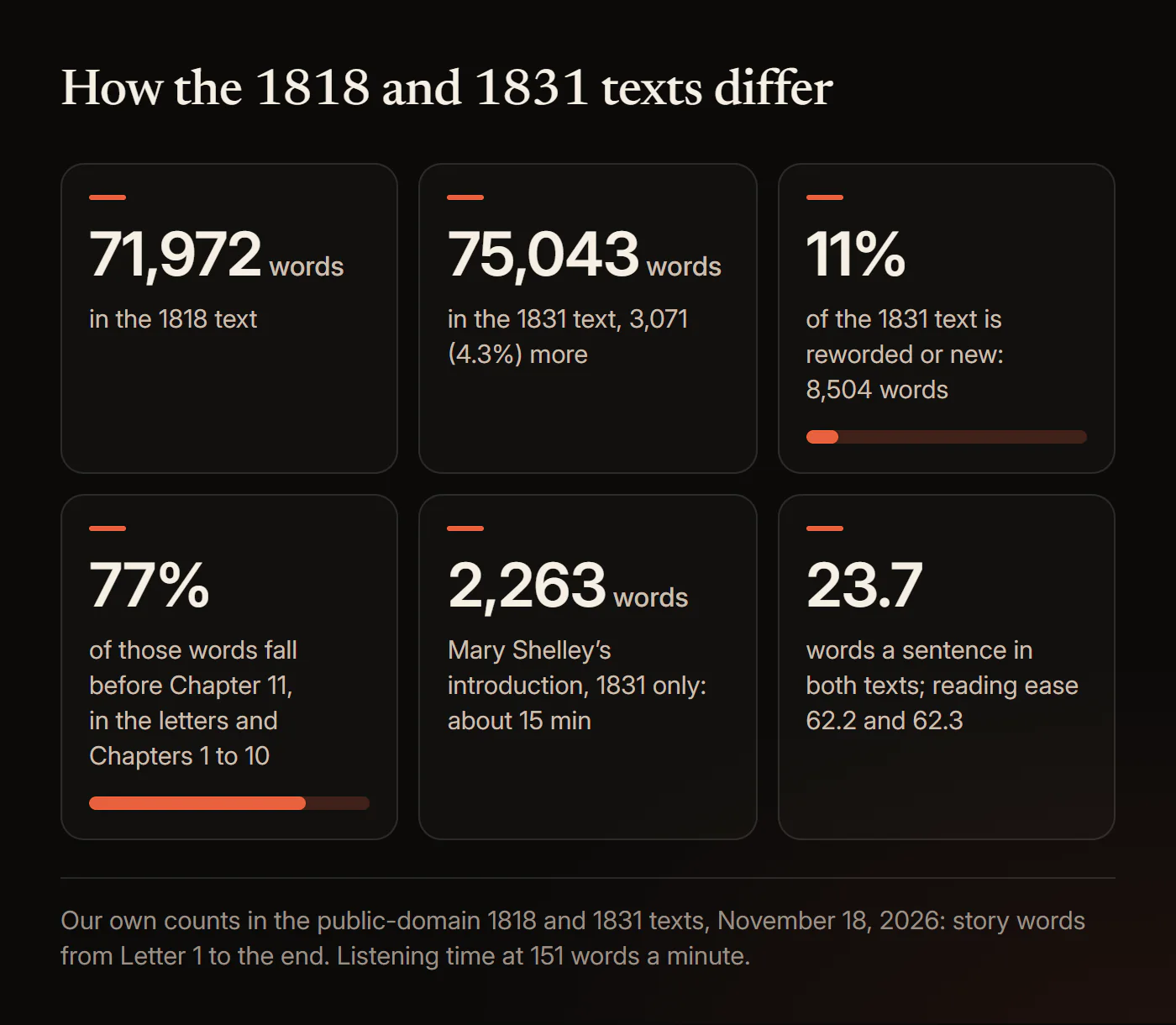
The 1831 text is 4.3% longer, and most of the rewriting sits in the letters and the first ten chapters.
We compared Project Gutenberg's transcriptions of the two editions, eBook #41445 for 1818 and #42324 for 1831. By our count the 1818 story runs 71,972 words. The revised story runs 75,043, and Shelley added an Introduction of 2,263 words before it. About 11% of the revised text, 8,504 words, has no counterpart in the original.
Where those changes fall is the useful part. 77% of the new words come before Chapter 11, where the creature begins his own story. His six chapters are 98.5% the same in both texts, and the creation night, Chapter 5, is more than 99% the same. These are the best-known changes, all from the opening, before the creation:
- Mary Shelley's Introduction. The 1831 edition adds her account of the wet summer of 1816 at Lake Geneva, when Lord Byron said "We will each write a ghost story". It ends, "And now, once again, I bid my hideous progeny go forth and prosper."
- Elizabeth's family. In 1818 she is Victor's cousin, the daughter of his father's sister. In 1831 she is an orphan the family adopts in Italy, "the daughter of a Milanese nobleman."
- Walton's letters. Letters 2 to 4 grow in 1831, with the "Ancient Mariner" passage and more of Walton's hopes for his voyage.
- Fate. The 1831 Victor speaks of destiny, calling a professor's words "the words of fate, enounced to destroy me."
- The lightning lesson. In 1818 Victor's father explains a storm with one word, "Electricity"; in 1831 a visiting "man of great research in natural philosophy" talks of electricity and galvanism.
Does the difference matter for a first listen? Less than the debate suggests. The creature's story and the creation night barely change, and by our count the two texts are equally hard to read, at 23.7 words a sentence on average.
The biggest shift is one of tone: the 1831 Victor blames fate.
Which version of Frankenstein should you read?
The one your class names; with no class, we would start with 1818 and add Mary Shelley's 1831 Introduction.
Two teaching editions in print use the first edition: the Norton Critical Edition, edited by J. Paul Hunter, prints "The 1818 first edition text", and Penguin Classics publishes Frankenstein: The 1818 Text, introduced by Charlotte Gordon. Penguin's older Classics edition, edited by Maurice Hindle, follows 1831. So a Penguin copy can be either; look for "The 1818 Text" in its title.
Which one does your copy hold? It is 1818 if the chapters restart at Chapter I in each of three volumes. It is 1831 if they run straight through to 24 after an Introduction by Mary Shelley.
For pleasure, the free route covers both. Cori Samuel reads the 1818 text. The first file of Thomas A. Copeland's free 1831 recording, "Intro & Preface", holds Shelley's Introduction in about 19 minutes. In it she says she began the book with the words that open the creation chapter, meaning it at first as a short tale of a few pages.
That is the order we would choose: the original novel, then its author's story of it.
How long is the Frankenstein audiobook?
About 8 hours, and the revised 1831 text runs about 20 minutes longer than the original.
By our count, the 1818 text takes 7 hours 57 minutes at 151 words a minute. That is the median pace we measured across LibriVox readers in our guide to how long audiobooks run. The 1831 text takes 8 hours 17 minutes, or 8 hours 36 minutes with Mary Shelley's Introduction and the Preface.
| Speed | 1818 text at 151 words a minute | 1831 text at 151 words a minute | Dan Stevens (8 h 35 min) | Cori Samuel, free (8 h) |
|---|---|---|---|---|
| 1x | 7 h 57 min | 8 h 17 min | 8 h 35 min | 8 h 0 min |
| 1.25x | 6 h 21 min | 6 h 38 min | 6 h 52 min | 6 h 24 min |
| 1.5x | 5 h 18 min | 5 h 31 min | 5 h 43 min | 5 h 20 min |
| 2x | 3 h 58 min | 4 h 8 min | 4 h 18 min | 4 h 0 min |
Narrators differ far more than the two texts do. Ralph Cosham reads at about 174 words a minute by our calculation and finishes in 7 hours 11 minutes. Nico Evers-Swindell reads at about 127 and takes 9 hours 27 minutes. Among the complete recordings we checked, the shortest is Flo Gibson's at 6 hours 54 minutes, and the longest is Penguin's edition, which adds an introduction by Maurice Hindle, at 11 hours 43 minutes.
Reading it yourself is quicker. Brysbaert's 2019 review of 190 studies with 18,573 participants puts silent reading of fiction at about 260 words a minute. At that rate the 1818 text takes about 4 hours 37 minutes, a little over half the time a narrator at the typical pace needs.
The pace you pick changes the evening more than the edition does.
Which chapter is which in the Frankenstein audiobook?
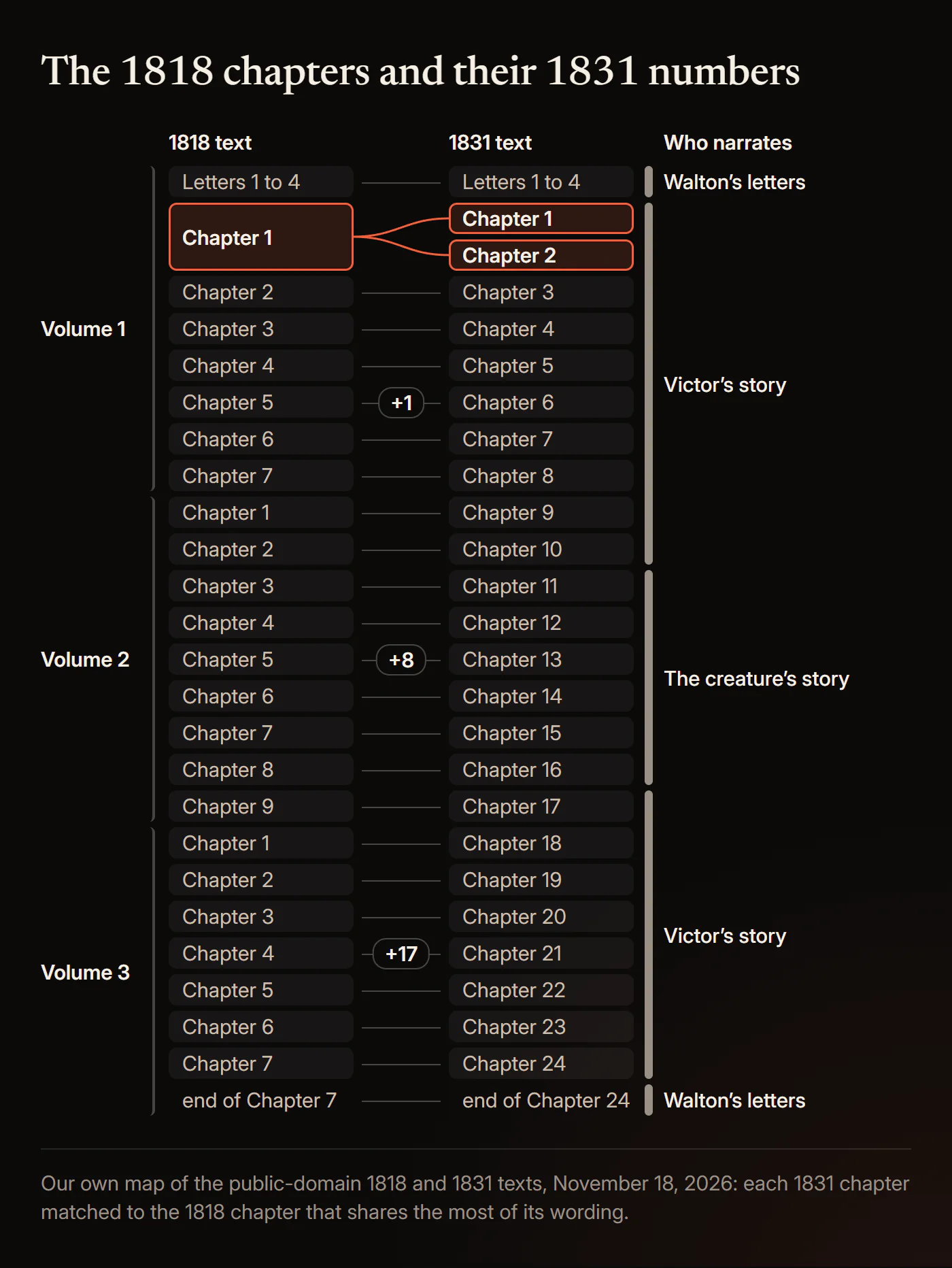
Both texts open with four letters; after that, the 1818 volumes restart their chapter numbers while the 1831 text counts straight through to 24.
The first edition came in three volumes, and each starts again at Chapter I. The 1831 edition split the first chapter in two and numbered everything in one run. That is how a YouTube upload's "Volume 2, Chapter 4" becomes Chapter 12 in a recording numbered straight through.
| 1818 edition | 1831 edition | Rule |
|---|---|---|
| Letters 1 to 4 | Letters 1 to 4 | The same |
| Volume 1, Chapter 1 | Chapters 1 and 2 | Split in two |
| Volume 1, Chapters 2 to 7 | Chapters 3 to 8 | Add 1 |
| Volume 2, Chapters 1 to 9 | Chapters 9 to 17 | Add 8 |
| Volume 3, Chapters 1 to 7 | Chapters 18 to 24 | Add 17 |
| Walton's closing letters, end of Volume 3, Chapter 7 | End of Chapter 24 | The same |
Chapter 1 is not the start of the recording. Four letters from the explorer Robert Walton come first, about 37 minutes at a typical pace. In Cori Samuel's free recording, Chapter 1 begins 35 minutes 53 seconds in.
Dan Stevens's recording borrows the volume labels but not the 1818 text. His first volume holds eight chapters, one more than the first edition's, because they are the revised text's opening eight. From his Volume 2 on, his numbers match the 1818 edition. His last track, titled End Credits, runs 40 minutes and holds Walton's closing letters before the credits.
Chapter 5 is the creation night. In the 1818 numbering it is Volume 1, Chapter 4, and Cori Samuel reaches it 1 hour 28 minutes in. Both texts print it almost word for word alike:
It was on a dreary night of November, that I beheld the accomplishment of my toils. ... I saw the dull yellow eye of the creature open; it breathed hard, and a convulsive motion agitated its limbs.
When the track names and your book disagree, the words settle it. With the text on screen you can see where Letter 4 ends and Chapter 1 begins, whatever a file is called, and HushBook shows that text for the free recordings.
Match on the words, never on the file name.
Who narrates which part of Frankenstein?
Three people, one inside another: Walton writes the letters, Victor tells most of the book, and the creature tells his own story.
By our count Victor's account is 65% of the words, Walton's letters 14% and the creature's story 20%. The creature takes over at Chapter 11 and speaks for six chapters. In Cori Samuel's recording his story starts in the file "Volume 2, Chapter 3", 3 hours 15 minutes in. It lasts 1 hour 39 minutes.
Why is this hard by ear? Each voice speaks inside the one before it. Walton writes down what Victor tells him, and Victor repeats what the creature told him, so at the heart of the book you hear a story inside a story inside a letter. In a solo reading, the narrator's change of tone is the only cue.
Three complete recordings give the narrators separate voices. One is the Naxos cast recording of 2011, 9 hours 8 minutes. Blackstone's, with Anthony Heald, Stefan Rudnicki and Simon Templeman, runs 8 hours 42 minutes and is also on hoopla. LibriVox's free dramatic reading spreads the text across 20 readers and runs 9 hours 7 minutes, the free choice if you want more than one voice. If the nesting loses you, we would pick the Naxos cast.
| 1831 chapter | 1818 edition | Who narrates | Minutes at 151 words a minute (1831) | Cori Samuel's file (1818) |
|---|---|---|---|---|
| Introduction | Not in 1818 | Mary Shelley | 15 | |
| Preface | Dedication and Preface | The author's preface | 4 | 4:36 |
| Letter 1 | Volume 1, Letter 1 | Walton | 8 | 7:52 |
| Letter 2 | Volume 1, Letter 2 | Walton | 9 | 6:50 |
| Letter 3 | Volume 1, Letter 3 | Walton | 2 | 1:50 |
| Letter 4 | Volume 1, Letter 4 | Walton | 18 | 14:45 |
| Chapter 1 | Volume 1, Chapter 1 | Victor | 12 | 20:01 (both) |
| Chapter 2 | Volume 1, Chapter 1 | Victor | 15 | |
| Chapter 3 | Volume 1, Chapter 2 | Victor | 18 | 15:17 |
| Chapter 4 | Volume 1, Chapter 3 | Victor | 17 | 17:24 |
| Chapter 5 | Volume 1, Chapter 4 | Victor | 16 | 15:40 |
| Chapter 6 | Volume 1, Chapter 5 | Victor | 18 | 17:31 |
| Chapter 7 | Volume 1, Chapter 6 | Victor | 24 | 24:59 |
| Chapter 8 | Volume 1, Chapter 7 | Victor | 21 | 19:50 |
| Chapter 9 | Volume 2, Chapter 1 | Victor | 15 | 13:43 |
| Chapter 10 | Volume 2, Chapter 2 | Victor | 16 | 14:57 |
| Chapter 11 | Volume 2, Chapter 3 | The creature | 19 | 18:25 |
| Chapter 12 | Volume 2, Chapter 4 | The creature | 14 | 13:56 |
| Chapter 13 | Volume 2, Chapter 5 | The creature | 14 | 14:14 |
| Chapter 14 | Volume 2, Chapter 6 | The creature | 12 | 11:37 |
| Chapter 15 | Volume 2, Chapter 7 | The creature | 20 | 20:32 |
| Chapter 16 | Volume 2, Chapter 8 | The creature | 21 | 19:57 |
| Chapter 17 | Volume 2, Chapter 9 | Victor | 13 | 12:58 |
| Chapter 18 | Volume 3, Chapter 1 | Victor | 19 | 18:04 |
| Chapter 19 | Volume 3, Chapter 2 | Victor | 17 | 16:03 |
| Chapter 20 | Volume 3, Chapter 3 | Victor | 23 | 22:45 |
| Chapter 21 | Volume 3, Chapter 4 | Victor | 25 | 23:22 |
| Chapter 22 | Volume 3, Chapter 5 | Victor | 23 | 21:17 |
| Chapter 23 | Volume 3, Chapter 6 | Victor | 17 | 16:29 |
| Chapter 24 | Volume 3, Chapter 7 | Victor | 20 | 19:58 |
| Chapter 24, "Walton, in continuation" | Volume 3, Chapter 7, "Walton, in continuation" | Walton | 35 | 35:30 |
Minutes at 151 words a minute come from our word count of each chapter; Cori Samuel's file lengths are the Internet Archive's. Her "Walton, in Continuation" is a file of its own.
Is there a free Frankenstein audiobook?
Yes: LibriVox has seven complete English recordings, all free and legal because the novel is in the public domain.
Six read the 1831 text, and Cori Samuel's is the only free recording of the 1818 text. We decided each one from the source text LibriVox names and from its chapter lengths. All seven are free in the Discover tab of HushBook, the app we built. Our page for Cori Samuel's reading has its running time and all 29 chapter lengths.
| LibriVox title | Reader | Text | Running time | Pace (our count) |
|---|---|---|---|---|
| Frankenstein; or, The Modern Prometheus (1818) | Cori Samuel, 2011 | 1818 | 8 h 0 min | 150 words a minute |
| Frankenstein (Edition 1831) | Thomas A. Copeland, 2013 | 1831, with the Introduction | 8 h 45 min | 148 |
| Frankenstein | 12 readers, 2005 | 1831 | 8 h 15 min | 151 |
| Frankenstein | Caden Vaughn Clegg, 2011 | 1831 | 7 h 26 min | 168 |
| Frankenstein (dramatic reading) | 20 readers, 2012 | 1831 | 9 h 7 min | 137 |
| Frankenstein: or, the Modern Prometheus (Version 4) | John Van Stan, 2020 | 1831, with the Introduction | 10 h 1 min | 130 |
| Frankenstein; or, The Modern Prometheus, Version 5 | Mark F. Smith, 2026 | 1831, with the Introduction | 9 h 12 min | 141 |
Two carry the plain title "Frankenstein", so tell them apart by running time. The 2005 group reading is the most downloaded, with 3,136,374 downloads on the Internet Archive. Its reviews there are mixed: "The volume levels are completely inconsistent," one listener wrote in 2015. Caden Vaughn Clegg's solo reading is the quickest, and a 2013 reviewer called it the best version they had found on LibriVox.
For the 1818 text we would pick Cori Samuel. For the 1831 text with Shelley's Introduction, Thomas A. Copeland reads it alone in 8 hours 45 minutes. John Van Stan is slower, at 130 words a minute. One listener wrote in 2026 that he "put his heart and soul into this performance!"
Outside LibriVox, Apple Books listed Aaron Mahnke's complete reading at no charge on November 18, 2026, a reading by the host of the Lore podcast that runs 8 hours 12 minutes. Its preview plays Chapter 1 in the 1831 wording. Full uploads on YouTube are free to watch too; check the description for the reader, or use the Letter 2 phrases above to find the text.
Free covers both texts, so cost need not decide the edition.
Which Frankenstein audiobooks are abridged or dramatised?
Kenneth Branagh's, the most rated of them, is abridged: 3 hours 1 minute, cut from the 1831 text.
Its preview plays Letter 4 in the 1831 wording. The abridgements below run about 2 to 3 hours, against about 8 for a complete recording of either text. Our guide to abridged and unabridged audiobooks explains the store labels.
| Version | What the store calls it | Runtime |
|---|---|---|
| Kenneth Branagh | Abridged | 3 h 1 min |
| Richard Pasco | Abridged | 3 h 6 min |
| Julie Harris | Abridged | 3 h 7 min |
| Daniel Philpott and Jonathan Oliver (2000) | Abridged | 2 h 37 min |
| David Rintoul | Abridged | 2 h 22 min |
| Big Finish, Arthur Darvill, Nicholas Briggs and cast | Dramatized | 5 h 19 min |
| BBC Radio, John Wood and Michael Maloney | Dramatisation | 1 h 53 min |
| BBC, Jamie Parker (2026) | Dramatised for BBC Radio | 1 h 54 min |
| L.A. Theatre Works, Stacy Keach and cast | Dramatized | 1 h 58 min |
| Monterey SoundWorks full cast | Dramatized, abridged | 2 h 1 min |
| Brian Cox and Heathcote Williams, with Dracula | Abridged | 6 h 34 min for both |
| Rebecca K. Reynolds, Classic Starts | Retold for younger listeners | 2 h 25 min |
Two longer editions are complete with extras. Chas Burns's 2026 edition reads the whole 1831 text with sound effects, in 10 hours 22 minutes. The Naxos Educational Edition adds an audio study guide to the 2011 cast recording and runs 11 hours 6 minutes.
For children, the Classic Starts retelling is the one made for them. For anyone else, a dramatisation is a taste of the story with a cast, and we would go straight to a complete recording if the novel itself is the goal.
Is Frankenstein hard to read?
Moderately, and not because of the edition: by our count both texts average 23.7 words a sentence.
Both score about 62 on the Flesch reading-ease scale, roughly grade 10.5. What asks the most of a listener is the length of those sentences and the nesting of three narrators described above. You have to keep track of who is telling whom.
A narrator's phrasing can carry a listener through the long sentences, but the evidence on how much you keep is mixed. Across 46 studies with 4,687 people, Clinton-Lisell's 2022 meta-analysis found no reliable overall difference between understanding a text by reading it and by listening, though reading did better on questions that need an inference. In Hui and Godfroid's 2026 study, 86 Chinese learners of English understood novel excerpts less well reading while listening than reading silently, and both beat listening alone.
So for a class, we would read the chapters you will be tested on and listen to the rest. Our guide to reading classics without getting bored has more ways through a slow opening, and our free audiobook catalogue has other classics measured the same way.
The edition will not make it easier; the narrator might.
What we could not verify
- Five recordings' texts. George Guidall's, Sam Kusi's and the Naxos Educational Edition play Mary Shelley's 1831 Introduction in their previews, but their tracks do not follow chapters. We also could not settle Cheryl Bassett's, or a 2017 listing under Caden Vaughn Clegg's name that runs 33 minutes longer than his free reading.
- Spotify. Which recordings Spotify carries and which count toward its listening hours. Christopher Tester's 2025 recording is published by Spotify Audiobooks, and its chapter lengths show the 1831 text.
- Sound. We did not rank the recordings by ear. The quality notes above are ratings and performance scores, not our judgement.
- Voices. Whether every listing is a human voice, beyond the narrator's name on the store page.
- The 2025 film. We found no source that says which text Guillermo del Toro's film follows.
- Your library. Copies and holds change daily. The figures above are from five library systems on November 18, 2026.
Each gap leaves the picks above standing.
Is there a Frankenstein audiobook with text?
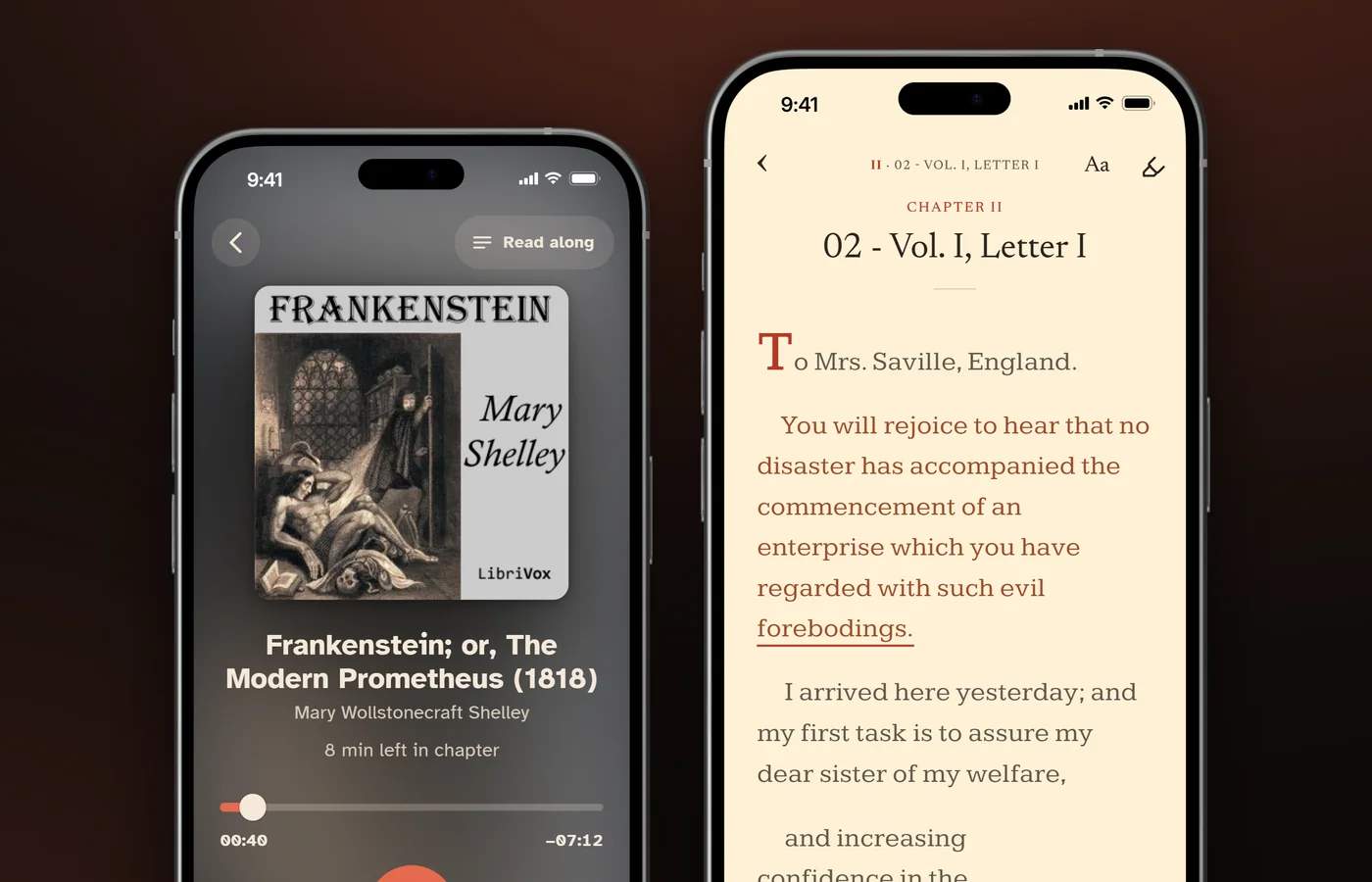
Yes: HushBook, the app we built, shows each word of the free LibriVox recordings as the narrator reads it, on iPhone and Android.
Frankenstein is a book where seeing the words pays twice. The first reason is the nesting. When Victor starts repeating the creature's account, the narrator's voice may barely change, but the page reads "It is with considerable difficulty that I remember", and you know who is speaking. Long-press any line to play from there, so you can hear a change of narrator again.
The second reason is the edition. In Discover, search "frankenstein 1818" and pick "Frankenstein; or, The Modern Prometheus (1818)", the card that reads 7h 59m: that is Cori Samuel's reading. Search "frankenstein 1831" and pick "Frankenstein (Edition 1831)" for Thomas A. Copeland's, with Mary Shelley's Introduction. HushBook queues the transcription as soon as the book is added, and it runs on your phone, with no account and no upload of your audio.
For Shelley's printed words, attach a matching DRM-free EPUB, PDF or TXT. E-book sync, with the first sync free, aligns the book's text to the audio word by word. Use Project Gutenberg's eBook #41445 with Cori Samuel and #42324 with Copeland: the edition match this post was written to settle.
For a paid recording, a DRM-free MP3 or M4B copy you own opens in HushBook on iPhone, Android, Windows and Mac. The core read-along and the public-domain library are free.
The label can say Volume 1; the words tell you which Frankenstein it is.
Follow all three narrators of Frankenstein, word by word
HushBook finds Cori Samuel's free LibriVox reading of Mary Shelley's original 1818 text and shows each word as she reads it, from Walton's first letter to his last. Free for iPhone and Android, no account.
Sources
Texts
- Project Gutenberg eBook #41445, "Frankenstein; or, The modern Prometheus" (1818 edition)
- Project Gutenberg eBook #42324, "Frankenstein; or, The modern Prometheus" (1831 edition)
- Project Gutenberg eBook #84, "Frankenstein; or, The modern Prometheus"
Editions
- Frankenstein, Norton Critical Edition, Third Edition, ed. J. Paul Hunter (W. W. Norton)
- Frankenstein: The 1818 Text, introduction by Charlotte Gordon (Penguin Classics)
- Frankenstein, edited with an introduction and notes by Maurice Hindle (Penguin Classics, 1831 text)
Recordings
- Audible, Frankenstein (Dan Stevens, Audible Studios)
- Audible, Frankenstein (Simon Vance, Tantor Audio)
- Audible, Frankenstein (Nico Evers-Swindell, AmazonClassics)
- Audible, Frankenstein (Jamie Bell, Audible Studios)
- Audible, Frankenstein (Derek Jacobi, silksoundbooks)
- Audible, Frankenstein (Edoardo Ballerini, Simon & Schuster Audio)
- Audible, Frankenstein (Daniel Philpott and cast, Naxos AudioBooks)
- Audible, Frankenstein (Daniela Acitelli, Spoken Realms)
- Audible, Frankenstein: The Original 1818 Text (Joseph Kent)
- Audible, Frankenstein (Kenneth Branagh, abridged)
- Audible, Frankenstein (George Guidall, Recorded Books)
- LibriVox, Frankenstein; or The Modern Prometheus (1818), read by Cori Samuel
- LibriVox, Frankenstein, or The Modern Prometheus (Edition 1831), read by Thomas A. Copeland
- LibriVox, Frankenstein, or The Modern Prometheus (2005 group reading)
- LibriVox, Frankenstein, or the Modern Prometheus (version 3), read by Caden Vaughn Clegg
- LibriVox, Frankenstein (version 2 dramatic reading)
- LibriVox, Frankenstein: or, the Modern Prometheus (Version 4), read by John Van Stan
- LibriVox, Frankenstein; or, The Modern Prometheus, Version 5, read by Mark F. Smith
- Internet Archive, Frankenstein; or, The Modern Prometheus (1818), Cori Samuel
- Audio Publishers Association, 2014 Audie Awards
Film
Studies
- Clinton-Lisell (2022), "Listening Ears or Reading Eyes: A Meta-Analysis of Reading and Listening Comprehension Comparisons", Review of Educational Research
- Hui and Godfroid (2026), "Listening, Reading, or Both? Rethinking the Comprehension Benefits of Reading-While-Listening", Language Learning
- Brysbaert (2019), "How many words do we read per minute? A review and meta-analysis of reading rate", Journal of Memory and Language
Frequently asked questions
What is the best Frankenstein audiobook?
Dan Stevens's 2013 Audible Studios recording, 8 hours 35 minutes, with 4.5 stars from 23,571 Audible US ratings. It reads the 1831 text. For the original 1818 text, Cori Samuel's free LibriVox reading runs 8 hours.
Which Frankenstein audiobook reads the 1818 text?
Few do. Cori Samuel's free LibriVox recording, 8 hours, and Nico Evers-Swindell's, 9 hours 27 minutes with 4.4 stars from 580 ratings, are the best known. Of 60 complete Audible listings we checked, 11 read 1818.
Is the Dan Stevens Frankenstein the 1818 or 1831 text?
The 1831 text, judged by his chapter lengths. His tracks are labelled in three volumes, but his Chapter I is shorter than his Chapter II, an order only the 1831 text produces.
How long is the Frankenstein audiobook?
About 8 hours. The 1818 text has 71,972 words, 7 hours 57 minutes at 151 words a minute; the 1831 text has 75,043, about 8 hours 17 minutes. Complete recordings run 6 h 54 min to 11 h 43 min.
Is there a free Frankenstein audiobook?
Yes. LibriVox has seven complete English recordings, all free in the HushBook app's Discover tab. Cori Samuel's reads the original 1818 text in 8 hours; Thomas A. Copeland's reads the 1831 text with Mary Shelley's Introduction.
Is Kenneth Branagh's Frankenstein audiobook unabridged?
No. Audible lists Kenneth Branagh's reading as abridged; it runs 3 hours 1 minute and is cut from the 1831 text, against about 8 hours for a complete recording of either text.
Why are Frankenstein's chapter numbers different in some editions?
The 1818 first edition came in three volumes, each starting again at Chapter I. The 1831 edition splits the first chapter in two and runs Chapters 1 to 24, so Volume 2, Chapter 1 is Chapter 9.