

Key takeaways
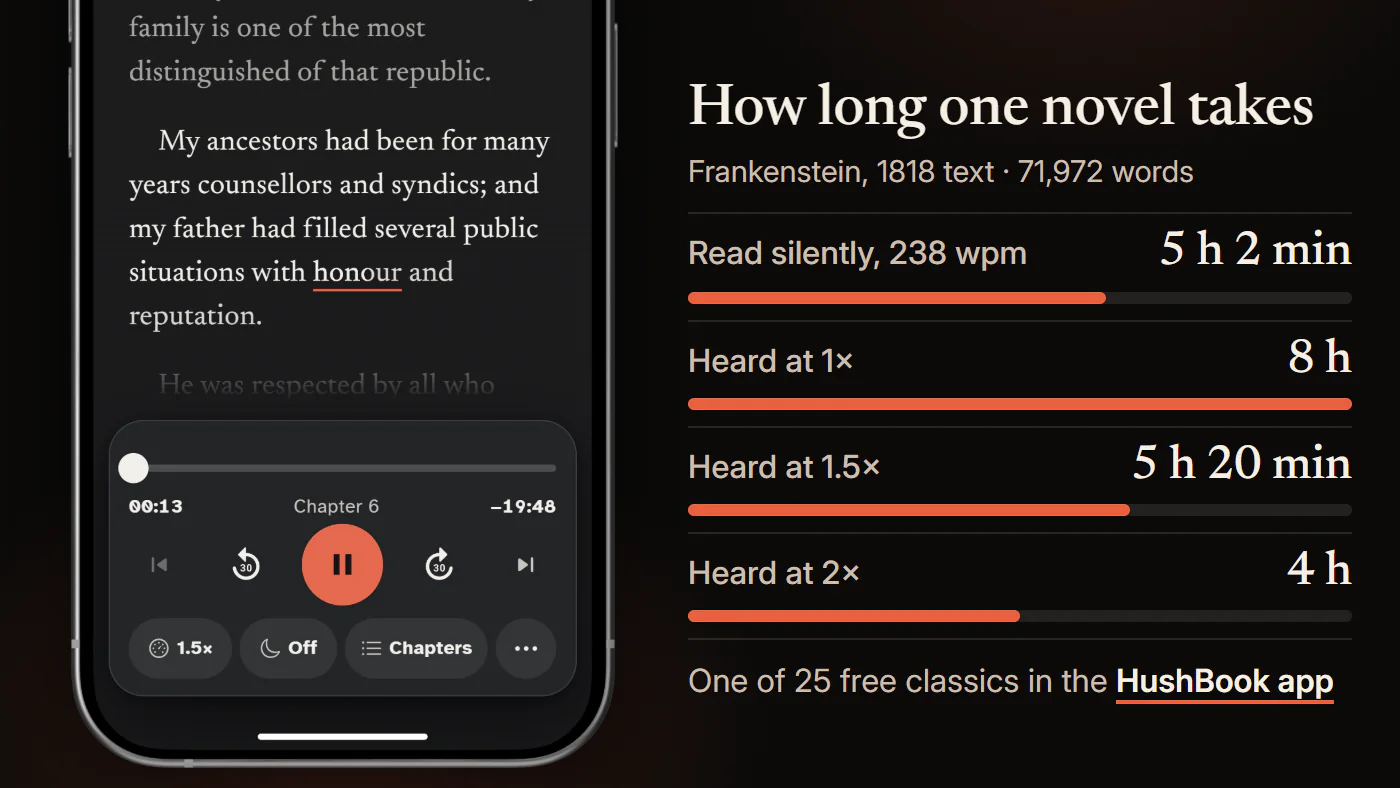
- The middle book of the 25 we timed, Frankenstein in its 1818 text, takes 5 h 02 min to read silently and 8 h 00 min to hear in Cori Samuel's reading.
- Sixteen of the 25 books can be read silently in an eight-hour day, and a 300-page paperback takes 5 h 15 min to 6 h 56 min to read.
- To finish a 72,000-word novel in a week, read 43 minutes a day. Adding 40 minutes of listening at 1.5x to the daily reading finishes it in about five days.
- A fixed daily slot, an if-then plan and a written page number rest on research about habits and goals; speed reading costs understanding, Rayner and colleagues concluded in 2016.
- War and Peace takes 118 days at 20 minutes a day. A daily chapter quota, plus listening in the hours you cannot read, turns a long book into a plan.
A typical 72,000-word novel takes 5 h 02 min to read silently, so finishing a book fast mostly means finding those hours. Marc Brysbaert's 2019 review of 190 studies puts adults at 238 words a minute on non-fiction, and we used that cautious rate.
But a rate is not a book. We timed 25 classics: we counted the words in each Project Gutenberg text and added up the running time of each free LibriVox recording. The middle one is Frankenstein in its 1818 text, which takes 8 h 00 min to hear in Cori Samuel's reading.
At the 16 minutes a day Americans spent reading in 2025, Frankenstein takes 19 days. That average comes from the Bureau of Labor Statistics' American Time Use Survey and covers teenagers and adults alike.
One mixed plan, reading plus listening to the same book, cuts that to five days.
How long does it take to finish a book?
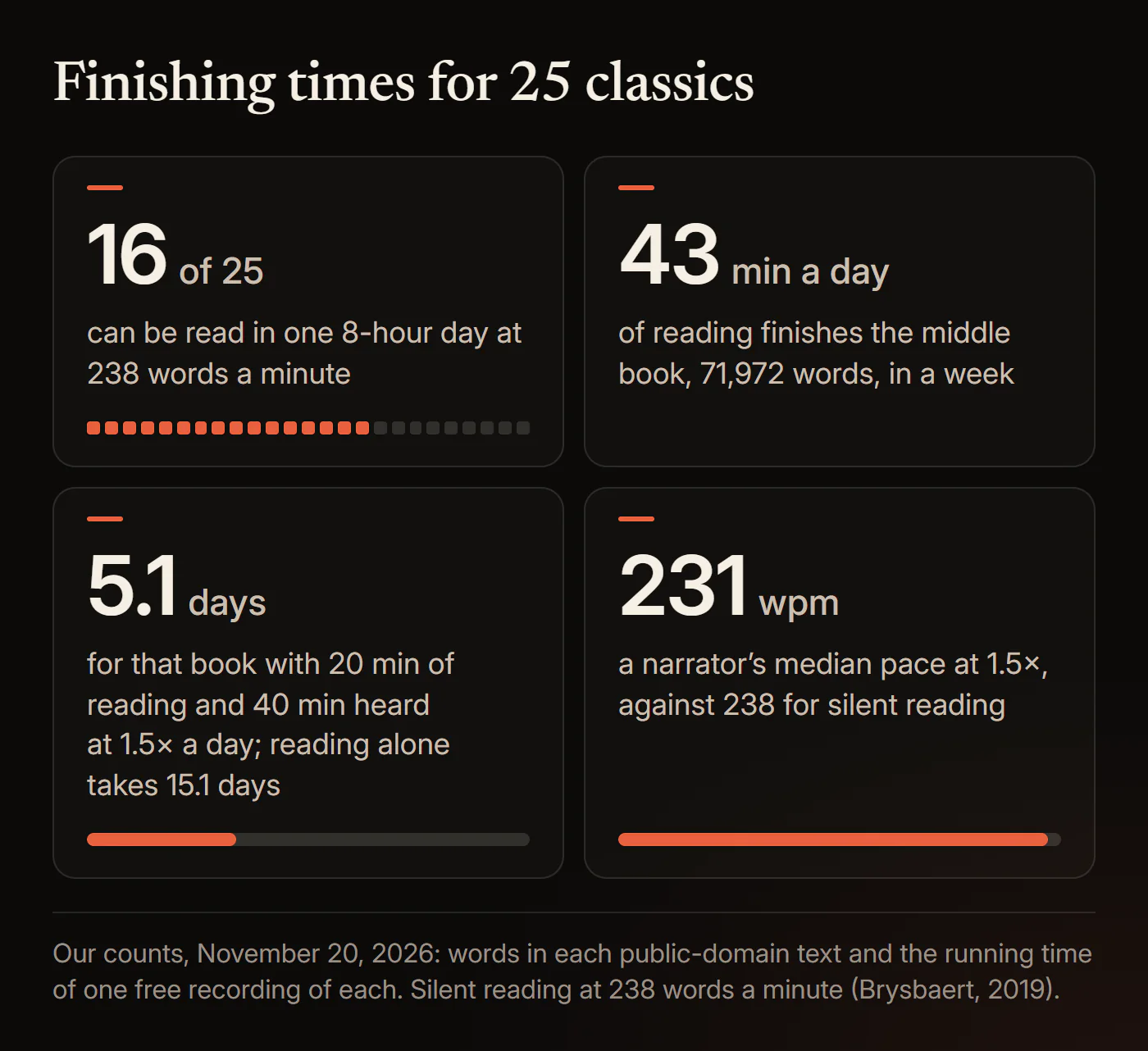
Reading our middle book takes 5 h 02 min, and hearing it at normal speed takes 8 h 00 min.
That reading time uses Brysbaert's non-fiction rate, the slower of his two. His review pooled 18,573 silent readers and put fiction faster, at 260 words a minute. All our books are fiction, so at that rate Frankenstein drops to 4 h 37 min. Narrators are slower than either, because reading aloud takes longer than reading in your head.
Is there an official average? No. Nobody publishes an average time to finish a book. The four to eight hours quoted on other reading pages comes without a source; ours comes from counted words and timed files. Our guide to how long an audiobook is covers lengths by genre and speed. It times a different edition and narrator of Frankenstein, so its figures differ from these.
Averages hide people, though. Brysbaert found that most adults read fiction at 200 to 320 words a minute, so a slow reader may need six hours for Frankenstein and a fast one under four. Narrators vary too, and another recording of the same book can run much longer or shorter. And no study has tested a finishing method by whether people finish; the steps below borrow from research on plans, progress and habits.
Our rule of thumb: an hour of silent reading for every 14,000 words, and an hour of listening at normal speed for every 9,300, the figure ACX gives narrators.
The next question is whether those hours fit into one day.
Can you finish a book in a day?
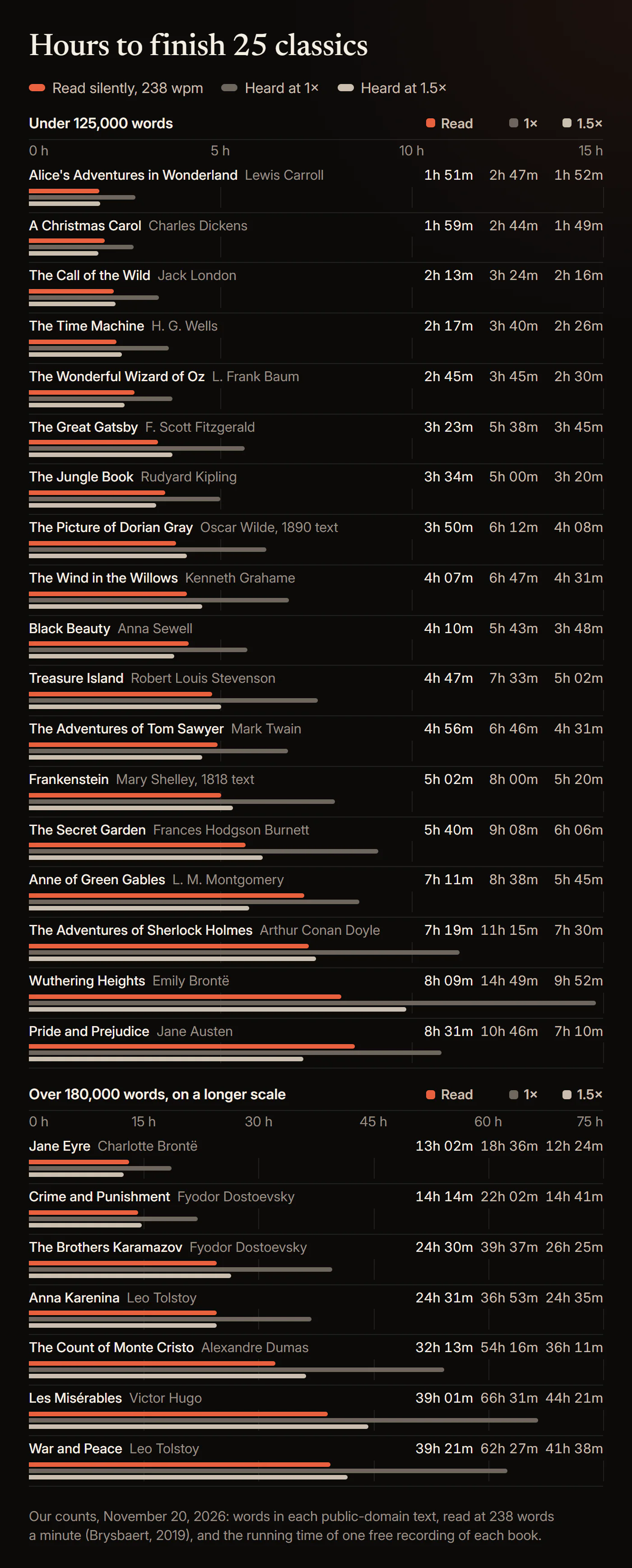
Yes, for most novels: 16 of the books we timed can be read silently in an eight-hour day.
The table lists every book by length, with the words we counted, each narrator's pace, the time to read at Brysbaert's two rates and the time to hear the free recording at two speeds.
| # | Book (narrator) | Words | Narrator's pace | Read at 238 words a minute | Read at 260 words a minute | Heard at 1x | Heard at 1.5x |
|---|---|---|---|---|---|---|---|
| 1 | Alice's Adventures in Wonderland (Kara Shallenberg) | 26,519 | 158 words a minute | 1 h 51 min | 1 h 42 min | 2 h 47 min | 1 h 52 min |
| 2 | A Christmas Carol (Glen Hallstrom) | 28,237 | 172 words a minute | 1 h 59 min | 1 h 49 min | 2 h 44 min | 1 h 49 min |
| 3 | The Call of the Wild (Mark F. Smith) | 31,755 | 155 words a minute | 2 h 13 min | 2 h 02 min | 3 h 24 min | 2 h 16 min |
| 4 | The Time Machine (Mark Nelson) | 32,493 | 148 words a minute | 2 h 17 min | 2 h 05 min | 3 h 40 min | 2 h 26 min |
| 5 | The Wonderful Wizard of Oz (J. Hall) | 39,254 | 175 words a minute | 2 h 45 min | 2 h 31 min | 3 h 45 min | 2 h 30 min |
| 6 | The Great Gatsby (Kara Shallenberg) | 48,385 | 143 words a minute | 3 h 23 min | 3 h 06 min | 5 h 38 min | 3 h 45 min |
| 7 | The Jungle Book (Meredith Hughes) | 51,051 | 170 words a minute | 3 h 34 min | 3 h 16 min | 5 h 00 min | 3 h 20 min |
| 8 | The Picture of Dorian Gray, 1890 text (John Gonzalez) | 54,654 | 147 words a minute | 3 h 50 min | 3 h 30 min | 6 h 12 min | 4 h 08 min |
| 9 | The Wind in the Willows (Mark F. Smith) | 58,755 | 144 words a minute | 4 h 07 min | 3 h 46 min | 6 h 47 min | 4 h 31 min |
| 10 | Black Beauty (Cori Samuel) | 59,573 | 174 words a minute | 4 h 10 min | 3 h 49 min | 5 h 43 min | 3 h 48 min |
| 11 | Treasure Island (Adrian Praetzellis) | 68,227 | 151 words a minute | 4 h 47 min | 4 h 22 min | 7 h 33 min | 5 h 02 min |
| 12 | The Adventures of Tom Sawyer (John Greenman) | 70,521 | 174 words a minute | 4 h 56 min | 4 h 31 min | 6 h 46 min | 4 h 31 min |
| 13 | Frankenstein, 1818 text (Cori Samuel) | 71,972 | 150 words a minute | 5 h 02 min | 4 h 37 min | 8 h 00 min | 5 h 20 min |
| 14 | The Secret Garden (Kara Shallenberg) | 80,878 | 147 words a minute | 5 h 40 min | 5 h 11 min | 9 h 08 min | 6 h 06 min |
| 15 | Anne of Green Gables (Karen Savage) | 102,602 | 198 words a minute | 7 h 11 min | 6 h 35 min | 8 h 38 min | 5 h 45 min |
| 16 | The Adventures of Sherlock Holmes (Mark F. Smith) | 104,477 | 155 words a minute | 7 h 19 min | 6 h 42 min | 11 h 15 min | 7 h 30 min |
| 17 | Wuthering Heights (Ruth Golding) | 116,440 | 131 words a minute | 8 h 09 min | 7 h 28 min | 14 h 49 min | 9 h 52 min |
| 18 | Pride and Prejudice (Karen Savage) | 121,676 | 188 words a minute | 8 h 31 min | 7 h 48 min | 10 h 46 min | 7 h 10 min |
| 19 | Jane Eyre (Elizabeth Klett) | 186,145 | 167 words a minute | 13 h 02 min | 11 h 56 min | 18 h 36 min | 12 h 24 min |
| 20 | Crime and Punishment, Garnett translation (Mark Nelson) | 203,197 | 154 words a minute | 14 h 14 min | 13 h 02 min | 22 h 02 min | 14 h 41 min |
| 21 | The Brothers Karamazov, Garnett translation (Bruce Pirie) | 349,788 | 147 words a minute | 24 h 30 min | 22 h 25 min | 39 h 37 min | 26 h 25 min |
| 22 | Anna Karenina, Dole translation (MaryAnn Spiegel) | 350,021 | 158 words a minute | 24 h 31 min | 22 h 26 min | 36 h 53 min | 24 h 35 min |
| 23 | The Count of Monte Cristo (David Clarke) | about 460,000 | 141 words a minute | 32 h 13 min | 29 h 29 min | 54 h 16 min | 36 h 11 min |
| 24 | Les Misérables, Hapgood translation (97 volunteers) | 557,137 | 140 words a minute | 39 h 01 min | 35 h 43 min | 66 h 31 min | 44 h 21 min |
| 25 | War and Peace, Maude translation (Mark Nelson) | 561,870 | 150 words a minute | 39 h 21 min | 36 h 01 min | 62 h 27 min | 41 h 38 min |
| Median | 71,972 | 154 words a minute | 5 h 02 min | 4 h 37 min | 8 h 00 min | 5 h 20 min |
The heard times come from the LibriVox files themselves, and because each track opens with a short spoken announcement, those times run a few minutes long.
Five short books fit in a single three-hour sitting: Alice's Adventures in Wonderland, A Christmas Carol, The Call of the Wild, The Time Machine and The Wonderful Wizard of Oz. A 300-page paperback fits in a day too. By Gatekeeper Press's words-per-page figures for common paperback sizes, it takes 5 h 15 min to 6 h 56 min of silent reading.
Hearing a book in a day is harder. Only 12 of the 25 recordings run under eight hours at normal speed, and the narrator matters as much as the book. Ruth Golding's Wuthering Heights takes four hours longer to hear than Karen Savage's Pride and Prejudice, which has more words. Golding simply reads more slowly, as the pace column shows.
A reading day also needs breaks. In a 2025 meta-analysis covering more than 10,000 people, Zanesco, Denkova and Jha found that minds wander more the longer a task goes on. Their tasks were of every kind, not reading in particular, and we read the finding as a case for stopping every hour.
We would try a one-day book only under 114,000 words, about what eight hours of silent reading covers. Most days hold far less than eight spare hours, though.
How to finish a book faster: 6 things that work
Protect a daily slot, write down where you stop, and add listening time to the book you are already reading.
Why minutes and not speed? At 20 minutes a day, Frankenstein takes 15 days to read silently; at half that, a month. Doubling the minutes halves the wait, while doubling your reading speed costs understanding, as Rayner's review shows further down. So the steps below are about adding minutes and not losing them, and each one names the research behind it.
Our pick if you try only two: the if-then plan and the written page number, because both rest on meta-analyses.
1. Give the book a fixed time and a cue
Read at the same point in every day, straight after something you already do: the commute home, or the tea after dinner. When Lally's team followed 96 volunteers in 2010, each repeating one daily habit in the same setting, the habits took from under three weeks to more than eight months to become automatic. They were eating, drinking and activity habits, not reading, and missing a single day did not derail the process.
2. Write the plan as one if-then sentence
Make the plan specific: "After dinner, on the sofa, I read one chapter." Gollwitzer and Sheeran's 2006 meta-analysis of 94 independent tests found that if-then plans like this had a medium-to-large effect on reaching goals. The goals were of every kind, so the trick is naming the moment, not the book.
3. Write down the page where you stopped
A number on paper keeps the book moving. In 2016, Harkin and colleagues pooled 138 studies and found that monitoring progress helped people reach their goals. The effect was larger when progress was "physically recorded" or "made public", so a page number in a notebook, or a note to a friend, counts.
4. Set a chapter quota, not a page count
A chapter is a target with a natural end, and long recordings come in short sections: Mark Nelson's War and Peace has 365. No study has found a best session length for books, so the daily minutes in our tables are planning units, not findings. In HushBook, set the sleep timer to the end of the chapter, and the narrator stops when the chapter does.
5. Match the book to the minutes you have
Check the length before you start, using the rule of thumb above. At half an hour a day, only six of our books can be read in a week; at an hour a day, more than half can. If the week matters more than the title, pick from the short end of the table.
6. Add listening time to the same book
The hours you cannot read in, such as a commute, a walk or the washing up, can still move the same book on. A narrator at 1.5x reads at a median 231 words a minute in our recordings, close to silent-reading speed. When you switch from page to voice, HushBook highlights each word as the narrator says it, so a glance finds your line.
Every listening hour moves the book without you sitting down.
How to finish a book in a week
A 72,000-word novel takes 43 minutes of silent reading a day to finish in a week.
The table gives the daily minutes for Frankenstein, read silently or heard in Cori Samuel's recording, over a day, a week, two weeks and a month.
| Way to finish | In 1 day | In 7 days | In 14 days | In 30 days |
|---|---|---|---|---|
| Read at 238 words a minute | 5 h 02 min | 43 min | 22 min | 10 min |
| Read at 260 words a minute | 4 h 37 min | 40 min | 20 min | 9 min |
| Heard at 1x | 8 h 00 min | 69 min | 34 min | 16 min |
| Heard at 1.5x | 5 h 20 min | 46 min | 23 min | 11 min |
| Heard at 2x | 4 h 00 min | 34 min | 17 min | 8 min |
Now mix the two, keeping the daily reading slot. Add 40 minutes of listening at 1.5x, on the commute or a walk, and the book takes about five days, a third of the time.
| Plan for each day | Words a day (reading at 238 words a minute, listening at 154 words a minute) | Days to finish 71,972 words |
|---|---|---|
| Read 20 min | 4,760 | 15.1 |
| Read 20 min, hear 20 min at 1.5x | 9,380 | 7.7 |
| Read 20 min, hear 40 min at 1x | 10,920 | 6.6 |
| Hear 40 min at 1.5x, no reading | 9,240 | 7.8 |
| Read 20 min, hear 40 min at 1.5x | 14,000 | 5.1 |
The mixed plan wins because it adds hours to the day, not speed to the reader. Our pick for a week: the fixed reading slot, plus the commute by ear.
A week suits a normal novel. A long one needs months.
How to finish a long book fast
Set a daily chapter quota and plan in months: War and Peace takes 118 days at 20 minutes a day.
The Maude translation is the longest book in our set, so finishing it in two months means 39 minutes of reading a day. What do you do with a book that size? Break it into the units it already has. Anna Karenina, in MaryAnn Spiegel's recording of the Dole translation, comes in 238 sections with a median of 9 minutes, so three a day is about half an hour.
The mixed plan helps most here: with it, War and Peace comes down to about 40 days by our arithmetic, a third of the reading-only time.
For a book this long, we would count chapters, not pages, and set a quota you can meet on a bad day.
Length is one reason books stall. Boredom is the other.
How to finish a boring book fast, or when to stop
Skim the slow stretch for the story, and if the book still drags after a couple of chapters, stopping is normal.
Readers drop off early. In reader tests by Jellybooks, an analytics firm that tracks how far test readers get, the biggest drop usually comes in chapter 1. A strong book, by its account, loses readers gradually over the first couple of chapters and then holds steady. Its test readers get free advance ebooks, and Jellybooks does not publish how many take part.
Should you push through anyway? Not always. In experiments published in 2009, whose summary gives no sample size, Duggan and Payne gave readers time for only half of each text. Those who skimmed remembered the important ideas better than those who read half the text, though not the details. Their texts were expository, not novels, so treat skimming as a tool for plot rather than prose.
Quitting deserves less guilt than it gets. Our guide to why you can't finish books anymore looks at the reasons readers give for putting a book down, and at reading slumps.
If a book still drags by the third chapter, we would skim to the next scene, and stop if that fails too. Quitting a book frees the hours for one you will finish.
Can you read a book faster and still understand it?
Not by much: Rayner and four colleagues concluded in 2016 that speed reading trades understanding for speed.
Readers are unlikely to double or triple their speed from around 250 words a minute "while still being able to understand the text as well", the review says. Skimming gets you through "with moderate comprehension". The authors' route to reading faster is plain hard work: "to practice reading and to become a more skilled language user".
Going back is part of reading too. In a 2014 experiment by Schotter, Tran and Rayner, comprehension fell when words were masked after the eyes had passed them, so readers could not look back. Apps that flash one word at a time take the same thing away, by our reading. Remembering is a separate question from speed, and our guide to remembering what you hear covers it for audiobooks.
If you listen faster, keep the speed modest for books you care about. Tharumalingam and colleagues pooled 24 studies of lecture videos in 2025. As Marcus Pearce summarised it for The Conversation, up to 1.5x "the cost was very small", but at 2x and above the harm was "moderate to large". Those studies used lectures, not novels, and our guide to audiobook listening speed matches speeds to kinds of book.
We would not pay for a speed-reading course: read more, and slow down wherever you would otherwise reread. Faster eyes are not the lever. More minutes are.
How to read more books in a year
Twenty minutes a day is enough for 24 novels the length of Frankenstein in a year.
In October 2025, Pew Research Center surveyed 8,046 US adults about their reading over the past year. Only 14% had read more than 20 books, and a quarter had read none. By our arithmetic, twenty minutes a day would put a reader of novels this size inside that 14%.
| Time each day | Hours a year | Books read at 238 words a minute | Books heard at 1x | Books heard at 1.5x |
|---|---|---|---|---|
| 16 min (US average, 2025) | 97 h | 19 | 12 | 18 |
| 20 min | 122 h | 24 | 15 | 23 |
| 30 min | 182 h | 36 | 23 | 34 |
Each book in the table is the length of our middle one. The Bureau of Labor Statistics average comes with two catches. It includes people who read nothing that day, and it counts all reading for interest, not only books.
If you have ADHD, the same plan can be tried in smaller pieces: shorter sittings, more of them. Our guide to audiobooks and ADHD covers what research says about listening; treat audio as a reading aid, not treatment. If you track a yearly challenge, books finished by ear count on Goodreads as well.
We would choose a short slot every day over a weekend marathon that keeps slipping. Twenty minutes is the floor. Listening hours go on top.
Finish the same book by ear in HushBook
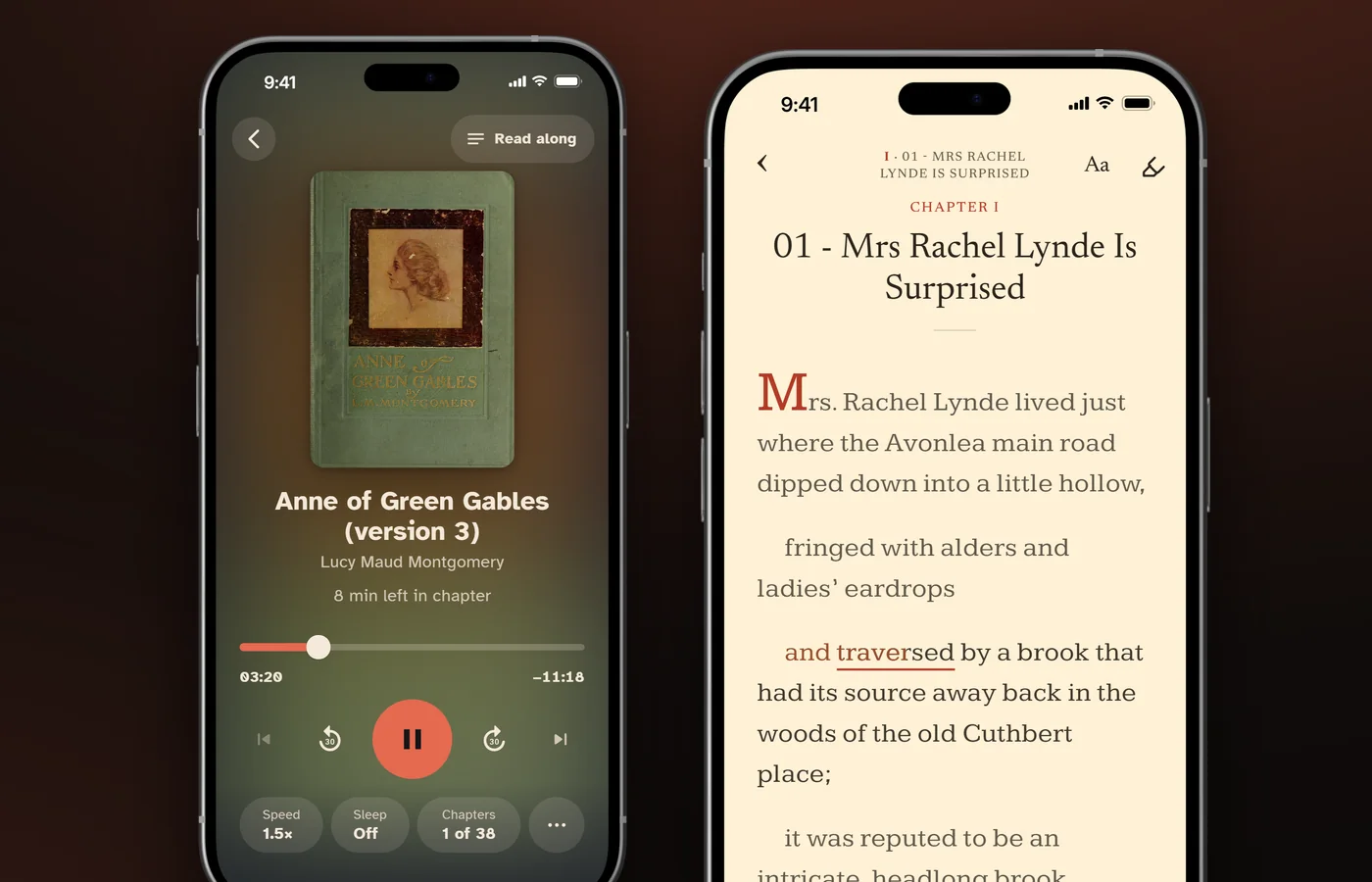
We built HushBook for the listening half of that plan. Its Discover catalogue holds free LibriVox and Internet Archive recordings in English, German, French, Spanish, Italian and Portuguese. Download one, and HushBook transcribes it and highlights each word as the narrator says it.
A long press on any line plays from there, so you can pick up the audio at the sentence where you put the paperback down. Speed goes up to three times normal, with the speed in our tables among the presets.
The player shows the minutes left in the chapter, which makes a chapter quota easy to judge on a short walk, and the sleep timer can stop at the chapter's end. The home screen shows today's streak and word count, a running record of the kind the page-number step recommends.
Finishing fast was always about finding the hours, and some of them can be heard.
Finish the book in the hours you can't sit and read
HushBook downloads free LibriVox and Internet Archive classics and highlights each word as the narrator says it. Listen on the commute at 1.5x, then long-press any line to play from there.
Sources
- Brysbaert (2019), "How many words do we read per minute? A review and meta-analysis of reading rate", Journal of Memory and Language
- Rayner, Schotter, Masson, Potter and Treiman (2016), "So Much to Read, So Little Time: How Do We Read, and Can Speed Reading Help?", Psychological Science in the Public Interest
- Schotter, Tran and Rayner (2014), "Don't Believe What You Read (Only Once): Comprehension Is Supported by Regressions During Reading", Psychological Science
- Duggan and Payne (2009), "Text skimming: The process and effectiveness of foraging through text under time pressure", Journal of Experimental Psychology: Applied
- Tharumalingam, Roberts, Fawcett and Risko (2025), "Increasing Video Lecture Playback Speed Can Impair Test Performance – a Meta-Analysis", Educational Psychology Review
- Pearce (2025), "Your Brain on Speed: Is Watching Video in Fast-Forward Bad For Your Memory?", ScienceAlert, republished from The Conversation
- Zanesco, Denkova and Jha (2025), "Mind-wandering increases in frequency over time during task performance: An individual-participant meta-analytic review", Psychological Bulletin
- Gollwitzer and Sheeran (2006), "Implementation Intentions and Goal Achievement: A Meta-analysis of Effects and Processes", Advances in Experimental Social Psychology
- Harkin, Webb, Chang, Prestwich, Conner, Kellar, Benn and Sheeran (2016), "Does monitoring goal progress promote goal attainment? A meta-analysis of the experimental evidence", Psychological Bulletin
- Lally, van Jaarsveld, Potts and Wardle (2010), "How are habits formed: Modelling habit formation in the real world", European Journal of Social Psychology
- U.S. Bureau of Labor Statistics (2026), "Americans age 15 and over read for an average of 16 minutes per day in 2025", The Economics Daily
- Pew Research Center (2026), "Americans still opt for print books over digital or audio versions; few are in book clubs"
- Jellybooks, "Completion Rate"
- ACX Help, "Narrate an audiobook" (section "How long will my narrated audiobook be?")
- Gatekeeper Press, "How Many Pages Will My Book Be?"
- Project Gutenberg, plain-text editions used for our word counts (ebooks 11, 46, 215, 35, 55, 64317, 236, 4078, 289, 271, 120, 74, 41445, 113, 45, 1661, 768, 1342, 1260, 2554, 28054, 1399, 1184, 135, 2600)
- LibriVox, the free recordings we timed, one per book, listed in our audiobook catalogue
- Our timing, November 2026: words counted in 25 Project Gutenberg texts, running times summed from each LibriVox recording's files, reading times at 238 and 260 words a minute from Brysbaert (2019).
Frequently asked questions
How long does it take to finish a book?
5 h 02 min for a 72,000-word novel at the 238 words a minute Brysbaert's 2019 review found for non-fiction. Hearing Frankenstein in Cori Samuel's free recording takes 8 h 00 min at normal speed.
Can you finish a book in a day?
Yes, for most novels. Of the 25 books we timed, 16 can be read silently in eight hours at 238 words a minute, which covers books up to about 114,000 words.
Can I finish a 300-page book in a day?
Yes. By Gatekeeper Press's words-per-page figures for common paperbacks, 300 pages take 5 h 15 min to 6 h 56 min of silent reading at 238 words a minute, well inside an eight-hour day.
How many minutes a day do I need to finish a book in a week?
43 minutes of silent reading a day finishes a 72,000-word novel in a week. Listening alone to the same book takes 46 minutes a day at 1.5x.
Does speed reading help you finish books faster?
No, not without understanding less. Rayner and four colleagues concluded in 2016 that readers are unlikely to double or triple their speed from around 250 words a minute and still understand the text as well.
How many books can you read in a year at 20 minutes a day?
24 novels of 72,000 words, reading at 238 words a minute. In Pew's October 2025 survey of 8,046 US adults, 14% had read more than 20 books in the past year.