

Key takeaways
- Audiobooks help you learn Italian. In a 2026 study of 88 advanced Persian-speaking learners of Italian, the audiobook of L'amica geniale taught about twice as many new words as the printed novel.
- No study has tested learners of Italian reading along. Elsewhere, text with audio beat audio alone, but in a 2025 study of 86 learners of English, silent reading beat reading along for understanding a novel.
- Spoken Italian is not especially fast. The hard part is consonant length: pala (shovel) and palla (ball) differ only in it, learners hear it less reliably than Italians, and the page always writes it double.
- We counted 89 finished Italian LibriVox recordings on November 20, 2026, with a median length of 4 h 15 min. Twelve of the 22 under two hours are La Fontaine fables in verse.
- No big store shows Italian text in step with the narrator. Audible's Read & Listen covers only English and German titles, and LibriVox and Liber Liber give the text as a separate file.
Yes: audiobooks help you learn Italian, especially when you can see the Italian words as the narrator reads them. In a 2026 study of 88 advanced Persian-speaking learners of Italian, Aliyar and colleagues found that the audiobook of L'amica geniale taught about twice as many new words as the printed novel.
The catch is that nobody in that study read along, and the free Italian shelf is mostly old literary Italian. On November 20, 2026 we counted every Italian recording on LibriVox, the free public-domain audiobook library: 89 books with a median length of 4 h 15 min. Twelve of the 22 that run under two hours are books of La Fontaine's fables, in rhymed verse.
Seeing the text helps for a reason of Italian's own. Palla (ball) and pala (shovel) differ only by a consonant held a moment longer, which is easy to miss by ear and always written double. Below are the free recordings in the order we would take them, shortest first.
Can you learn Italian with audiobooks?
Yes, for listening and vocabulary, and Italian has better evidence for it than most languages.
That 2026 study is the reason. Aliyar, Siyanova-Chanturia and Skalicky gave advanced university students of Italian in Iran the opening chapters of Elena Ferrante's novel, about five hours of audio, to enjoy over three and a half weeks. One group listened, one read, and a third did neither. On a test of new word forms straight afterwards, the listeners recognised 49.5% of the target words and the readers 25.6%. Three weeks later the listeners still recognised almost as many, and they had understood the story better too.
Why would listening beat reading? The authors offer a tentative reason: "Italian has a close spelling-to-sound correspondence, which makes it easier to comprehend the form of a new word even through listening". By our arithmetic, their audiobook ran at about 135 words a minute, inside the range of the free LibriVox narrators we timed for this guide.
Italian is also one of the quicker languages for an English speaker. The US Foreign Service Institute puts it at 24 weeks of full-time classes, against 30 for Spanish and French. And a small core of words does most of the work. By Tullio De Mauro's 2016 count, Italian's 2,000 most common words make up about 86% of the words in everyday texts and speech. The next 3,000 add only 6%.
So even a learner who knows all of those words meets about one unfamiliar word in 12, by our arithmetic. That is short of the 95% at which learners understood speech well in van Zeeland and Schmitt's 2013 study of 40 non-native listeners of English. De Mauro counts dictionary headwords, so his figures and English word counts are not measured the same way, so treat the comparison as rough.
Audiobooks will not make you speak or write, either. After six years in a program built on listening and reading alone, Lightbown and colleagues reported in 2002, children matched comparison groups on comprehension and some speaking "but not on measures of written production".
We would use audiobooks for the listening half of Italian and practise speaking separately.
What does the research say about reading along in Italian?
Nothing yet for Italian: no study has tested learners of Italian reading along with an audiobook.
The nearest is a 2022 study by Aliyar and Peters with 35 Iranian learners of Italian. Most of them read four comic books and then read them again while listening, over four weeks, and picked up new words along the way. Reading and listening were bundled, so the study cannot say which of the two did the work.
The rest of the evidence comes from other languages. Learners of Japanese who read with audio for a year "outperformed all other groups" on the Japanese Computerized Adaptive Test in Peterson's 2025 study, whose abstract gives no sample size. Zhang and Peng found in 2024 that audio added to reading helped intermediate-low learners of Chinese, while for intermediate-high ones the difference was not significant.
Does seeing a word mean you will remember it? Not on its own. Montero Perez and colleagues showed French clips to 133 Flemish undergraduates in 2014. Captions helped them recognise the forms of new words, but "Captioning did not affect comprehension nor meaning recall."
The captioned-video studies for Spanish are collected in how to learn Spanish with audiobooks, and the studies of English learners in how to learn English with audiobooks. Our reading of all of it: the text earns its place while the Italian is still too fast to follow by ear.
Text plus audio beats audio alone; against a page alone, it is unproven.
Why is spoken Italian hard to follow?
Not because it is fast: the trap is consonant length, which changes meanings and slips past the ear.
Italian sits in the middle for speed. Pellegrino, Coupé and Marsico, writing in Language in 2011, had six to ten native speakers per language read the same short texts aloud. The Italians produced 6.99 syllables a second, against 6.19 for English, and Spanish was faster still. Each Italian syllable carried less information, so the meaning delivered per second came out close to English.
Length is the harder part. Pala is a shovel and palla a ball, and the only difference is how long the speaker holds the l. English has no such contrast, and neither does German. In a 2012 study, Altmann, Berger and Braun asked native Italians, advanced German learners of Italian and Germans who had never studied it to judge, against the clock, whether two spoken items were the same or different. The learners beat the non-learners but trailed the Italians, and their reaction times showed the decision was just as hard for them as for the non-learners. Its abstract does not say how many took part.
The gap holds elsewhere. In 2025, De Iacovo, Dian and Hajek found that second-language and heritage speakers in Australia "show much less reliance" on duration cues than listeners in Italy. Speed makes it worse. In a 1999 study, Pickett, Blumstein and Burton found that at a fast speaking rate, Italian double consonants were held no longer than single consonants said in isolation.
On the page, nothing hides: Italian always writes a long consonant double. Its spelling is regular in other ways too. Seymour, Aro and Erskine compared first-graders across 13 European spelling systems in 2003. By the end of the year, the Italian children read 95% of familiar words correctly, and the Scottish children about a third.
Apostrophes show what speech runs together: l'amica, dell'anno and c'è keep them in print. The page does not mark stress except on a final vowel, as in città and perché, so the narrator supplies the rest. No study has tested whether seeing a double letter helps a learner hear it. We think it does the plain job of marking the contrast the ear lets slip, at the moment you hear it.
Should you slow the audio down? Replay first. Jensen and Vinther found in 2003 that 84 upper-intermediate learners of Spanish improved from hearing each line three times, whether or not the middle hearing was slowed. A slower rate does give a double consonant back some of its length, if Pickett's finding holds, but that is our inference, and no study has tested a slower setting for learners. The general evidence is in how fast to play an audiobook.
When palla and pala blur at speed, HushBook puts the word on screen with a red underline as the narrator reaches it, and a long press on the line plays it again.
The ear needs the page most where the letters double.
Where can you find free Italian audiobooks?
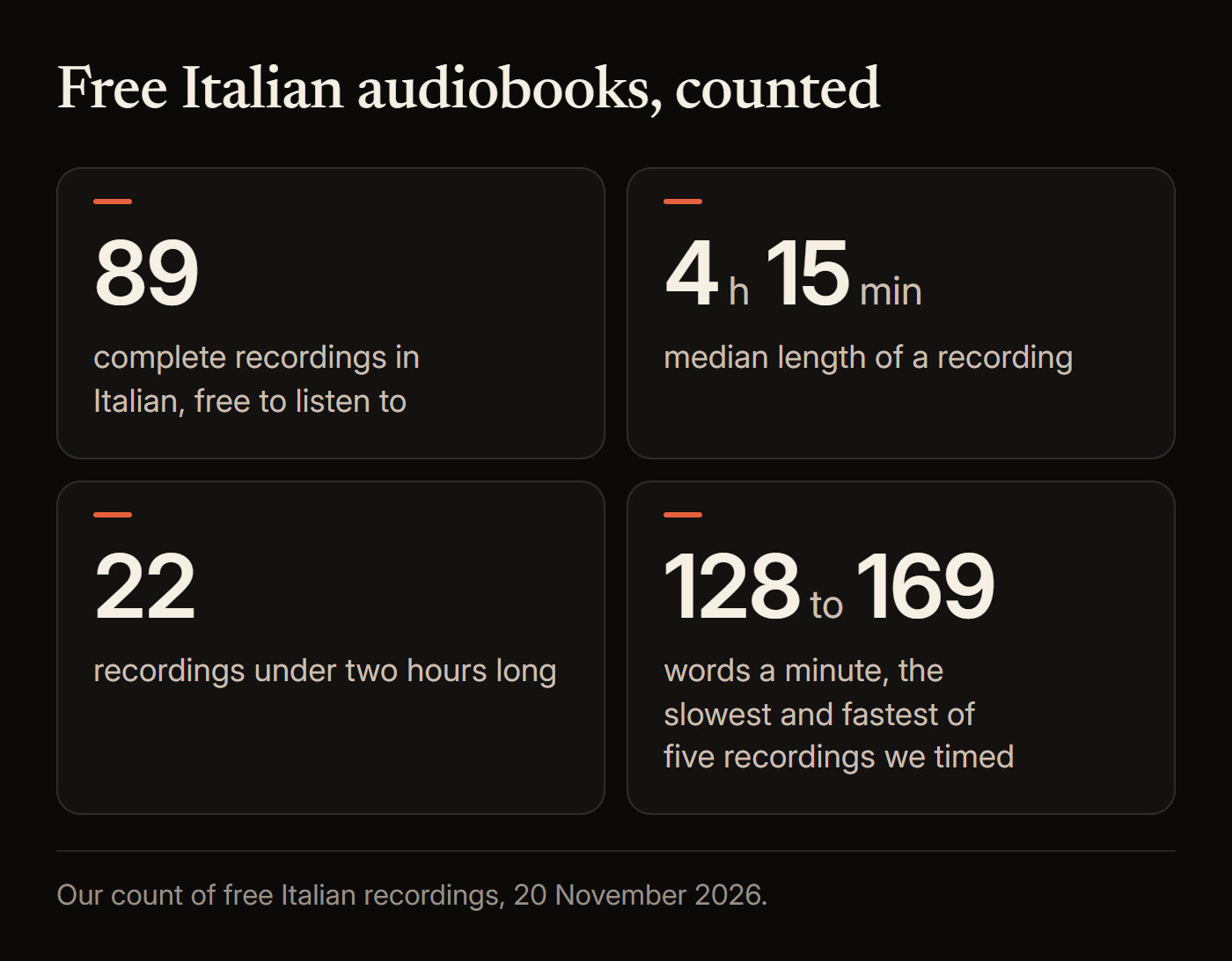
LibriVox has the most whole Italian books: 89 finished recordings on November 20, 2026, all in the public domain.
We pulled the running time of every one from the Internet Archive, which hosts them. The median is 4 h 15 min, and 22 run under two hours. Volunteers read just over half of them alone; the rest are group recordings, with a new voice each chapter. Most of the shelf is classic literature, from Dante and Boccaccio to Manzoni, Verga and Pirandello, who alone has 17 recordings. By downloads, the favourite is Le avventure di Pinocchio.
Why does the literary tilt matter? Because most of these books were written in an Italian few people then spoke. In a 2011 essay for the Accademia della Crusca, Maraschio and Biffi put Italian speakers in 1861 at only 10% of the population, on the most optimistic estimates. In 2024, Istat found that 53.6% of people in Italy speak mainly Italian at home. Italian was a written language long before most Italians spoke it at home, and the old books on LibriVox read that way.
| Source | What you get | Text | Cost on November 20, 2026 |
|---|---|---|---|
| LibriVox | 89 finished Italian recordings by volunteer readers | A separate public-domain text, often on Project Gutenberg | Free, public domain |
| Liber Liber, Libro parlato | About 106 audiobooks by our count, one MP3 per chapter, including Pinocchio and Cuore | The ebook, as a separate free download | Free for personal use; title pages carry a CC BY-NC-SA 4.0 licence |
| Ad alta voce, Rai Radio 3 | 62 audiobooks in the archive by our count, read by Italian actors; new episodes on weekdays | None | Free; on-demand listening needs a free Rai account |
| Libby | Your library's Italian audiobooks, found with a pinned language filter | None we found | Free with a library card |
Liber Liber is free, but unlike LibriVox it is not public domain, so keep its files for your own listening. French learners get free news read aloud with a transcript, collected in how to learn French with audiobooks. We would take whole Italian books from LibriVox, because their texts are free too, and save Ad alta voce for when you can follow an actor without a page.
Free Italian is plentiful; free Italian with text needs the right book.
What are the best Italian audiobooks for beginners?
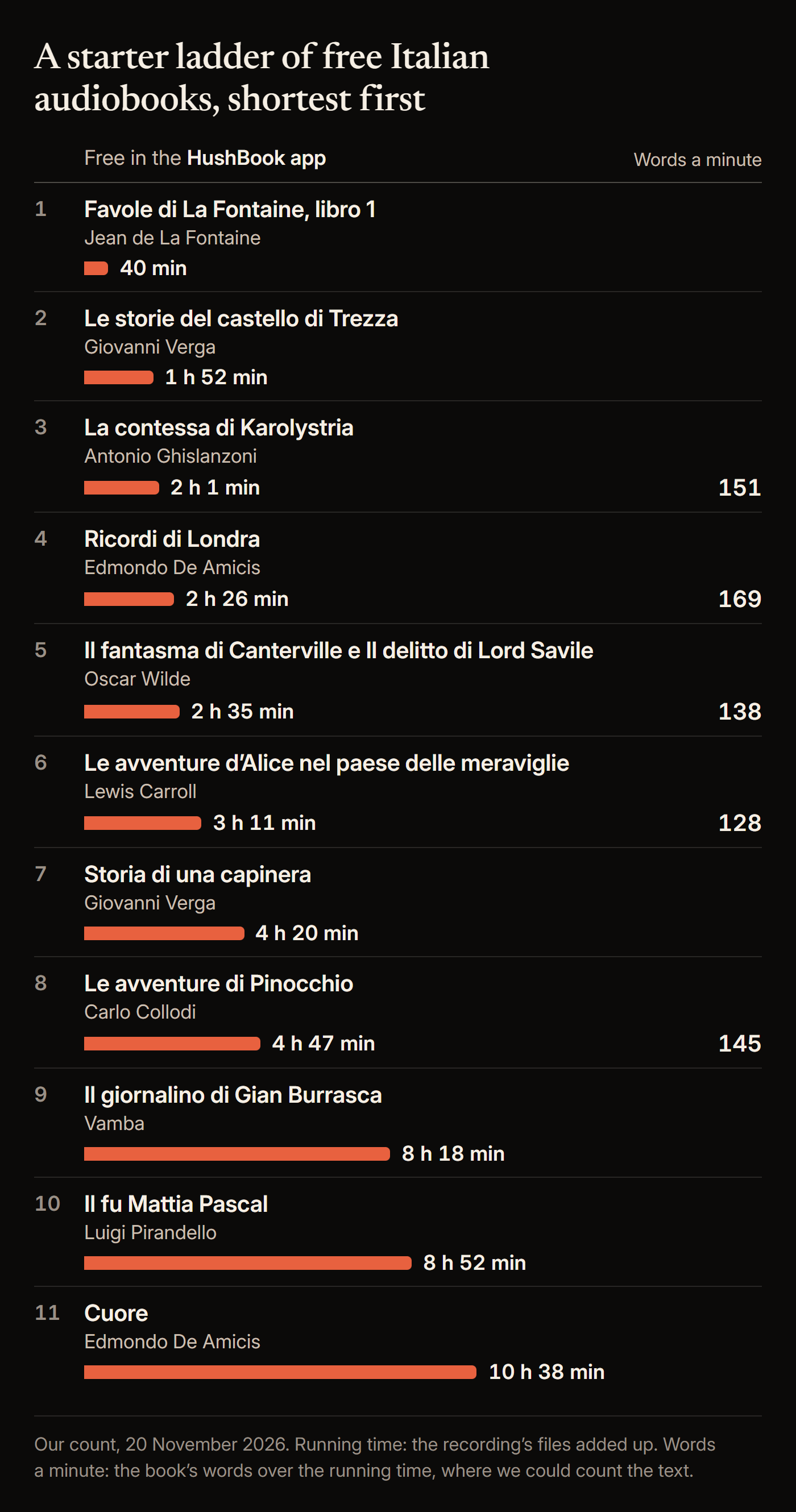
Stories written for learners come first; among free recordings, start with La Fontaine's fables, then Pinocchio.
Olly Richards's Short Stories in Italian for Beginners is the best-known graded reader. Its publisher, Hachette, describes it as "Mapped to A2-B1 on the Common European Framework of Reference", so it starts a step past the first lessons, whatever the title says. The Audible edition runs 4 h 6 min and cost $11.06 on November 20, 2026. Lingo Mastery's Italian Short Stories for Beginners runs 6 h 19 min, with a PDF of summaries, vocabulary and questions.
For the free ladder, we sorted our LibriVox count by length and picked the books a learner has the best chance with, from fables and children's stories to a first novel. Then we timed five narrators, dividing the words in each Project Gutenberg text by the recording's running time. The paces include LibriVox's spoken announcements, so the real reading speed is a little higher.
| Book | Author | Running time | Read by | Pace |
|---|---|---|---|---|
| Favole di Jean de La Fontaine, libro 1 | Jean de La Fontaine, translated by Emilio De Marchi | 40 min | Paolo Fedi | Not measured |
| Le storie del castello di Trezza, 1875 | Giovanni Verga | 1 h 52 min | Francesca Roma | Not measured |
| La contessa di Karolystria, 1883 | Antonio Ghislanzoni | 2 h 01 min | Riccardo Fasol | 151 words a minute |
| Ricordi di Londra | Edmondo De Amicis, with a piece by Louis Simonin | 2 h 26 min | Claudia Caldi | 169 words a minute |
| Il fantasma di Canterville e Il delitto di Lord Savile | Oscar Wilde, translated by Giuseppe Vannicola | 2 h 35 min | 11 readers | 138 words a minute |
| Le avventure d'Alice nel paese delle meraviglie, 1872 | Lewis Carroll, translated by Teodorico Pietrocòla-Rossetti | 3 h 11 min | 8 readers | 128 words a minute |
| Storia di una capinera, 1871 | Giovanni Verga | 4 h 20 min | Francesca Roma | Not measured |
| Le avventure di Pinocchio, 1883 | Carlo Collodi | 4 h 47 min | Simona | 145 words a minute |
| Il giornalino di Gian Burrasca, 1912 | Vamba | 8 h 18 min | 4 readers | Not measured |
| Il fu Mattia Pascal, 1904 | Luigi Pirandello | 8 h 52 min | Riccardo Fasol | Not measured |
| Cuore, 1886 | Edmondo De Amicis | 10 h 38 min | Filippo Gioachin | Not measured |
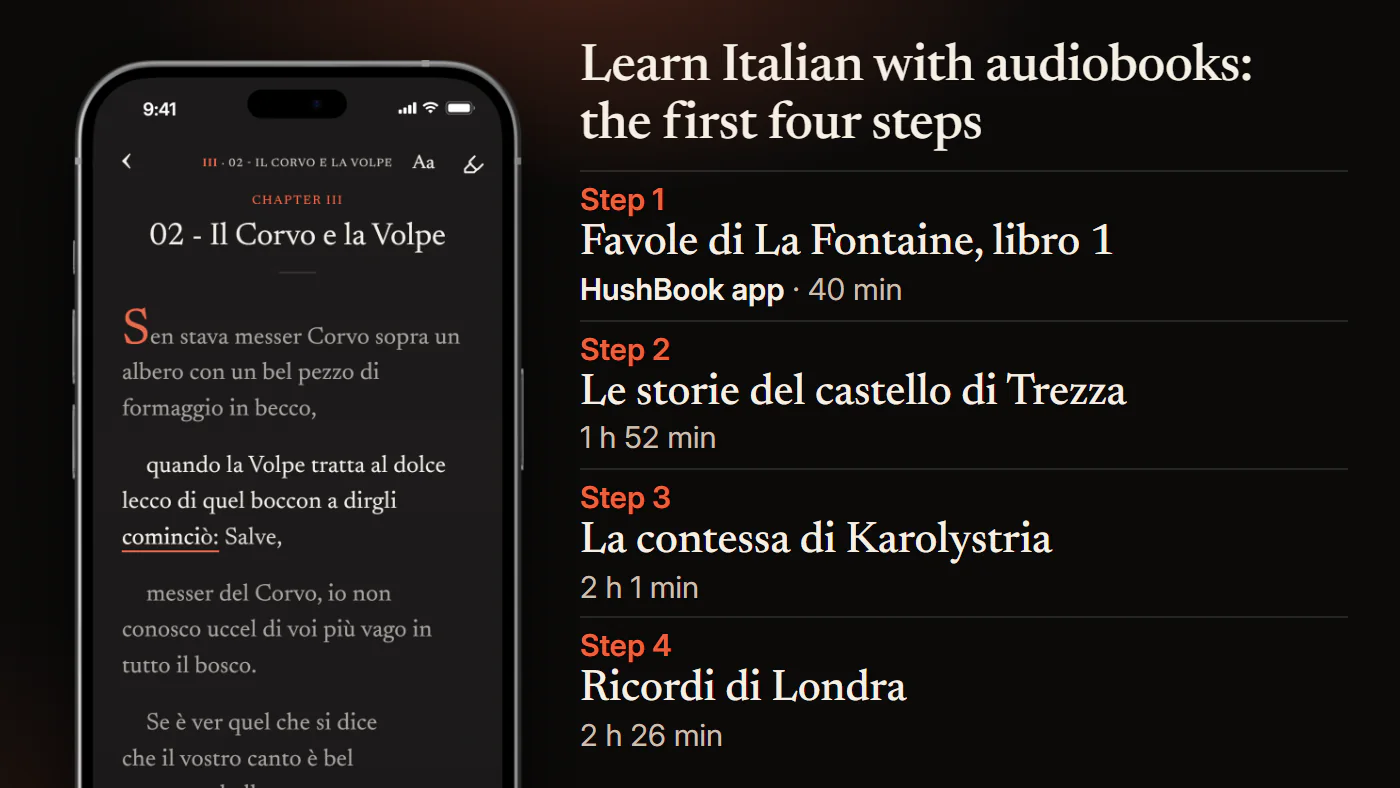
Start at the top. The first book holds 22 fables, none longer than three and a half minutes, and many are stories you already know, such as "Il Corvo e la Volpe". They are verse, though, not plain prose. Here Master Crow sits in a tree with a fine piece of cheese in his beak:
Sen stava messer Corvo sopra un albero / con un bel pezzo di formaggio in becco
Pinocchio is the rung we would aim for after the fables. Collodi wrote it for children, its 36 short chapters run about eight minutes each, and one voice reads them all. Old forms turn up across the ladder: the 1872 Alice writes "lagrime" and "de' gamberi". The five narrators we timed range from 128 to 169 words a minute, a spread of about a third. Alice and Canterville, both group recordings, are the slowest, and Claudia Caldi's Ricordi di Londra is the fastest. We know of no published pace for Italian audiobooks to compare them with. We would pick a one-voice book whenever there is a choice, because it gives you one accent and one rhythm to learn.
Finish one rung before you climb to the next.
Italian audiobooks for intermediate learners
The last three rungs of the ladder are whole books: Gian Burrasca's diary in 102 short files, Il fu Mattia Pascal in a single voice, and Cuore in dated school entries. Past them, three kinds of recording stretch you further.
Plays are mostly dialogue. On LibriVox, Pirandello's Sei personaggi in cerca d'autore runs 2 h 31 min with 19 readers. Goldoni's La locandiera runs 2 h 48 min with nine.
A familiar voice helps too. LibriVox credits Simona, the reader of Pinocchio, with Verga's Vita dei campi too (5 h 11 min), so you can keep a narrator you already know while the Italian gets harder. Or keep the book and change the voice: Liber Liber's Pinocchio is read by Silvia Cecchini, with background music by Eric Montbel.
When you can follow without a page, move to Ad alta voce on RaiPlay Sound, where Italian actors read whole books and new episodes air on weekdays. It has no text, which makes it the right test of an ear that no longer needs one. We would replay a book you have already read along with, this time without the text: the story is known, so all your attention goes to the sound.
Change one thing at a time: a new voice or a new book, not both.
Are there Italian audiobooks with subtitles or text?
Not from the big stores: Audible's synced Read & Listen works only for English and German titles.
Audible's Italian page says so in as many words: "Attualmente disponibile solo per i titoli in lingua inglese e tedesca" (currently available only for titles in English and German). We found no big Italian store that keeps the text in step with the narrator. German is the lucky language here. Free recordings do come with text, but not in step: LibriVox and Liber Liber publish the audio and point you to a separate free text, and a graded reader on Audible puts a PDF in your library.
| Route | What you see while it plays | Price on November 20, 2026 |
|---|---|---|
| Audible Read & Listen (Leggi e Ascolta) | Nothing for Italian titles; the Kindle ebook, highlighted, for English and German ones | Audiobook plus Kindle ebook |
| Graded reader on Audible | A PDF in your Audible library; no text in the player | $11.06 for Olly Richards's beginners' book |
| LibriVox with a Project Gutenberg text | The audio in one app and the text in another, kept in step by you | Free |
| Liber Liber | MP3 chapters, with the ebook as a separate download | Free for personal use |
| HushBook | The Italian words, transcribed on your phone, with the current word underlined | Free, for LibriVox Italian books and DRM-free MP3 or M4B files you own |
What about an English translation? It helps you follow the plot, but the Italian text is what teaches the words. In a 2022 meta-analysis of 20 studies, mostly of English learners, Reynolds and colleagues found a large boost to vocabulary from captions (d = 0.88). The effect was largest when the captions were in the language being learned. Check a meaning in English, then go back to the Italian. More free audio that comes with its text is in free read-along audiobooks.
For Italian, text in step with the voice is something you add yourself.
Can you learn Italian on Spotify, Audible or YouTube?
You can listen to Italian books on Spotify and Audible, but neither shows the text of an Italian audiobook as it plays.
| Service | Italian audiobooks | Text while it plays | Price on November 20, 2026 |
|---|---|---|---|
| Spotify Premium, Italy | Italian catalogue added in the October 2026 rollout | None; speed, 15-second skips and a sleep timer | €11.99 a month with 12 hours of audiobooks; Audiolibri+ adds 15 hours for €8.99 |
| Audible.it | "Oltre 70.000 titoli" (more than 70,000 titles) | None for Italian titles | Premium €9.99 a month after 30 days free |
| Storytel Italia | "Oltre 400.000 titoli in 3 lingue" (more than 400,000 titles in three languages) | Switching between listening and reading, for books that allow it | Unlimited €9.99 a month; Basic €6.49 for 10 hours |
Courses are a different thing. Learn Italian with Paul Noble for Beginners is a spoken course taught in English, with a booklet: 13 hours for $28.97 on audible.com on November 20, 2026. Pimsleur's first five Italian lessons run 2 h 52 min for $19.76. Both teach through English, which has its uses, but neither puts an Italian book in your ears.
What about YouTube? Uploads of Italian audiobooks there vary, so check who posted a recording and where it came from before you settle in. We would use Spotify or Audible for books you can already follow by ear, and LibriVox while you still need the page.
Pay for listening hours once your ear can work without the text.
A four-pass routine for each chapter
Give each chapter four passes, each with one job; we would keep them in this order.
- First pass, eyes on the Italian. Follow the chapter in the text and keep going past words you do not know.
- Second pass, the lines you lost. Replay each one until every word is clear, and look for the double letters and apostrophes you did not hear. In Jensen and Vinther's study, three hearings of each line helped whether or not one was slowed.
- Third pass, no text. Play the chapter again with the screen off. This is the test.
- Next rung. When a chapter makes sense on that third pass, move one book down the ladder table.
Listening alone will not train your mouth. Read a page aloud with the narrator, holding each double consonant as long as they do. Then do it again tomorrow, one chapter further on.
What the evidence does not show
The best objection is that the Italian evidence is narrow. Aliyar and colleagues tested advanced Persian-speaking students in Iran, and nobody in their study read along: the audiobook group only listened. No study has tested learners of Italian reading along, and none has tested whether seeing a double letter helps you hear it. That link is our inference.
Reading along may not beat reading alone, either. When Hui and Godfroid tested 86 Chinese learners of English in a preregistered 2025 study, readers understood a novel less well with the audio on than in silence. Both beat listening alone.
Text helps most while the audio alone is still too hard.
How to read along with an Italian audiobook in HushBook
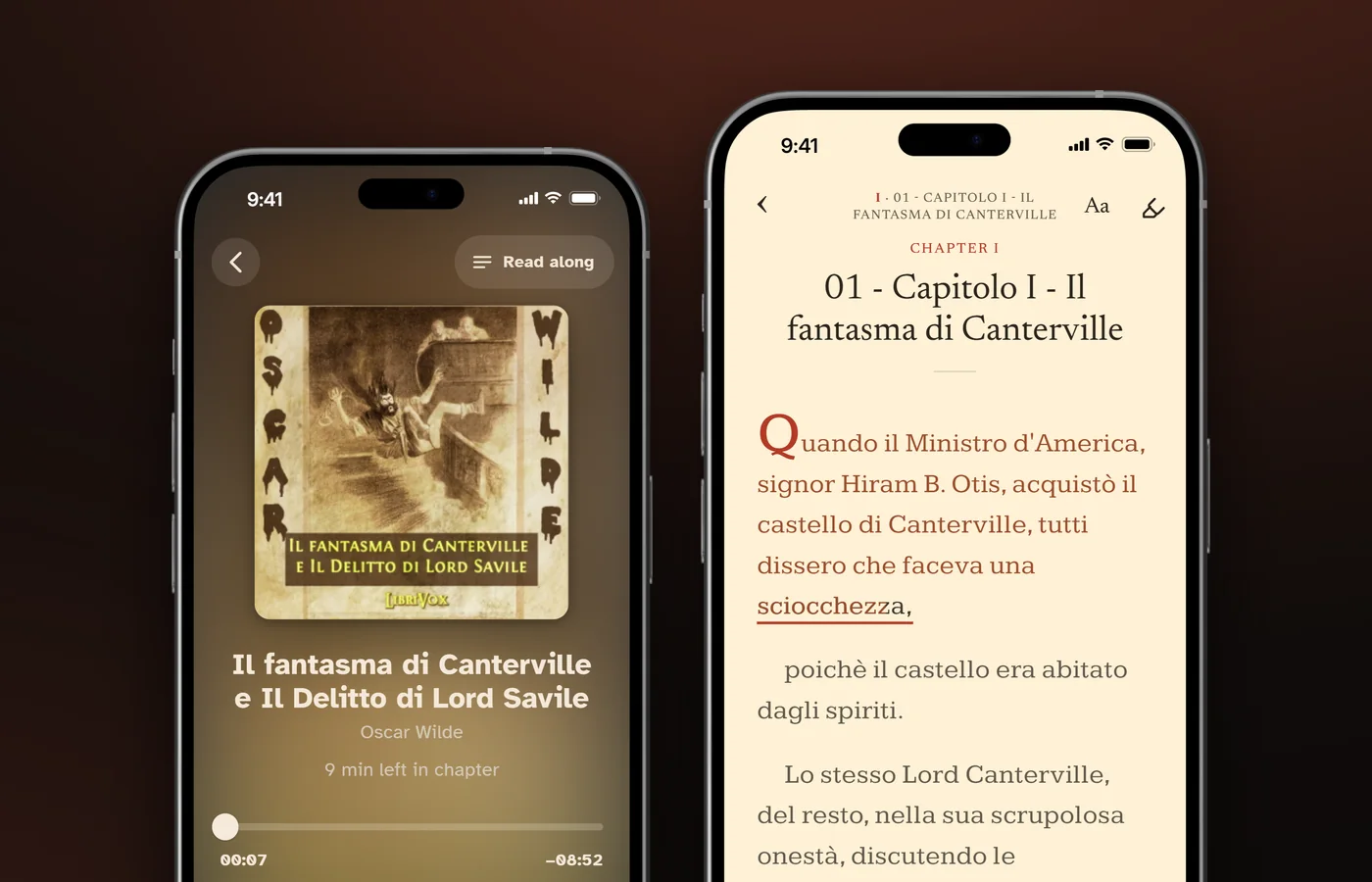
HushBook, the app we built, plays audiobooks on iPhone and Android and shows each word as the narrator reads it. It works with free LibriVox recordings and with DRM-free MP3 or M4B files you own.
- Find the book. In Discover, set the language filter to Italian and search by title: pinocchio, favole, cuore or gian burrasca. Match the card to the ladder by title and length: Le avventure di Pinocchio runs 4 h 47 min, and Favole di Jean de La Fontaine, libro 1 runs 40 min. For Alice, search Carroll or meraviglie. Or import a DRM-free Italian MP3 or M4B you own.
- Leave the Universal engine on. It is the default, it handles Italian, and it works out the language for itself.
- Start the transcript. Transcription runs on your phone, with no account and no upload.
- Read along. The words fill in as the narrator speaks, with a red underline on the current one. A long press on any line starts playback there.
- Slow down when the consonants blur. Speed goes from 0.5x up to 3x, in steps of 0.05x.
- Keep the words you missed. Mark a line, then choose Highlight, Note or Quote, and it waits for you in Quotes & notes.
Palla or pala: with the text in view, you no longer have to guess.
Catch every double consonant on screen
HushBook transcribes Italian audiobooks on your phone and underlines each word as the narrator reaches it, so palla never passes for pala. Search Discover for Pinocchio or La Fontaine's fables, or import a DRM-free MP3 you own, and long-press any line to hear it again. Free, with no account.
Sources
- Aliyar, Siyanova-Chanturia and Skalicky (2026), "Reading versus listening: Which one is more effective for incidental vocabulary learning?", The Modern Language Journal
- U.S. Department of State, "Foreign Language Training"
- De Mauro (2016), "Il Nuovo vocabolario di base della lingua italiana", Internazionale
- van Zeeland and Schmitt (2013), "Lexical Coverage in L1 and L2 Listening Comprehension: The Same or Different from Reading Comprehension?", Applied Linguistics
- Lightbown, Halter, White and Horst (2002), "Comprehension-Based Learning: The Limits of 'Do It Yourself'", The Canadian Modern Language Review
- Aliyar and Peters (2022), "Incidental acquisition of Italian words from comic books", Reading in a Foreign Language
- Peterson (2025), "Exploring general language ability development through monitored extensive reading, extensive listening, and audio-assisted extensive reading", Foreign Language Annals
- Zhang and Peng (2024), "Multimodal reading in reading-only versus reading-while-listening modes: evidence from Chinese language learners", Chinese as a Second Language Research
- Montero Perez, Peters, Clarebout and Desmet (2014), "Effects of captioning on video comprehension and incidental vocabulary learning", Language Learning & Technology
- Pellegrino, Coupé and Marsico (2011), "A cross-language perspective on speech information rate", Language
- Altmann, Berger and Braun (2012), "Asymmetries in the perception of non-native consonantal and vocalic length contrasts", Second Language Research
- De Iacovo, Dian and Hajek (2025), "The perception of gemination in Italian by first-language speakers in Italy and heritage and second-language speakers in Australia", Phonetica
- Pickett, Blumstein and Burton (1999), "Effects of Speaking Rate on the Singleton/Geminate Consonant Contrast in Italian", Phonetica
- Seymour, Aro and Erskine (2003), "Foundation literacy acquisition in European orthographies", British Journal of Psychology
- Jensen and Vinther (2003), "Exact Repetition as Input Enhancement in Second Language Acquisition", Language Learning
- LibriVox, "About LibriVox"
- Maraschio and Biffi (2011), "Italiano 2011", Accademia della Crusca
- Istat (2026), "L'uso della lingua italiana, dei dialetti e delle lingue straniere – Anno 2024"
- Liber Liber, "Libro parlato (audiolibri) – Liber Liber"
- Liber Liber, "Licenze audiolibri – Liber Liber"
- Liber Liber, "Scarica audiolibri (tutti) – Liber Liber"
- Liber Liber, "Pinocchio (audiolibro) – Liber Liber"
- RaiPlay Sound, "Ad alta voce | Rai Radio 3 | RaiPlay Sound"
- Rai, "Faq RaiPlaySound"
- Libby Help, "Can I transfer audiobooks to an MP3 player with Libby?"
- LibbyLife, "Search like a pro: Expert tips for finding your next read in the Libby app"
- Audible, "Short Stories in Italian for Beginners Audiobook by Olly Richards"
- Hachette UK, "Short Stories in Italian for Beginners by Olly Richards"
- Audible, "Italian Short Stories for Beginners: 20 Captivating Short Stories to Learn Italian & Grow Your Vocabulary the Fun Way! Audiobook by Lingo Mastery"
- Project Gutenberg, "Le avventure di Pinocchio: Storia di un burattino" (eBook #52484)
- Project Gutenberg, "La contessa di Karolystria: Storia tragicomica" (eBook #17849)
- Project Gutenberg, "Le avventure d'Alice nel paese delle meraviglie" (eBook #28371)
- Project Gutenberg, "Ricordi di Londra" (eBook #27640)
- Project Gutenberg, "Il fantasma di Canterville e il delitto di Lord Savile" (eBook #60586)
- Audible.it, "Leggi e Ascolta su Audible | Segui il Testo con Narrazione Sincronizzata"
- Audible, "Read & Listen on Audible | Read Along with Synced Narration"
- Reynolds, Cui, Kao and Thomas (2022), "Vocabulary Acquisition through Viewing Captioned and Subtitled Video: A Scoping Review and Meta-Analysis", Systems
- Spotify, "Audiolibri su Spotify | Trova il prossimo audiolibro che adorerai - Spotify (IT)"
- Spotify, "Spotify Premium (Italia) - Prova 3 mesi a 0 €"
- Spotify Newsroom (2026), "Audiobooks on Spotify Are Going Global"
- Spotify, "Sblocca audiolibri - Spotify"
- Audible.it, "Audible | Ascolta Audiolibri, Podcasts e Originali"
- Storytel, "Storytel - Audiolibri & Ebook per tutti"
- App Store, "App Storytel - audiolibri e libri - App Store"
- Audible, "Learn Italian with Paul Noble for Beginners – Complete Course Audiobook by Paul Noble"
- Audible, "Pimsleur Italian Level 1 Lessons 1-5 Audiobook by Pimsleur"
- Hui and Godfroid (2025), "Listening, Reading, or Both? Rethinking the Comprehension Benefits of Reading-While-Listening", Language Learning
Frequently asked questions
Can you learn Italian just by listening to audiobooks?
Partly. Audiobooks build listening and vocabulary: in a 2026 study, advanced learners picked up about twice as many new words from an audiobook as from the printed novel. Speaking and writing need practice of their own.
What is the best Italian audiobook for beginners?
A graded reader first, such as Olly Richards's Short Stories in Italian for Beginners. Among free recordings, start with La Fontaine's fables on LibriVox, 40 min for book 1, then Pinocchio at 4 h 47 min.
Are there Italian audiobooks with subtitles or text?
Not from the big stores. Audible's Read & Listen covers only English and German titles, and Spotify shows no text. HushBook transcribes Italian audiobooks on your phone and underlines each word as the narrator says it.
Is Learn Italian with Paul Noble an audiobook or a course?
A course. It is taught in English, with a booklet, and runs 13 hours; it cost $28.97 on audible.com on November 20, 2026. It does not give you an Italian book to follow.
Is Pinocchio a good first Italian audiobook?
Yes, after a few fables. LibriVox's free recording runs 4 h 47 min in 36 short chapters with one reader, and it is the most downloaded Italian LibriVox book. Collodi wrote it for children in 1883.
Why are double consonants in Italian hard to hear?
Because only length separates them: pala is a shovel, palla a ball. In a 2012 study, advanced learners heard consonant length less reliably than Italians, and fast speech shrinks it further. Print always writes it double.