

Key takeaways
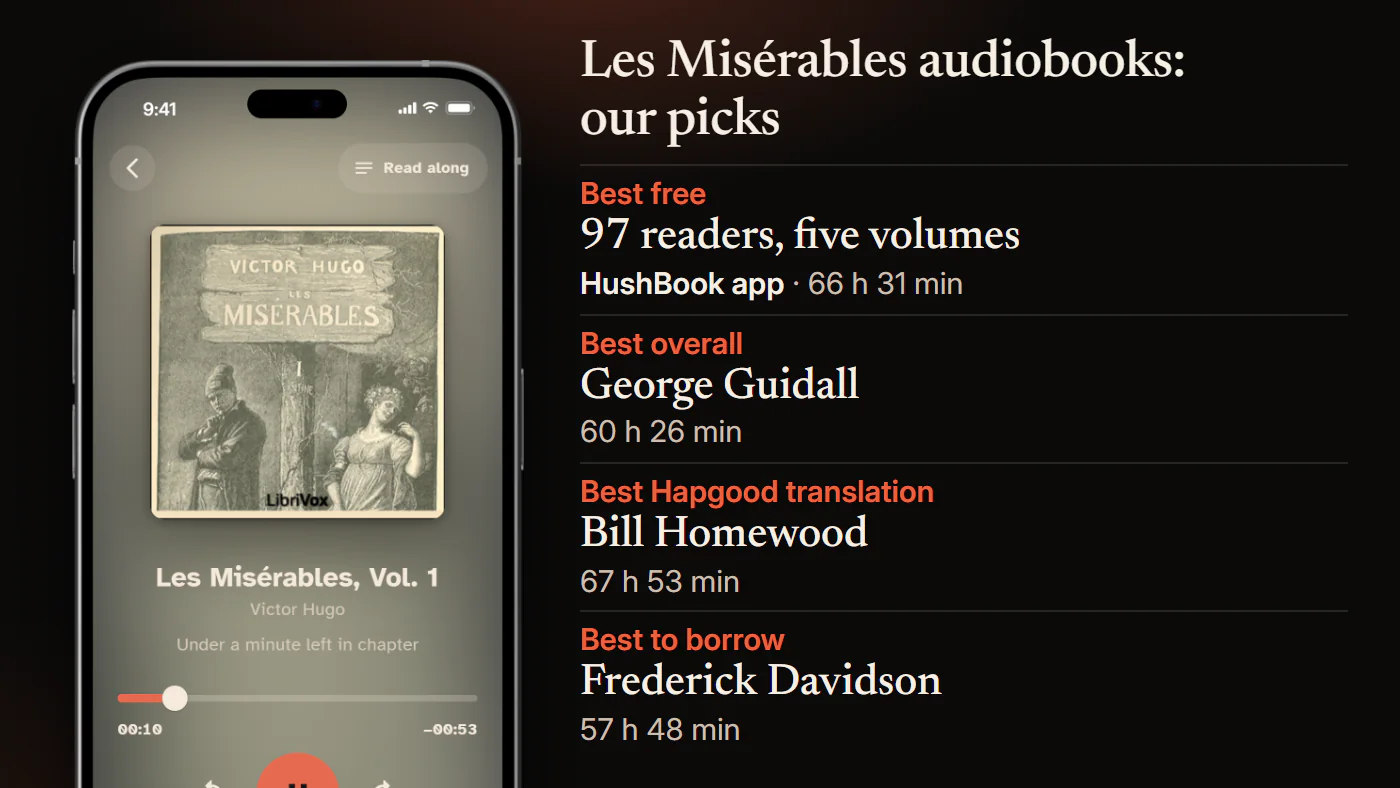
- The best free Les Misérables audiobook is LibriVox's complete recording of Isabel Hapgood's translation, five volumes and 97 volunteer readers, 66 hours 31 minutes, free in the HushBook app.
- George Guidall's 2011 Recorded Books recording of Julie Rose's translation, 60 hours 26 minutes, is our best overall pick, with 4.6 stars from 3,680 Audible US ratings, the most of any edition.
- Bill Homewood's Naxos recording, 67 hours 53 minutes, is the pick for Hapgood's translation, and Frederick Davidson's 57 hour 48 minute reading of Charles Wilbour's translation is the one to borrow.
- Hapgood's translation has 557,137 words in 365 chapters by our count: 61 hours 30 minutes at 1x, 49 hours 12 minutes at 1.25x and 41 hours at 1.5x.
- Hugo's four famous digressions, on Waterloo, the convent, argot and the sewers, are 56,130 words by our count, 10.1% of the novel, about 6 hours 12 minutes at 1x.
The best Les Misérables audiobook is George Guidall's Recorded Books recording of Julie Rose's translation, 60 hours 26 minutes long. It has 4.6 stars from 3,680 Audible US ratings as of November 15, 2026, the most of any edition. The best free one is LibriVox's complete recording in five volumes, read by 97 volunteers, 66 hours 31 minutes in all. Bill Homewood's Naxos recording (67 hours 53 minutes) is the pick for Isabel Hapgood's translation, and Frederick Davidson's (57 hours 48 minutes) is the best to borrow.
Les Misérables is Victor Hugo's novel of 1862: five volumes, 48 books and 365 chapters. It has seven English translations, four of them on complete audiobooks, and six of the nine complete recordings on Audible US read Hapgood's. Below: every complete recording with the translation it reads, checked against its Audible sample, the matching print editions, the length at each speed, Hugo's digressions measured and located in the free recording, the abridged versions that look complete, and a spoiler-free list of names. Every edition fact was read from the publisher's or store's own page on November 15, 2026.
Which Les Misérables audiobook is best?
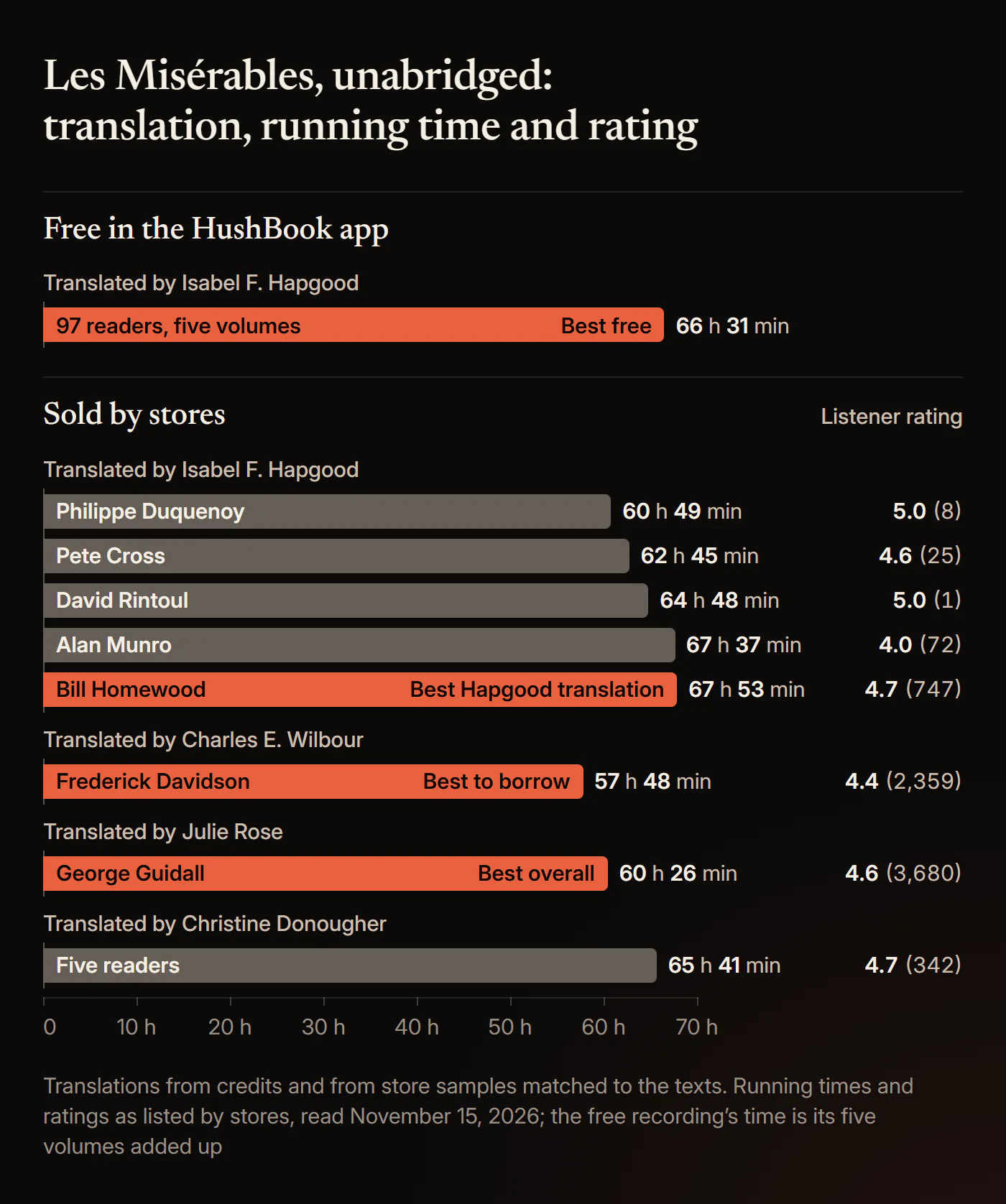
LibriVox's five volumes for free, George Guidall for most listeners, Bill Homewood for Hapgood's translation, and Frederick Davidson to borrow from a library.
Best free: LibriVox, five volumes (97 readers)
LibriVox's complete recording comes in five volumes, one per part of the novel, read by 97 volunteers between 2008 and 2010: 66:31:18 in all. It reads Isabel Hapgood's 1887 translation, the text of Project Gutenberg eBook #135, and it is free and in the public domain. It is free in the HushBook app too: in Discover, search Les Misérables and download the five cards "Les Misérables, Vol. 1" to "Les Misérables, Vol. 5", 1.8 GB in all.
It is a group reading, so the voice changes from chapter to chapter and the readers vary. Each volume has a few readers who carry more of it: Ruth Golding reads 25 of Volume 2's 76 files, and Bruce Pirie, whose solo Brothers Karamazov is the free pick in our guide to that book, reads 18 of Volume 3's 48. LibriVox has no other complete English recording of the novel. How the five volumes compare, with the reviews on each, is in the free section below.
Best overall: George Guidall (Recorded Books, 2011)
George Guidall's Recorded Books recording runs 60 hours 26 minutes. It has 4.6 stars from 3,680 ratings on Audible US, with 4.8 for performance, as of November 15, 2026: the most of any Les Misérables audiobook, ahead of Frederick Davidson's 2,359 and five times Bill Homewood's 747.
It reads Julie Rose's 2008 translation. Audible titles it "Les Misérables: Translated by Julie Rose" and prints "©2008 Random House (P)2011 Recorded Books, LLC", and the sample opens with the spoken credit "translated from the French by Julie Rose". Its text matched 43.3% of the six-word runs in a short publisher excerpt of Rose's translation, which covers only part of the first chapter, against 0.3% for Hapgood's. One translation guide pairs this recording with the Fahnestock and MacAfee translation; the credits and the sample say Rose.
Kirkus Reviews, in a review posted January 22, 2026, wrote that "his accurate pronunciation of French words is a pleasure" and called Rose's "highly accessible translation". A top Audible review says "His French pronunciation is superb." On Reddit his recording has been the usual answer from 2017 to 2026, though a few listeners cannot take his voice for 60 hours. Guidall received the Audio Publishers Association's 2014 Special Achievement Award for his career, not for this book.
Buy it on Audible US or borrow it. It is not on Audible UK or Australia, and Apple Books sells a 13 hour 10 minute listing titled "Les Miserables", read by Guidall, with the same description. A 2023 review there warns: "this is only a portion (probably half or slightly more) of the story." On Libby the New York Public Library had 4 copies with 2 holds, and hoopla carries it at 60 hours 28 minutes. It listed at $27.54 on Audible US.
Best Hapgood translation: Bill Homewood (Naxos AudioBooks, 2015)
Bill Homewood's Naxos recording reads Isabel Hapgood's translation, the text of Project Gutenberg eBook #135 and of the free LibriVox recording, so you can switch between them and hear the same words. Audible's summary ends "Translated by Isabel F. Hapgood", and its sample matched Hapgood's text on 63.8% of its six-word runs. At 67 hours 53 minutes it is the longest complete recording.
It has 4.7 stars from 747 ratings on Audible US, with 4.8 for performance, tied with the Penguin recording for the highest score of any complete recording with more than 100 ratings. On Audible UK it has 4.6 from 476, and it is the pick there, because Guidall's recording is not on Audible UK. One Audible reviewer wrote: "Even the four chapters on the history of the sewers of Paris was made interesting by Mr Homewood." A 2021 r/audiobooks reply said "He has good enunciation, modulation, and voice distinctness."
Naxos also sells a 5 hour 5 minute abridgement read by Homewood, so check the runtime. The complete one listed at $28.31 on Audible US.
Best to borrow: Frederick Davidson (Blackstone, 1996)
Frederick Davidson reads Charles Wilbour's 1862 translation, the one Everyman's Library prints, in 57 hours 48 minutes, the shortest complete recording. OverDrive credits Wilbour, though Audible names no translator. The sample opens on the last words of Wilbour's preface, "books like this cannot be useless", then his title for Book First, "An Upright Man", where Hapgood has "A Just Man".
It is the easiest to borrow. On Libby on November 15, 2026, the Chicago Public Library had 8 copies with 4 available, the San Francisco Public Library 5 with 3 available and the New York Public Library 6, and hoopla carries it. It has 4.4 stars from 2,359 Audible US ratings and 3.9 from 297 on Audible UK. Reviews split on the sound more than the voice: "The narrator is, I think, quite good, but the audio recording is terrible," one says. To buy, Davidson's recording on Audible listed at $27.30. Blackstone also sells his 12 hour 4 minute abridgement.
Also worth knowing. The Penguin Classics recording is the pick for Christine Donougher's 2013 translation, the one the Hugo scholar Marva Barnett ranks first. Five actors share the unabridged reading: Adeel Akhtar, Natalie Simpson, Adrian Scarborough, Emma Fielding and John Owen-Jones, who, Penguin says, has played Jean Valjean in the stage musical on Broadway and in the West End. Penguin also lists Les Miserables among the credits of Akhtar, Simpson and Fielding. It runs 65 hours 41 minutes with Robert Tombs's introduction, has 4.7 stars from 342 Audible US ratings with 4.8 for performance, and listed at $19.32, or $12.99 on Apple Books. In 2026 Reddit threads it is the alternative listeners name to Guidall: "They each read one big chunk of the book and gave it their personal flair."
Every unabridged recording compared
Our table has all nine complete single-title recordings on Audible US and the free LibriVox set. Ratings are Audible US stars with the number of ratings in brackets, as of November 15, 2026.
| Narrator | Translation | Runtime | Publisher | Year | Audible US rating | Where we found it |
|---|---|---|---|---|---|---|
| LibriVox volunteers, five volumes | Isabel Hapgood | 66 h 31 min | LibriVox | 2008 to 2010 | Free | LibriVox, Internet Archive, HushBook Discover |
| George Guidall | Julie Rose | 60 h 26 min | Recorded Books | 2011 | 4.6 (3,680) | Audible US, Libby, hoopla |
| Bill Homewood | Isabel Hapgood | 67 h 53 min | Naxos AudioBooks | 2015 | 4.7 (747) | Audible, Apple Books, Libby |
| Frederick Davidson | Charles Wilbour | 57 h 48 min | Blackstone | 1996 | 4.4 (2,359) | Audible, Apple Books, Libby, hoopla |
| Adeel Akhtar, Natalie Simpson, Adrian Scarborough, Emma Fielding, John Owen-Jones | Christine Donougher | 65 h 41 min | Penguin Classics | 2020 | 4.7 (342) | Audible, Apple Books, Libby |
| Pete Cross | Isabel Hapgood | 62 h 45 min | Dreamscape Media | 2018 | 4.6 (25) | Audible, Apple Books, hoopla |
| Alan Munro | Isabel Hapgood | 67 h 37 min | Trout Lake Media | 2015 | 4.0 (72) | Audible, Apple Books |
| Philippe Duquenoy | Isabel Hapgood | 60 h 49 min | Goffin Media | 2022 | 5.0 (8) | Audible, Apple Books |
| David Rintoul | Isabel Hapgood | 64 h 48 min | SNR Audio | 2026 | 5.0 (1) | Audible, Apple Books |
| Peter Silverleaf | Isabel Hapgood | 58 h 25 min | Bookstream Audiobooks | 2023 | 1.0 (1) | Audible, Apple Books |
Runtimes are Audible's for the paid editions and LibriVox's for the free one. Years follow each recording's copyright line: Davidson's is "(P)1996", though Audible lists it from 2003. Libby holdings are from the New York, Los Angeles, San Francisco and Chicago public libraries and the King County Library System.
Listings we left out. Smaller Apple Books recordings whose translation we did not test, among them Charles Farrow's, single volumes sold apart, collections that bundle David Rintoul's recording with other novels, and machine-voiced or "adapted" listings.
Which translation does each Les Misérables audiobook use?
Isabel Hapgood's 1887 translation, on six of the nine complete recordings on Audible US and on the free LibriVox set; George Guidall reads Julie Rose's, the Penguin ensemble Christine Donougher's and Frederick Davidson Charles Wilbour's.
How we know. Several store pages name no translator, so we checked by ear. We transcribed the first 180 seconds of 14 Audible samples with speech recognition and compared each, six words at a time, with Hapgood's text (Project Gutenberg eBook #135), Wilbour's (two scanned editions on the Internet Archive), Lascelles Wraxall's (Gutenberg eBooks #48731 to #48735) and a publisher's excerpt of Rose's. The six Hapgood recordings matched her text on 64 to 89% of their six-word runs. Davidson's matched Wilbour on 62.3%. The Penguin sample matched none of the public-domain texts above 13%, which fits its credit to Donougher; we found no excerpt of her text to test.
| Translation | In print | Unabridged audiobook |
|---|---|---|
| Charles E. Wilbour, 1862 | Complete | Frederick Davidson (Blackstone) |
| Lascelles Wraxall, 1862 | Cut in nine places, including the Preface | None found |
| Isabel F. Hapgood, 1887 | Every book; prints Cambronne's famous word as a dash | Homewood, Pete Cross, Munro, Rintoul, Duquenoy, Silverleaf; the free LibriVox set |
| Norman Denny, 1976 | Moves the convent and argot books to appendices | None found |
| Lee Fahnestock and Norman MacAfee, 1987 | Complete; a revision of Wilbour | None found; abridged only, Mark McKerracher, 5 h 44 min |
| Julie Rose, 2008 | Complete | George Guidall (Recorded Books) |
| Christine Donougher, 2013, first titled The Wretched | Complete | Penguin Classics ensemble (2020) |
"None found" means we searched Audible's US, UK, Canadian and Australian catalogues, Apple Books, Libby at five library systems and hoopla on November 15, 2026, and found no recording. An r/audiobooks thread asked for a Fahnestock and MacAfee audiobook too.
What critics say about the translations you can hear:
- Christine Donougher (2013). Marva Barnett, Professor Emerita at the University of Virginia, ranks "first Donougher's, then either Rose's or Fahnestock and MacAfee's, then Denny's, and, finally, Wilbour's", and finds Donougher's "engaging, modern, and accurate". Penguin says David Bellos recommends it in The Novel of the Century. It won the 2016 French-American Foundation Translation Prize in fiction.
- Julie Rose (2008). Barnett calls it "a very lively translation, one that some readers at times find slangy". Jeanette Winterson, quoted by the publisher from The Times: "This is the one to read".
- Isabel Hapgood (1887). Barnett finds it "Very dated in its style" but adds: "Many readers enjoy Hapgood's translation."
- Charles Wilbour (1862). Barnett calls it "generally considered quite faithful to Hugo's original but sounding dated in ways that Hugo's novel does not."
Which audiobook matches your print edition?
Match the translator, not the cover: Penguin Classics is Donougher and the Penguin ensemble, Modern Library and Vintage are Rose and George Guidall, Everyman's Library and Wordsworth are Wilbour and Frederick Davidson, and any Hapgood edition matches Bill Homewood or the free recording.
- Penguin Classics, Penguin Classics Deluxe, the 2018 BBC Books tie-in: Donougher, so the Penguin ensemble.
- Modern Library (US), Vintage Classics (UK): Rose, so George Guidall.
- Everyman's Library, Wordsworth Classics, the 1931 Modern Library edition: Wilbour, so Frederick Davidson.
- Project Gutenberg, Standard Ebooks, Dover's 2018 reprint of the 1887 Crowell edition: Hapgood, so Homewood, Pete Cross, Munro, Rintoul, Duquenoy, Silverleaf or the free LibriVox volumes.
- Signet Classics: Fahnestock and MacAfee. No complete recording; Davidson reads the Wilbour text they revised, so expect differences in wording.
- Penguin Clothbound Classics and older Penguin Classics paperbacks: Denny. No matching audiobook found.
- Barnes & Noble Classics: an abridged Wilbour. No matching audiobook found.
Hear the difference
Hugo's short preface ends on one long clause, and the recordings that include it read it first. Here is its end in the three translations we could compare:
| Translation (narrators) | The end of Hugo's preface |
|---|---|
| Hapgood (the free LibriVox set) | "so long as ignorance and poverty exist on earth, books of the nature of Les Misérables cannot fail to be of use." |
| Wilbour (Davidson) | "so long as ignorance and misery remain on earth, books like this cannot be useless." |
| Rose (Guidall, as transcribed from his sample) | "as long as ignorance and misery exist in this world, books like the one you are about to read are perhaps not entirely useless." |
The first book's title tells them apart too: "A Just Man" in Hapgood and Rose, "An Upright Man" in Wilbour.
How long is the Les Misérables audiobook?
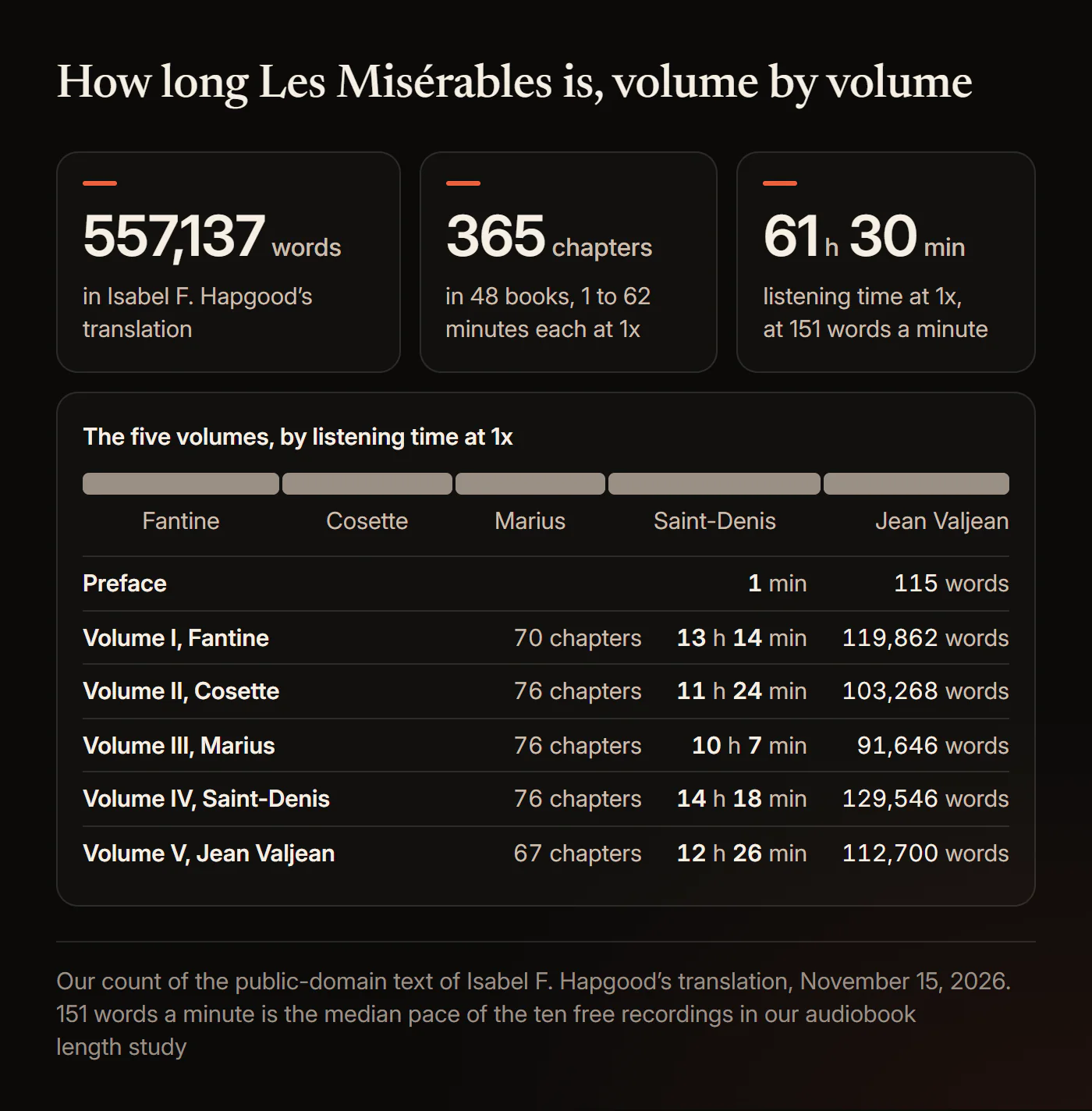
About 61 hours 30 minutes at 1x: Hapgood's translation has 557,137 words by our count, and complete recordings run from 57 hours 48 minutes to 67 hours 53 minutes.
We counted the words ourselves. Project Gutenberg eBook #135, Hapgood's translation, downloaded on November 15, 2026, has 557,137 words in the preface and chapters, without headings or captions. A second count from Gutenberg's HTML edition, with a different parser, gave 557,122, so call it about 557,000. Other translations differ in length. We used 151 words a minute, the median pace we measured for LibriVox solo readers in our guide to how long audiobooks run. The recordings at speed are each runtime divided by the speed.
| Speed | The novel at 151 words a minute | LibriVox (free) | George Guidall | Bill Homewood | Frederick Davidson |
|---|---|---|---|---|---|
| 1x | 61 h 30 min | 66 h 31 min | 60 h 26 min | 67 h 53 min | 57 h 48 min |
| 1.25x | 49 h 12 min | 53 h 13 min | 48 h 21 min | 54 h 18 min | 46 h 14 min |
| 1.5x | 41 h 0 min | 44 h 21 min | 40 h 17 min | 45 h 15 min | 38 h 32 min |
| 2x | 30 h 45 min | 33 h 16 min | 30 h 13 min | 33 h 56 min | 28 h 54 min |
The real range. Complete recordings on Audible run from 57 hours 48 minutes (Frederick Davidson) to 67 hours 53 minutes (Bill Homewood). Across the seven Hapgood recordings, the free set included, narrators read at 137 to 159 words a minute, median 143. A figure of 13.8 hours that circulates online is about one volume: the free Volume 1 alone runs 13 hours 46 minutes. Read silently at 260 words a minute, Hapgood's text takes about 35 hours 43 minutes.
Days to finish, our calculation at 151 words a minute, rounded up to whole days:
| Speed | 30 min a day | 60 min a day |
|---|---|---|
| 1x | 123 days | 62 days |
| 1.25x | 99 days | 50 days |
| 1.5x | 82 days | 41 days |
| 2x | 62 days | 31 days |
How long is each volume?
Between 10 hours 7 minutes (Volume III, Marius) and 14 hours 18 minutes (Volume IV, Saint-Denis) at 151 words a minute.
| Volume | Books | Chapters | Words (our count) | At 1x | Free LibriVox volume |
|---|---|---|---|---|---|
| I, Fantine | 8 | 70 | 119,862 | 13 h 14 min | 13 h 46 min |
| II, Cosette | 8 | 76 | 103,268 | 11 h 24 min | 12 h 55 min |
| III, Marius | 8 | 76 | 91,646 | 10 h 7 min | 10 h 59 min |
| IV, Saint-Denis | 15 | 76 | 129,546 | 14 h 18 min | 15 h 36 min |
| V, Jean Valjean | 9 | 67 | 112,700 | 12 h 26 min | 13 h 15 min |
Hapgood gives Volume IV the full title "The Idyl in the Rue Plumet and the Epic in the Rue Saint-Denis". The chapters are short: by our count the median is 1,229 words, about 8 minutes at 1x, and 238 of the 365 take under 10 minutes; one, in Volume III, takes about an hour. The shortest, Volume II, Book Seventh, Chapter I, "The Convent as an Abstract Idea", has 178 words, about a minute. "The chapters move at a lick. And they are artfully short," Miranda Seymour wrote in The Observer in 2017.
Is Les Misérables longer than War and Peace?
No, almost exactly as long: Les Misérables is 0.99 times the length of War and Peace, 557,137 words in Hapgood's translation against 561,870 in the Maude translation, and both have 365 chapters.
The difference is 4,733 words, about 31 minutes at 151 words a minute. Our War and Peace audiobook comparison counts 206 of its 365 chapters under 10 minutes, against 238 here. Les Misérables is 1.59 times as long as The Brothers Karamazov (349,788 words in Garnett's translation), counted with the same rules.
Which chapters of Les Misérables can you skip?
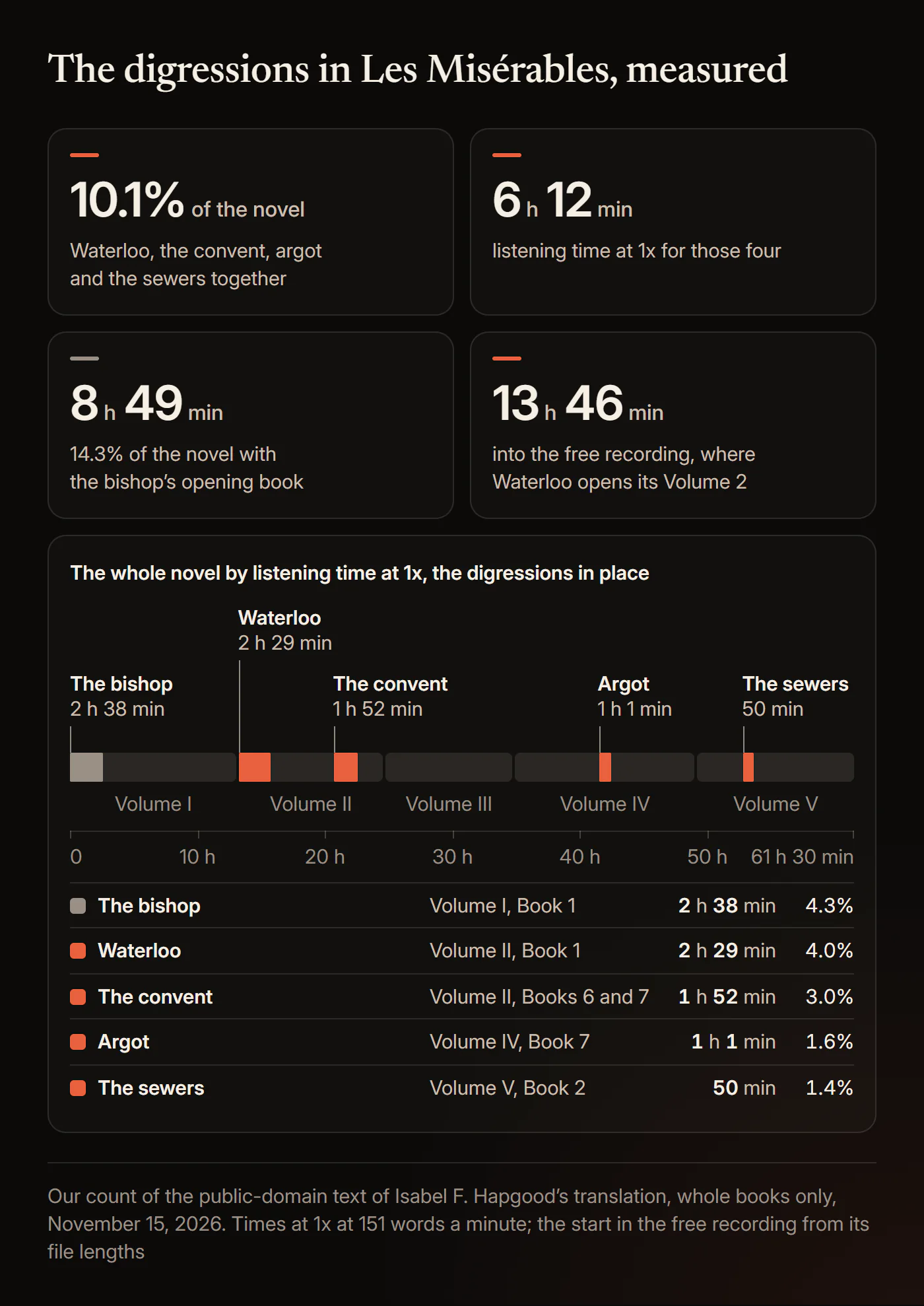
Hugo's four famous digressions, on Waterloo, a convent, thieves' slang and the Paris sewers, are whole books you can skim: 56,130 words by our count, 10.1% of the novel, about 6 hours 12 minutes at 1x.
With the bishop's opening book, which some readers count as one more, the total is 79,923 words, 14.3%, about 8 hours 49 minutes. We measured each as whole books of Hapgood's text in Project Gutenberg eBook #135. Minutes and starting points are at 151 words a minute; the last column is where each starts inside that LibriVox volume, from the Internet Archive's file lengths.
| Digression | Where (Hapgood's titles) | Words | At 1x | Share | Starts | In the free recording |
|---|---|---|---|---|---|---|
| The bishop | Volume I, Book First, "A Just Man", 14 chapters | 23,793 | 2 h 38 min | 4.3% | At the start | "Vol. 1", 0:01:03 |
| Waterloo | Volume II, Book First, "Waterloo", 19 chapters | 22,469 | 2 h 29 min | 4.0% | 21.5%, 13 h 15 min in | "Vol. 2", 0:00:00 |
| The convent | Volume II, Books Sixth and Seventh, "Le Petit-Picpus" and "Parenthesis", 19 chapters | 16,927 | 1 h 52 min | 3.0% | 33.8%, 20 h 47 min in | "Vol. 2", 8:23:13 |
| Argot | Volume IV, Book Seventh, "Slang", 4 chapters | 9,183 | 1 h 1 min | 1.6% | 67.4%, 41 h 26 min in | "Vol. 4", 7:04:52 |
| The sewers | Volume V, Book Second, "The Intestine of the Leviathan", 6 chapters | 7,551 | 50 min | 1.4% | 85.7%, 52 h 42 min in | "Vol. 5", 3:59:54 |
Wikipedia's "more than a quarter of the novel, by one count" counts every essay passage, not whole books, so both figures can be true.
What each carries for the story, without spoilers:
- The bishop. It introduces Monseigneur Myriel, the Bishop of Digne, the man Jean Valjean meets in Book Second, which begins 4.3% in. "I don't think the bishop's story is a digression because it's part of the narrative. It's more like a prologue," a 2026 r/lesmiserables reply said.
- Waterloo. Chapters 1 to 18 are the battle, 20,082 words, about 2 hours 13 minutes. The last chapter, XIX, "The Battle-Field at Night" (2,387 words, 16 minutes), carries a scene that matters later. Marva Barnett's advice for anyone bogged down is to skip to it.
- The convent. Book Sixth describes the convent where the story continues in Book Eighth. Book Seventh is Hugo's essay on convents, 32 minutes, and he opens it: "This book is a drama, whose leading personage is the Infinite."
- Argot. No scene happens in it. It explains the thieves' slang that criminals speak in the chapters around it, and the story resumes in Book Eighth.
- The sewers. It maps the sewers of Paris, which the story enters in the next book.
Listeners split. On Reddit the convent is the digression most often named as the one to skip ("The Petit Picpus is my least favorite digression. Just power through."), Waterloo the one to skim if you hear its end ("If you decide to skip Waterloo, do read the last 3-4 pages."), and the sewers the most defended ("I'm getting so tired of the slander against the Parisian sewers section"). Argot draws the harshest words: "absolutely terrible, at least for a non-French speaker," a 2025 r/books reply said. On audio the problem is different: "there isn't really a true equivalent to skimming pages when listening to audio books," a 2019 r/lesmiserables reply put it.
So the honest answer: you can skim the convent, argot and most of Waterloo and keep the thread, but hear Waterloo's last chapter, and know that the sewer book maps the place the next book happens in. Skimming by ear is the hard part. Seeing each word as the narrator reads it lets you find your place again after two hours of battle, and that is why we built HushBook: in the free "Vol. 2" there, Waterloo's last chapter carries "Bk 01 Ch 19: The Battle-Field at Night" in its title.
How long is the Waterloo section?
About 2 hours 29 minutes at 1x: Volume II, Book First has 19 chapters and 22,469 words by our count, 4.0% of the novel.
It starts 21.5% of the way in, about 13 hours 15 minutes into the book at 151 words a minute, and opens the second volume: in the free LibriVox "Vol. 2" it is the first 2 hours 51 minutes 53 seconds, files 1 to 19, starting 13 hours 46 minutes into the whole free set. Its last chapter is file 19, starting 2:36:13 into that volume and running 15 minutes 40 seconds. A 2021 r/books reply: "after about 2 hours (audiobook) of the Waterloo tactical discussion, I was still wondering where on earth he was going with it."
Is there a free Les Misérables audiobook?
Yes: LibriVox has one complete free English recording, Isabel Hapgood's translation in five volumes read by 97 volunteers, 66 hours 31 minutes in all.
All five volumes read the text of Project Gutenberg eBook #135, which is free too. 557,137 words in 66 hours 31 minutes is 140 words a minute by our calculation; at one hour a day the set takes 67 days at 1x, 54 at 1.25x, 45 at 1.5x and 34 at 2x. Our guide to whether LibriVox is free and legal explains why these recordings cost nothing.
Which LibriVox volumes make up the whole book?
All five, Vol. 1 to Vol. 5, one per part of the novel, each its own download.
| Volume | Title in apps and on the Internet Archive | Runtime | Files | Readers (most sections) | Internet Archive downloads | Reviews on its page |
|---|---|---|---|---|---|---|
| I, Fantine | Les Misérables, Vol. 1 | 13:45:58 | 71 | 30 (Melissa, 12) | 2,391,342 | 5, average 2.2 stars |
| II, Cosette | Les Misérables, Vol. 2 | 12:54:44 | 76 | 27 (Ruth Golding, 25) | 526,078 | None |
| III, Marius | Les Misérables, Vol. 3 | 10:59:19 | 48 | 17 (Bruce Pirie, 18) | 340,383 | 1, five stars |
| IV, Saint-Denis | Les Misérables, Vol. 4 | 15:35:58 | 49 | 18 (May Low, 7) | 200,780 | 1, five stars |
| V, Jean Valjean | Les Misérables, Vol. 5 | 13:15:19 | 42 | 16 (Joyce Martin, 8) | 159,307 | None |
Running times come from the LibriVox API; readers from LibriVox's section credits, 97 different names across the five; downloads and reviews from the Internet Archive on November 15, 2026. The 286 files make 1.8 GB as 64 kbps MP3s. Volume 1's five reviews, from 2008 to 2021, average 2.2 stars. Volume 3's one review, from 2018, says "Robert Keiper is terrific", and Volume 4's, from 2014, says "May Low is one of my favorite readers". The five volumes were catalogued from October 28, 2008 to November 1, 2010.
Is the YouTube Les Misérables audiobook free?
Uploads are free to play, but we did not check which recording each one plays or who holds the rights; LibriVox's five volumes are the free route with named readers.
LibriVox recordings are in the public domain, so anyone may re-upload them.
Is there a Les Misérables audiobook in French?
Yes: LibriVox has all five tomes of the original French free, 62 hours 48 minutes in all, and Editions Theleme sells a complete reading by five actors, 56 hours 52 minutes.
Didier reads tome 1 alone (14:09:07) and Gilles G. Le Blanc tome 5 (12:25:11); tomes 2 to 4 are group readings. Tome 1's one review on the Internet Archive, from 2016, says "The audio is clearly spoken and follows the text accurately." Au Fil des Lectures has a second free French reading by "Pomme", about 67 hours of MP3s. Theleme's "Les misérables, L'intégrale" has 4.8 stars from 167 Audible US ratings, and the Los Angeles Public Library had 83 copies on Libby, 82 of them available. For listening in French more generally, see our guide to learning French with audiobooks.
Which Les Misérables audiobooks are abridged?
Many, and some are long enough to pass for complete: Pete Cross's abridged recording runs 43 hours 23 minutes, while every complete recording runs at least 57 hours 48 minutes.
| Version | Publisher, year | Runtime | What it is |
|---|---|---|---|
| Pete Cross, "Les Misérables (ABR)" | Dreamscape Media, 2018 | 43 h 23 min | Abridged |
| Walter Covell | Jimcin Recordings, on Audible since 2004 | 33 h 13 min | Abridged |
| George Guidall on Apple Books | Recorded Books, 2011 | 13 h 10 min | Part of the recording |
| David Case | Tantor Media, 2007 | 12 h 25 min | Abridged |
| Frederick Davidson | Blackstone, 1995 | 12 h 4 min | Abridged |
| Peter Silverleaf, single volumes | Bookstream Audiobooks, 2023 | 9 h 41 min to 12 h 14 min each | One volume each |
| Mark McKerracher | Penguin Audio, 2009 | 5 h 44 min | Abridged, Fahnestock and MacAfee translation |
| BBC Radio 4, Joss Ackland, Roger Allam, Leslie Phillips | BBC Digital Audio, on Audible since 2015 | 5 h 40 min | Full-cast radio drama |
| Bill Homewood | Naxos AudioBooks, 1996 | 5 h 5 min | Abridged |
| Jim Hodges Productions | Blackstone, 2017 | 3 h 19 min | Radio drama |
| Orson Welles | BN Publishing, on hoopla | 3 h 17 min | Radio drama |
| Christopher Cazenove | Phoenix Books, 1987 | 2 h 47 min | Abridged |
| Real Reads, Rob Penman | Real Reads, 2021 | 42 min | Retelling |
Runtimes are Audible's, Apple's for Guidall's listing and hoopla's for Welles, read November 15, 2026.
Pete Cross's "(ABR)" recording is abridged. At 43 hours 23 minutes it passes for complete, and Dreamscape sells it at the same $29.72 as his 62 hour 45 minute unabridged reading, side by side on Audible, Apple Books and hoopla. A 2019 r/audible reply was "considering the 43hr Pete Cross abridged narration." Walter Covell's 33 hour 13 minute recording is abridged too, though Apple Books lists it as plain "Les Misérables". David Case also read a 17 hour 18 minute abridgement of The Count of Monte Cristo, which our Count of Monte Cristo audiobook comparison flags the same way.
Same narrator, two lengths. Frederick Davidson and Bill Homewood each recorded the novel complete and abridged, and Bookstream sells Peter Silverleaf's 58 hour 25 minute reading whole and as single volumes. A buyer of its Volume 1 gets 12 hours 14 minutes. Check the runtime before you buy. Our guide to abridged and unabridged audiobooks explains how to tell them apart in any store.
Is there a full-cast Les Misérables audiobook?
Only as radio drama: the BBC Radio 4 full-cast dramatisation runs 5 hours 40 minutes, and the Penguin recording is an unabridged reading shared by five actors, not a dramatisation.
The BBC version, with Joss Ackland, Roger Allam and Leslie Phillips, has 4.8 stars from 299 Audible US ratings. A new BBC full-cast pairing of Les Misérables and The Hunchback of Notre Dame is listed for release on February 4, 2027.
How do you keep track of the names in Les Misérables?
Keep one list with each person's other names and the chapter that introduces them, because some main characters arrive more than 25 hours in.
The table gives each name as Hapgood's translation spells it, with our count from Project Gutenberg eBook #135, and the chapter that tells you who the person is. It carries no spoilers: every fact in it is told by the chapter shown, all within the first 45% of the novel.
| Character | Names in Hapgood's translation (our count) | Who | Told in | Say it |
|---|---|---|---|---|
| The bishop | the Bishop 263, Myriel 29, Monseigneur Welcome 11 | "M. Charles-François-Bienvenu Myriel was Bishop of" Digne | Vol. I, Book First, Ch. I and II | |
| Jean Valjean | Jean Valjean 1,100 | A released convict; an innkeeper tells him "Your name is Jean Valjean." | Vol. I, Book Second, Ch. I | zhahn val-ZHAHN |
| His prison number | "number 24,601" | "he was no longer even Jean Valjean; he was number 24,601" | Vol. I, Book Second, Ch. VI | |
| Fantine | Fantine 202 | One of four young women in Paris in 1817, "called the Blonde, because of her beautiful, sunny hair" | Vol. I, Book Third, Ch. II | fahn-TEEN |
| Cosette | Cosette 1,002, Euphrasie 14 | Fantine's little girl: "The child's name was Euphrasie." | Vol. I, Book Fourth, Ch. I | ko-ZET |
| The Thénardiers | Thénardier 530, Madame Thénardier 41 | A couple who keep a cook-shop at Montfermeil | Vol. I, Book Fourth, Ch. I | tay-nar-DYAY |
| Éponine and Azelma | Éponine 81, Azelma 22 | The Thénardiers' daughters | Vol. I, Book Fourth, Ch. II | ay-po-NEEN |
| Javert | Javert 452 | "His name was Javert, and he belonged to the police" | Vol. I, Book Fifth, Ch. V | zha-VAIR |
| Marius | Marius 1,340 | "a very poor young man who was called M. Marius" | Vol. III, Book First, Ch. XIII | mar-YOOS |
| Gavroche | Gavroche 300 | A street boy of the Boulevard du Temple | Vol. III, Book First, Ch. XIII | ga-VROSH |
| Enjolras | Enjolras 250 | First of "the principal ones" among the students of the Friends of the A B C | Vol. III, Book Fourth, Ch. I | ahn-zhol-RAH |
The counts are whole words, case-sensitive. The "Say it" column is our respelling of the French pronunciation Wikipedia gives.
The traps.
- Full names. Jean Valjean is "Jean Valjean" 1,100 times and almost never "Jean" alone.
- A title more than a name. The bishop is "the Bishop" 263 times and "Myriel" only 29. Hapgood mostly puts his nickname into English, "Monseigneur Welcome" (11 times), and prints his town as "D" with a dash; Wilbour and Rose write Digne.
- A real name told once. Cosette's real name, Euphrasie, is given in Volume I, Book Fourth, and used 14 times.
- Late arrivals. Marius first appears 41.3% of the way in, about 25 hours 24 minutes at 151 words a minute, and Enjolras at 44.8%.
By ear, a name you last heard hours ago is hard to place. HushBook's free character map keeps every name a person goes by on one card: add Cosette once and keep Euphrasie in her card's notes. Our guide on how to keep track of characters has methods that work for any book.
How do you pronounce Les Misérables?
In English, lay miz-ə-RAHB or lay miz-ə-RAH-blə; in French, le mee-zay-RAHBL, with the stress at the end.
Wikipedia gives the English as /leɪ ˌmɪzəˈrɑːb(əl)/ and the French as [le mizeʁabl]. Wiktionary gives Hugo as /y.ɡo/: ee-GO, with a silent H. The respellings are ours.
Is Les Misérables hard to read?
Not sentence by sentence (Project Gutenberg rates Hapgood's text 79.7, "Fairly easy to read"); the length and Hugo's essays are the hard part.
We measured it against The Brothers Karamazov with the same script on both texts:
| Les Misérables (Hapgood) | The Brothers Karamazov (Garnett) | |
|---|---|---|
| Words | 557,137 | 349,788 |
| Words a sentence | 15.6 | 14.0 |
| Words inside quotation marks | 20.9% | 55.5% |
| Project Gutenberg reading ease | 79.7 | 82.0 |
So the sentences are plain, but the talk is thin: one narrator carries long stretches of narration alone. Talk is uneven by volume: 26.9% of Volume I's words sit inside quotation marks, 13.8% of Volume II's, which holds Waterloo and the convent, 21.5% of Volume III's, 17.4% of Volume IV's and 24.3% of Volume V's.
Should you read or listen to Les Misérables?
Either works for following the story, but minds wander most when people only listen, and Hugo's essays give the narrator hours without a scene.
Across 46 studies with 4,687 people, Clinton-Lisell's 2022 meta-analysis found no reliable overall difference between understanding a text by reading it and by listening to it. Varao Sousa, Carriere and Smilek (2013) found that listening produced the most mind wandering of three ways of taking in a passage.
Neither study used a novel. In this one, the stretches with the least talk are the essays, and readers who mix print and audio use the audio there: "when I get to a long tangent I switch over to the audio and follow along with the book. It helps me keep momentum going," a 2025 r/classicliterature reply said. So listen when it fits your day, and have the text in front of you for Waterloo and the convent.
What we could not verify
- Sound. We did not rank the recordings by listening. The samples stop early, so we could not hear how each narrator says the names; the one remark on accent above is an Audible reviewer's.
- Apple's Guidall listing. Which part of the novel its 13 hours 10 minutes hold.
- The preface. Whether the Homewood, Munro, Duquenoy, Rintoul, Silverleaf and Penguin recordings include Hugo's preface; Guidall's and Davidson's do.
- The Penguin recording. Which actor reads which part, and Donougher's text against the sample.
- Some stores. We did not check Spotify (it needs a login), Libro.fm, Chirp and Kobo (they blocked our requests), Google Play, Scribd, Everand or BBC Sounds.
- Radio dramas. The BBC Radio 4 version's first broadcast year, and the year of the Orson Welles version hoopla sells.
- Kindle pairing. Which recordings pair with which Kindle editions.
- Your country. Availability and prices vary by region. Prices, ratings and library holds above are a snapshot of November 15, 2026.
Is there a Les Misérables audiobook with text?
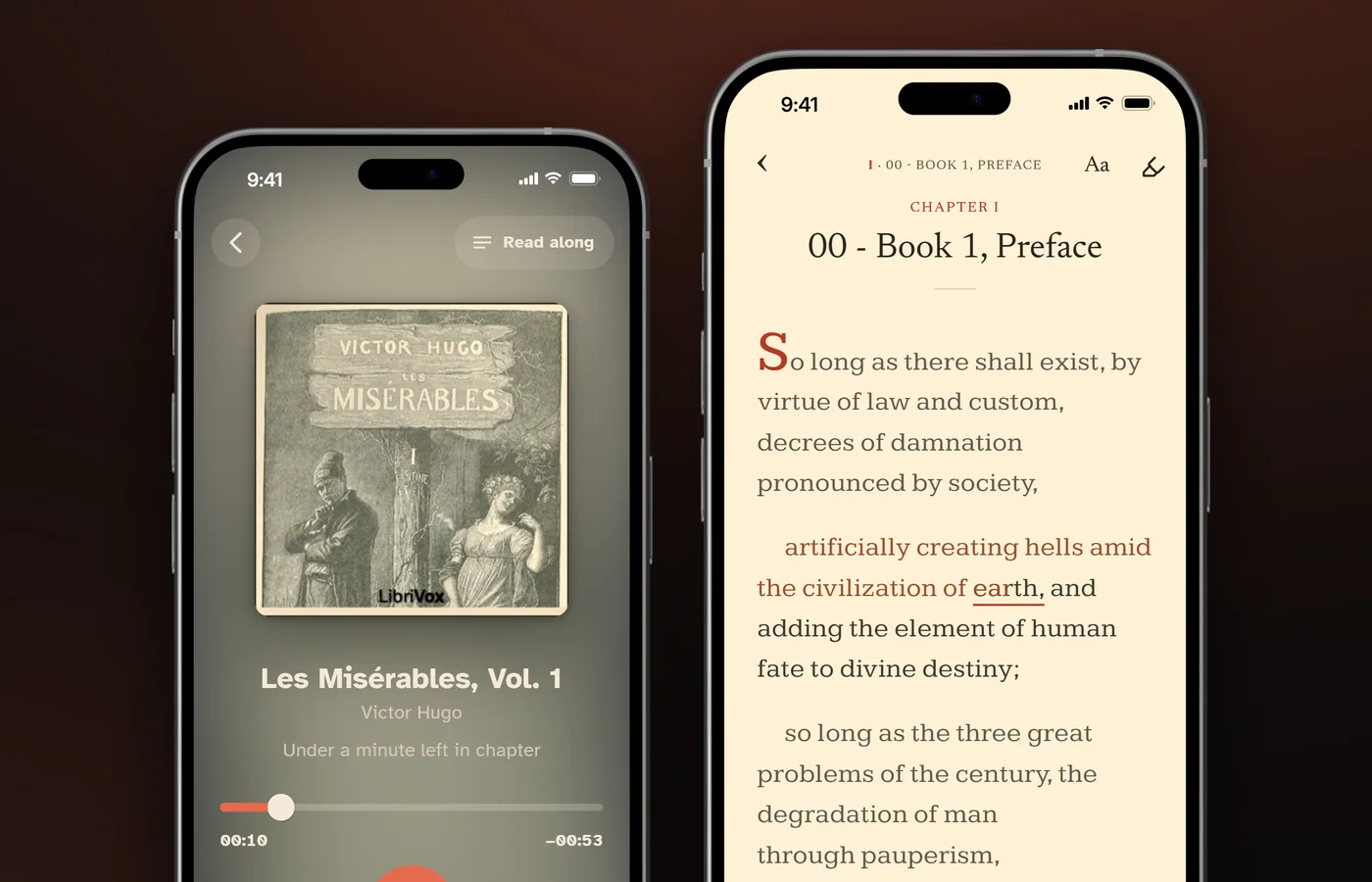
Yes: HushBook, the app we built, plays an audiobook and shows its words in time with the voice, on iPhone, Android, Windows and Mac.
HushBook is free, with no account, and transcription runs on your own device. In Discover, search Les Misérables and download the cards "Les Misérables, Vol. 1" to "Les Misérables, Vol. 5" (13h 46m, 12h 55m, 10h 59m, 15h 36m and 13h 15m): that is the complete LibriVox recording of Hapgood's translation, five books in your library, 1.8 GB in all, one chapter per file. Switch the language filter to English to see the five volumes first, or pick them by "Vol. 1" to "Vol. 5". Play a sample first if you like. HushBook queues the transcription on your phone as soon as each book is added.
Words fill in as the narrator reads them, with a red underline on the current one. Long-press any line to play from there. In Vol. 1 the first chapter is Hugo's preface, so the numbers there run one ahead of the book. Waterloo is the first 19 files of Vol. 2, so HushBook numbers them Chapters I to XIX, matching the book, and the last carries "Bk 01 Ch 19: The Battle-Field at Night" in its title. Mark a passage to keep it as a highlight, note or quote, and set the speed anywhere from 0.5x to 3x.
For Hapgood's own text, attach a matching DRM-free EPUB, PDF or TXT, such as Project Gutenberg's eBook #135, the text all five volumes read: e-book sync (first sync free) aligns the book's text to the audio word by word. For the names, add each person to the character map once, keep Euphrasie on Cosette's card and Myriel and Monseigneur Welcome on the bishop's, and see the chapter and time you first heard each person. For French, the French filter in Discover lists the five LibriVox tomes, and HushBook transcribes a French audiobook on your phone.
For a paid edition, read along with a DRM-free MP3 or M4B copy you own. HushBook imports MP3, M4A, M4B and more, and detects the chapters inside M4B files. The desktop app is free on Windows 10 or 11 (64-bit) and macOS 14 or later, and imports MP3 and M4B files or whole folders.
HushBook works with free public domain recordings and audio files you own without DRM.
Read all five volumes along with the free recording
HushBook finds LibriVox's free Les Misérables, all five volumes, and shows each word in time with the voices, volume by volume. Free on iPhone, Android, Windows and Mac, no account.
Sources
- LibriVox, "Les Misérables, Vol. 1"
- LibriVox, "Les Misérables, Volume 2"
- LibriVox, "Les Misérables, Vol. 3"
- LibriVox, "Les Misérables, Vol. 4"
- LibriVox, "Les Misérables, Vol. 5"
- LibriVox, API feed for "Les Mis"
- Internet Archive, LibriVox "Les Misérables, Vol. 1"
- Internet Archive, LibriVox "Les Misérables, Vol. 2"
- Internet Archive, LibriVox "Les Misérables, Vol. 3"
- Internet Archive, LibriVox "Les Misérables, Vol. 4"
- Internet Archive, LibriVox "Les Misérables, Vol. 5"
- Internet Archive, Au Fil des Lectures, "Les Misérables, T1, Fantine" (French)
- Audible, Les Misérables (George Guidall, Recorded Books, translated by Julie Rose)
- Audible, Les Misérables (Bill Homewood, Naxos AudioBooks)
- Audible, Les Misérables (Penguin Classics, translated by Christine Donougher)
- Audible, Les Misérables (Frederick Davidson, Blackstone)
- Audible, Les Misérables (Pete Cross, Dreamscape Media)
- Audible, Les Misérables (Alan Munro, Trout Lake Media)
- Audible, Les Misérables (Philippe Duquenoy, Goffin Media)
- Audible, Les Misérables (David Rintoul, SNR Audio)
- Audible, Les Misérables (Peter Silverleaf, Bookstream Audiobooks)
- Audible, Les Misérables, Volume 1 (Peter Silverleaf, Bookstream Audiobooks)
- Audible, Les Misérables (ABR) (Pete Cross, Dreamscape Media, abridged)
- Audible, Les Misérables (Walter Covell, Jimcin Recordings, abridged)
- Audible, Les Misérables (David Case, Tantor Media, abridged)
- Audible, Les Misérables (Frederick Davidson, Blackstone, abridged)
- Audible, Les Misérables (Mark McKerracher, Penguin Audio, abridged)
- Audible, Les Misérables (Bill Homewood, Naxos AudioBooks, abridged)
- Audible, Les Misérables (BBC Radio 4 full-cast dramatisation)
- Audible, Les Miserables and The Hunchback of Notre Dame (BBC full cast, pre-order)
- Audible, Les Misérables (Jim Hodges Productions, radio drama)
- Audible, Les Misérables (Christopher Cazenove, abridged)
- Audible, Les Misérables (Real Reads)
- Audible, Les misérables, L'intégrale (Editions Theleme, French)
- Audible, catalogue API results for "les miserables"
- Apple, iTunes Search API, audiobook results for "les miserables"
- Apple Books, Les Miserables (George Guidall, 13 h 10 min listing)
- Apple Books, Les Misérables (Bill Homewood)
- Apple Books, Les Misérables (Penguin Classics)
- Apple Books, Les Misérables (Frederick Davidson)
- Apple Books, Les Misérables (Walter Covell)
- OverDrive, catalogue API for the New York Public Library
- OverDrive, catalogue API for the Los Angeles Public Library
- OverDrive, catalogue API for the King County Library System
- OverDrive, catalogue API for the San Francisco Public Library
- OverDrive, catalogue API for the Chicago Public Library
- hoopla, Les Misérables (George Guidall)
- hoopla, Les Misérables (Frederick Davidson)
- hoopla, Les Misérables (Pete Cross)
- hoopla, Les Misérables (Orson Welles)
- Project Gutenberg, "Les Misérables by Victor Hugo" (eBook #135, translated by Isabel F. Hapgood)
- Project Gutenberg, plain text of eBook #135
- Project Gutenberg, Les Misérables, translated by Lascelles Wraxall (eBook #48731, first of five)
- Internet Archive, Les Misérables, translated by Charles E. Wilbour (1928 edition)
- Internet Archive, Les Misérables, translated by Charles E. Wilbour (second scanned edition)
- Penguin Random House Canada, Les Misérables (Julie Rose), excerpt
- Penguin UK, "Les Misérables" (Penguin Classics, translated by Christine Donougher)
- Penguin Random House, "Les Miserables" (Penguin Classics Deluxe Edition, translated by Christine Donougher)
- Penguin Random House, "Les Misérables" (Modern Library, translated by Julie Rose)
- Penguin UK, "Les Miserables" (Vintage Classics, translated by Julie Rose)
- Penguin Random House, "Les Miserables" (Signet Classics, translated by Lee Fahnestock and Norman MacAfee)
- Penguin Random House, "Les Miserables" (Penguin Clothbound Classics, translated by Norman Denny)
- Penguin Random House, "Les Miserables" (Everyman's Library, translated by Charles E. Wilbour)
- Wordsworth Editions, "Les Misérables Volume One" (translated by Charles E. Wilbour)
- Barnes & Noble, "Les Miserables (abridged) (Barnes & Noble Classics Series)"
- Marva Barnett, "Which translation of 'Les Misérables' do you recommend?"
- Michael H. Hoffheimer, "Copyright, Competition, and the First English-Language Translations of Les Misérables (1862)", Marquette Intellectual Property Law Review 17(2), 2013
- Translationista, "2016 French-American Foundation Translation Prize Winners Announced"
- Kirkus Reviews, Les Misérables audiobook review (Recorded Books)
- Audio Publishers Association, Audie Awards winners
- Miranda Seymour, "The Novel of the Century: The Extraordinary Adventure of Les Misérables, review", The Observer, 29 January 2017
- Wikipedia, "Les Misérables"
- Wikipedia, "Jean Valjean"
- Wiktionary, "Hugo"
- Reddit r/audiobooks, "Looking for the best version of Les Mis" (2021)
- Reddit r/audiobooks, "Les Miserables but not George Guidall?" (2026)
- Reddit r/audiobooks, Fahnestock and MacAfee audiobook question
- Reddit r/audible, "What is the best narration of Les Miserables?" (2019)
- Reddit r/lesmiserables, "I finished the audiobook! It only took 65 hours and 1.5 months" (2026)
- Reddit r/lesmiserables, "The complete audiobook" (2019)
- Reddit r/lesmiserables, "Can I skip?" (2026)
- Reddit r/lesmiserables, digressions thread (2026)
- Reddit r/books, "Les Miserables made me believe in abridged versions" (2021)
- Reddit r/books, sewers and argot thread (2025)
- Reddit r/classicliterature, "Tips for reading Les Miserables?" (2025)
- Reddit r/classicliterature, sewers thread (2026)
- Clinton-Lisell (2022), "Listening Ears or Reading Eyes: A Meta-Analysis of Reading and Listening Comprehension Comparisons", Review of Educational Research
- Varao Sousa, Carriere and Smilek (2013), "The way we encounter reading material influences how frequently we mind wander", Frontiers in Psychology
Frequently asked questions
Is the Les Misérables audiobook the same story as the musical?
Yes. The novel tells the same story in full: complete recordings run 57 hours 48 minutes to 67 hours 53 minutes and include Hugo's essays on Waterloo, convents, slang and the sewers.
Who reads the Penguin Classics Les Misérables audiobook?
Five actors: Adeel Akhtar, Natalie Simpson, Adrian Scarborough, Emma Fielding and John Owen-Jones, who has played Jean Valjean in the stage musical. It reads Christine Donougher's translation, unabridged, in 65 hours 41 minutes.
Why is my Les Misérables audiobook only 12 or 13 hours long?
It is abridged or only part of the book: complete recordings run at least 57 hours 48 minutes. Apple Books sells a 13 hour 10 minute George Guidall listing that a 2023 review called "only a portion" of the story.
Is there a Les Misérables audiobook in French?
Yes. LibriVox has all five tomes of the original French free, 62 hours 48 minutes, and HushBook's Discover lists them under the French filter. Editions Theleme sells a complete reading by five actors, 56 hours 52 minutes.
How do you pronounce Les Misérables?
In English, lay miz-ə-RAHB or lay miz-ə-RAH-blə; in French, le mee-zay-RAHBL, with the stress at the end. The respellings are ours, from the pronunciations Wikipedia gives.
Is there an audiobook of the Signet (Fahnestock and MacAfee) translation?
No. Only Mark McKerracher's abridged Penguin Audio recording, 5 hours 44 minutes. For the complete novel, Frederick Davidson reads Charles Wilbour's 1862 translation, the text Fahnestock and MacAfee revised.
How many volumes does Les Misérables have?
Five: Fantine, Cosette, Marius, Saint-Denis and Jean Valjean, in 48 books and 365 chapters. The free LibriVox recording comes as five separate downloads, one per volume, 10 hours 59 minutes to 15 hours 36 minutes each.