

Key takeaways
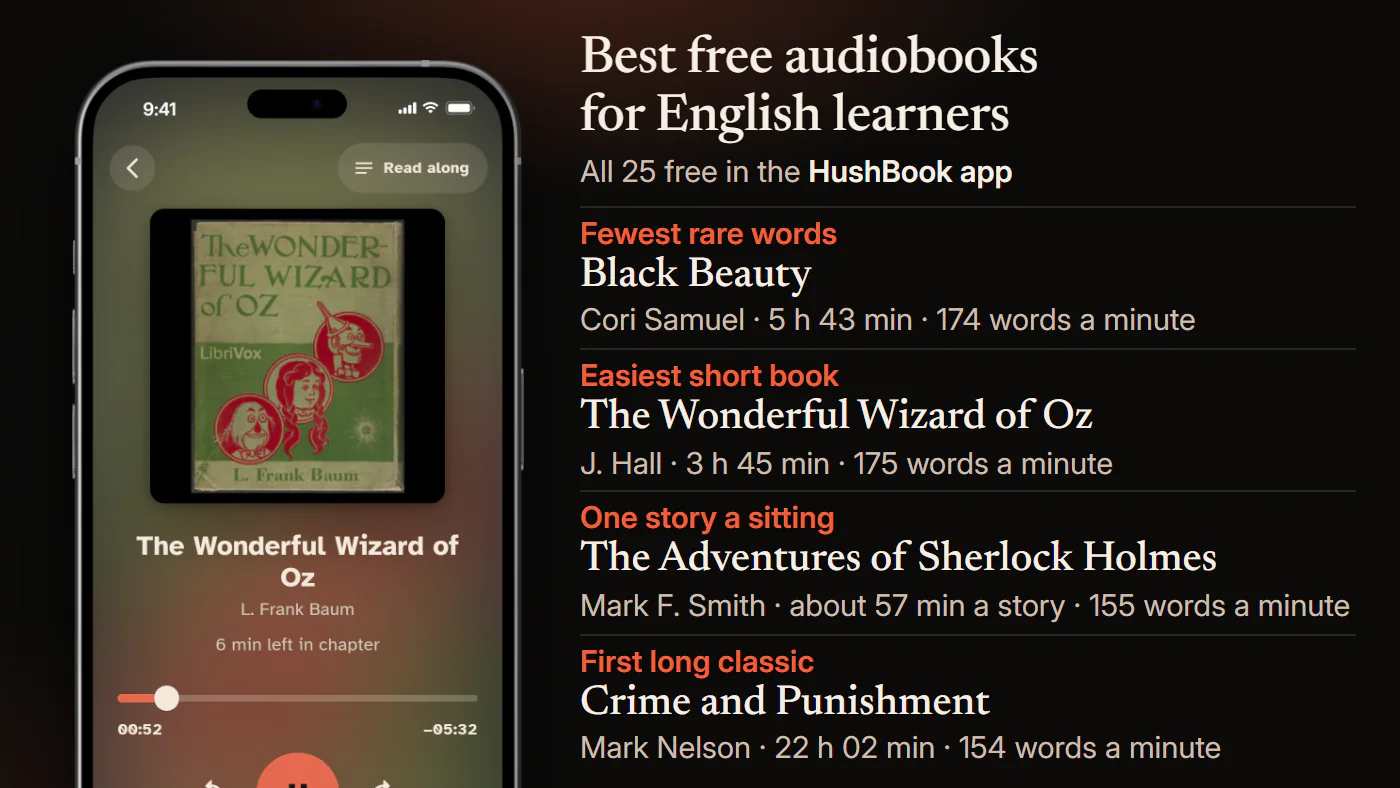
- Start with The Wonderful Wizard of Oz or Black Beauty: of 25 free recordings we measured, they need the fewest word families, 5,000 for 98%, and run under six hours.
- Narrators read at 131 to 198 words a minute. In a 1990 study, 200 words a minute cut learners' comprehension; 0.85x brings Oz's narrator to about 149.
- Books for children are not lighter in words. By our count, The Call of the Wild (3 h 24 min) needs 9,000 word families for 98%; Crime and Punishment needs 6,000.
- 12 of the 25 recordings run under 8 hours, the ceiling learners on Reddit suggest. Typical chapters run from about 7 minutes in Black Beauty to 57 for each Sherlock Holmes story.
- All 25 recordings are free and public domain, with the text on Project Gutenberg. In HushBook, the app we built, each word appears on screen as the narrator says it.
Start with The Wonderful Wizard of Oz (J. Hall, 3 h 45 min) or Black Beauty (Cori Samuel, 5 h 43 min). Of 25 free recordings we measured, these two need the fewest rare words: 98% of their running words fall within the 5,000 most common English word families. Each is read by one voice and runs under six hours. Both narrators read at about 175 words a minute, so slow the first chapters down: at 0.85x, J. Hall comes to about 149 words a minute.
Below are all 25 books, measured on November 16, 2026 and ranked by how many common words a learner needs, with each narrator's pace, the running time, the typical chapter and the narrator's accent where a listener has put it in writing. Then how to choose at your level, the books for beginners, intermediate and advanced learners, and how to read along with the words on screen.
What are the best audiobooks for English learners?
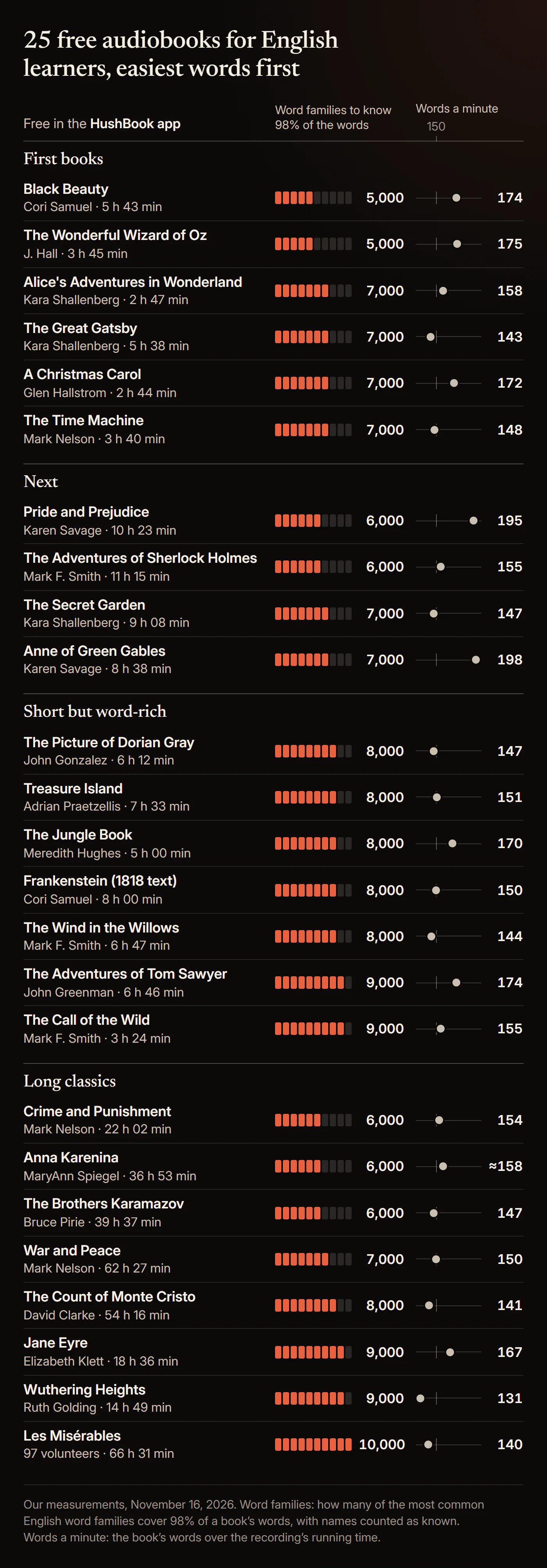
By our count, the best are Black Beauty and The Wonderful Wizard of Oz, followed by Pride and Prejudice, Crime and Punishment and The Adventures of Sherlock Holmes.
We counted every word of the Project Gutenberg text each narrator reads, looked each one up in Paul Nation's BNC/COCA word family lists, and timed each LibriVox recording from its files on the Internet Archive. All 25 are read by one narrator except Les Misérables.
| Rank | Book and author | Narrator | Length | Words a minute | Word families for 98% | Typical chapter |
|---|---|---|---|---|---|---|
| 1 | Black Beauty, Anna Sewell | Cori Samuel | 5 h 43 min | 174 | 5,000 | 7 min |
| 2 | The Wonderful Wizard of Oz, L. Frank Baum | J. Hall | 3 h 45 min | 175 | 5,000 | 9 min |
| 3 | Pride and Prejudice, Jane Austen | Karen Savage | 10 h 23 min | 195 | 6,000 | 9 min |
| 4 | Crime and Punishment, Fyodor Dostoevsky | Mark Nelson | 22 h 02 min | 154 | 6,000 | 32 min |
| 5 | The Adventures of Sherlock Holmes, Arthur Conan Doyle | Mark F. Smith | 11 h 15 min | 155 | 6,000 | 57 min |
| 6 | Anna Karenina, Leo Tolstoy | MaryAnn Spiegel | 36 h 53 min | 158 | 6,000 | 9 min |
| 7 | The Brothers Karamazov, Fyodor Dostoevsky | Bruce Pirie | 39 h 38 min | 147 | 6,000 | 23 min |
| 8 | Alice's Adventures in Wonderland, Lewis Carroll | Kara Shallenberg | 2 h 47 min | 158 | 7,000 | 14 min |
| 9 | The Secret Garden, Frances Hodgson Burnett | Kara Shallenberg | 9 h 08 min | 147 | 7,000 | 18 min |
| 10 | Anne of Green Gables, L. M. Montgomery | Karen Savage | 8 h 38 min | 198 | 7,000 | 13 min |
| 11 | The Great Gatsby, F. Scott Fitzgerald | Kara Shallenberg | 5 h 38 min | 143 | 7,000 | 37 min |
| 12 | War and Peace, Leo Tolstoy | Mark Nelson | 62 h 27 min | 150 | 7,000 | 9 min |
| 13 | A Christmas Carol, Charles Dickens | Glen Hallstrom | 2 h 44 min | 172 | 7,000 | 36 min |
| 14 | The Time Machine, H. G. Wells | Mark Nelson | 3 h 40 min | 148 | 7,000 | 14 min |
| 15 | The Picture of Dorian Gray, Oscar Wilde | John Gonzalez | 6 h 12 min | 147 | 8,000 | 28 min |
| 16 | Treasure Island, Robert Louis Stevenson | Adrian Praetzellis | 7 h 33 min | 151 | 8,000 | 13 min |
| 17 | The Count of Monte Cristo, Alexandre Dumas | David Clarke | 54 h 16 min | 141 | 8,000 | 24 min |
| 18 | The Jungle Book, Rudyard Kipling | Meredith Hughes | 5 h 00 min | 170 | 8,000 | 34 min |
| 19 | Frankenstein (1818 text), Mary Shelley | Cori Samuel | 8 h 00 min | 150 | 8,000 | 17 min |
| 20 | The Wind in the Willows, Kenneth Grahame | Mark F. Smith | 6 h 47 min | 144 | 8,000 | 33 min |
| 21 | The Adventures of Tom Sawyer, Mark Twain | John Greenman | 6 h 46 min | 174 | 9,000 | 11 min |
| 22 | Jane Eyre, Charlotte Brontë | Elizabeth Klett | 18 h 36 min | 167 | 9,000 | 26 min |
| 23 | Wuthering Heights, Emily Brontë | Ruth Golding | 14 h 49 min | 131 | 9,000 | 25 min |
| 24 | The Call of the Wild, Jack London | Mark F. Smith | 3 h 24 min | 155 | 9,000 | 31 min |
| 25 | Les Misérables, Victor Hugo | 97 volunteers | 66 h 31 min | 140 | 10,000 | 9 min |
How to read it. "Word families for 98%" is how many of the most common English word families you need to know before only 2 words in 100 are new, with names counted as known. The order follows that number; ties go to the book that reaches 95% with fewer families, then to the one with more of its words in the 3,000 most common families. Words a minute is the book's words divided by the running time. Pride and Prejudice, The Count of Monte Cristo and the other books with their own post on this site use that post's word count and running time, and Anna Karenina's pace is approximate because its recording reads a different translation from the one we counted.
Every recording here is free in the HushBook app's Discover tab, and the sections below name the card to pick. The recordings come from LibriVox, whose volunteers read public-domain books, so anyone may copy them; that is why the same readings turn up on YouTube and in other apps. Our guides to whether LibriVox is safe and legal and to the best LibriVox app explain where they come from.
How do you choose an English audiobook at your level?
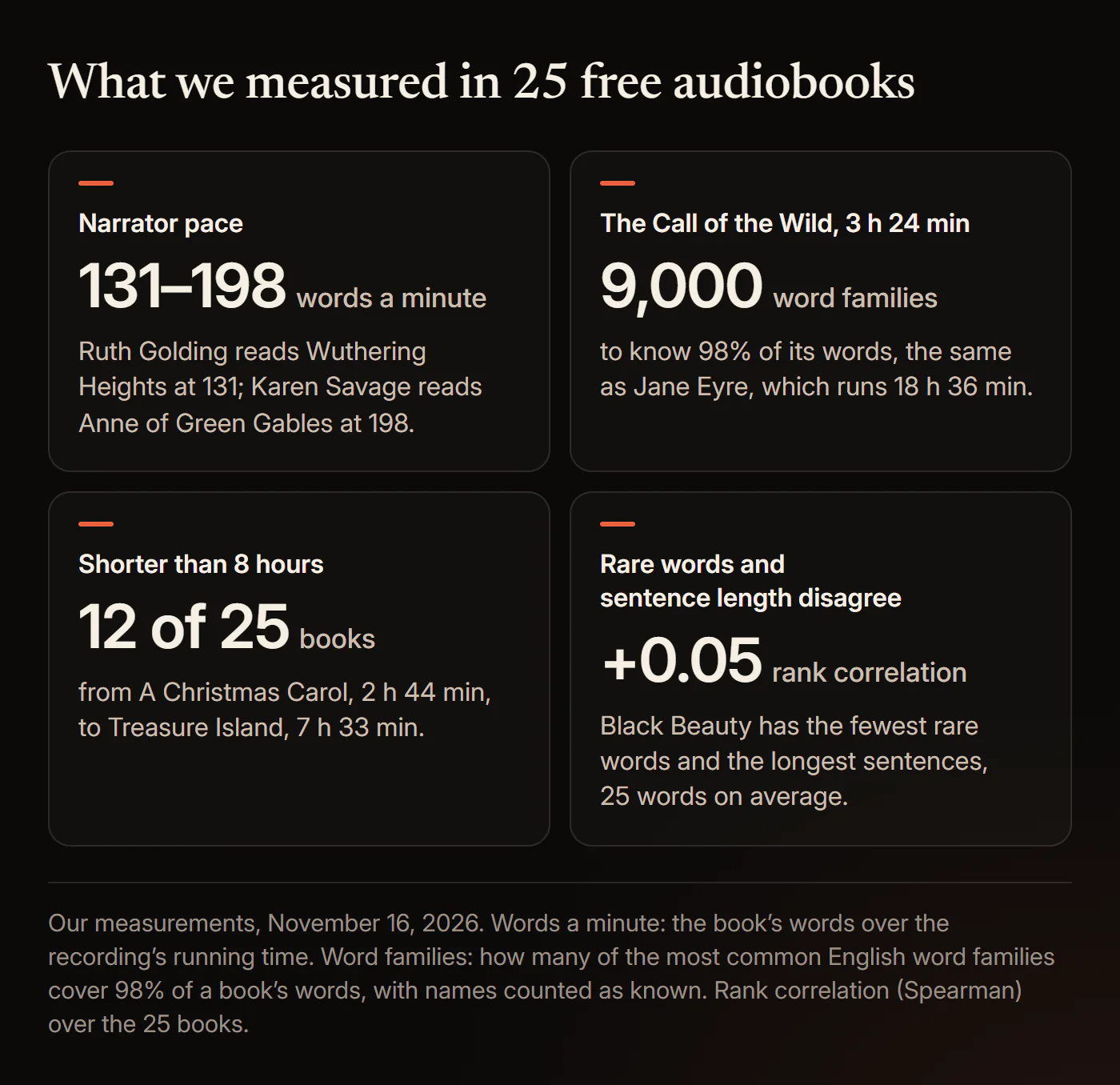
Check three things: how many words the book needs, how fast the narrator reads, and how long the book and its chapters run.
Words: how many families does the book need?
A word family is a word with its common forms: know "argue" and you also have "argues", "argued" and "argument". Our figure says how many of the most frequent families cover 98% of a book's running words. The 25 books here need 5,000 to 10,000.
The yardsticks come from a handful of studies:
- Reading on your own. In a 2006 corpus count with no learners involved, Nation found that 98% coverage of written English takes 8,000 to 9,000 word families, and of spoken English 6,000 to 7,000.
- Two thresholds. In a 2010 study of 745 students at an Israeli college, Laufer and Ravenhorst-Kalovski put the threshold for reading alone at 8,000 families and the minimum for reading "with some guidance" at 4,000 to 5,000.
- No sharp line. In a 2011 study of 661 readers from eight countries, Schmitt, Jiang and Grabe found that understanding rose roughly in step with the share of words known, with no threshold.
- Listening asks less. In a 2013 study of 36 native and 40 non-native listeners, van Zeeland and Schmitt found that learners understood informal spoken stories relatively well at 95% coverage.
We do not stamp A2, B1 or C1 on any book. No published source maps a book's vocabulary to a CEFR level. The closest yardstick is Milton's 2010 report of Milton and Alexiou's data: learners rated B1 by their teachers knew about 3,100 to 3,300 of the 5,000 most common words on the XLex test, in small school samples from Hungary (144 learners) and Greece (88). Our reading of that: a learner at B1 meets new words in every book on this list, which is why having the text in front of you matters.
Pace: how fast does the narrator read?
The narrators read at 131 to 198 words a minute, and the narrator changes the pace more than the book does. Ruth Golding reads Wuthering Heights at 131; Karen Savage reads Anne of Green Gables at 198. The Secret Garden runs 9 h 08 min with Kara Shallenberg (147 words a minute) and 6 h 57 min with Karen Savage (194).
About 150 words a minute is a sensible target. In a 1990 study of lower-intermediate adult learners, Griffiths found that speech at 200 words a minute cut comprehension significantly, while 100 was no better than 150; the abstract does not give the sample size. In a 2023 study of 66 junior-high students in Taiwan, Chiu and Chen found that slowing speech from 116 to 98 words a minute helped, but slowing it to 58 did not. For the fastest narrators on the list, these settings bring the pace to about 150:
| Book | Narrator | At 1x | Speed setting | Words a minute at that setting |
|---|---|---|---|---|
| Anne of Green Gables | Karen Savage | 198 | 0.75x | 149 |
| Pride and Prejudice | Karen Savage | 195 | 0.8x | 156 |
| The Wonderful Wizard of Oz | J. Hall | 175 | 0.85x | 149 |
| Black Beauty | Cori Samuel | 174 | 0.85x | 148 |
| The Adventures of Tom Sawyer | John Greenman | 174 | 0.85x | 148 |
| A Christmas Carol | Glen Hallstrom | 172 | 0.85x | 146 |
| The Jungle Book | Meredith Hughes | 170 | 0.9x | 153 |
| Jane Eyre | Elizabeth Klett | 167 | 0.9x | 150 |
The last column is our arithmetic: pace times speed. Treat a slower setting as a step back to 1x; our guide to audiobook listening speed has more.
Length: can you finish the book, and a chapter?
12 of the 25 run under 8 hours. That is about the ceiling English learners give each other on Reddit's r/audiobooks: one reply in a 2024 thread advised a first book "not longer than 7-8h and narrated by someone whose voice and speed you enjoy". It is advice from learners, not research. Our guide to how long an audiobook is has listening times for more books.
Chapter length decides whether you can finish one in a sitting. Black Beauty's chapters take about 7 minutes; each Sherlock Holmes story takes about 57.
What surprised us
- Vocabulary and sentence length do not agree. Across the 25 books, the rank correlation between word families for 98% and sentence length is +0.05, effectively none. Black Beauty needs the fewest rare words and has the longest sentences, 25 words on average by our count. The Picture of Dorian Gray has some of the shortest, about 13 words, and needs 8,000 families.
- Books written for children are not lighter in words. In a 2013 corpus study of 688 texts, Webb and Macalister found that text for children needed 10,000 word families, plus proper nouns and marginal words, for 98% coverage, the same as text for older readers, while graded readers needed 3,000. Our count agrees: The Call of the Wild and The Adventures of Tom Sawyer need 9,000, and Crime and Punishment 6,000.
When you have a candidate, use the test from our guide to how to learn English with audiobooks: play the first chapter with the text in front of you. If you know almost every word and can follow the story, the book is at your level.
What are the best English audiobooks for beginners?
The best first books are the six that need 7,000 families or fewer for 98% and run under 8 hours: Black Beauty, The Wonderful Wizard of Oz, Alice's Adventures in Wonderland, The Great Gatsby, A Christmas Carol and The Time Machine.
These are unsimplified books written for native speakers. If you know fewer than about 2,000 word families, start with graded readers that come with audio, which the Extensive Reading Foundation's guide recommends because books for native speakers assume readers "already know thousands of words and most of the grammar of English". The free ones are listed in where to find free English audiobooks. By our count, Black Beauty reaches 95% coverage with the first 2,000 families and Oz with 3,000; 95% is the coverage at which van Zeeland and Schmitt's learners understood spoken stories relatively well.
| Book | Narrator, words a minute | Typical chapter | Card in Discover |
|---|---|---|---|
| Black Beauty | Cori Samuel, 174 | 7 min | "Black Beauty", 5h 43m |
| The Wonderful Wizard of Oz | J. Hall, 175 | 9 min | "The Wonderful Wizard of Oz", 3h 45m |
| Alice's Adventures in Wonderland | Kara Shallenberg, 158 | 14 min | "Alice's Adventures in Wonderland", 2h 47m |
| The Great Gatsby | Kara Shallenberg, 143 | 37 min | "The Great Gatsby", 5h 38m |
| A Christmas Carol | Glen Hallstrom, 172 | 36 min | "A Christmas Carol", 2h 44m |
| The Time Machine | Mark Nelson, 148 | 14 min | "The Time Machine (version 3)", 3h 40m |
Several recordings share each title, so pick the card by its length.
- Black Beauty. The fewest rare words of the 25. What trips learners up is the long sentences and the stable words: oats, bridle, hostler, farrier, blinkers. Its 49 chapters fit a short break. Other cards with the title are a dramatic reading (5h 26m) and a second solo reading (4h 59m).
- The Wonderful Wizard of Oz. The easiest short book on the list: 5,000 families for 98% in 3 h 45 min. Words to learn: emerald, cyclone, humbug, stork, whiskers. It is the first result for "wizard of oz"; another card with the plain title runs 3h 47m.
- Alice's Adventures in Wonderland. Under 3 hours, in 12 chapters. The creatures are the hard words (gryphon, dormouse, caterpillar), and Carroll's wordplay, such as "curiouser", is the real hurdle. Search the full title, "Alice's Adventures in Wonderland".
- The Great Gatsby. The slowest narrator of the six, at 143 words a minute. There are only nine chapters, the longest about an hour, so plan for long sittings. Another plain-title card runs 5h 45m.
- A Christmas Carol. The shortest book on the list, in five staves of about 36 minutes. The hard words are Dickens's nouns: poulterer, phantom, spectre, ruddy. Many other cards share the title, from 2h 35m to 3h 42m.
- The Time Machine. 87% of the words sit inside quotation marks, because the Time Traveller tells his story aloud to his guests. Watch for sphinx, porcelain and camphor, and old words such as hither and thither.
Learners on Reddit often recommend Harry Potter, because many already know the story. It is in copyright, so it is sold or borrowed from a library, not free. The advice behind it holds: a story you know makes the gaps easier to fill, and Oz, Alice and A Christmas Carol are stories many people know from films.
Which audiobooks are best for intermediate English learners?
The best for intermediate learners are four books that also need 7,000 families or fewer for 98% but run 8 to 14 hours: Pride and Prejudice, The Adventures of Sherlock Holmes, The Secret Garden and Anne of Green Gables.
| Book | Narrator, words a minute | Typical chapter | Card in Discover |
|---|---|---|---|
| Pride and Prejudice | Karen Savage, about 195 | 9 min | "Pride and Prejudice (version 3)", 10h 23m |
| The Adventures of Sherlock Holmes | Mark F. Smith, 155 | 57 min | "The Adventures of Sherlock Holmes", 11h 15m |
| The Secret Garden | Kara Shallenberg, 147 | 18 min | "The Secret Garden", 9h 8m |
| Anne of Green Gables | Karen Savage, 198 | 13 min | "Anne of Green Gables (version 3)", 8h 38m |
- Pride and Prejudice. Easy on words (6,000 families) and hard on everything else: long, polite sentences and a fast reader. Its rare words are abstract ("imprudence", "countenance", "felicity", "amiable"), not names of things. Try 0.8x. Every edition is compared in our Pride and Prejudice audiobook guide.
- The Adventures of Sherlock Holmes. Twelve stories, one file each, so you finish a mystery in a sitting. 76% of the words are dialogue. Search "sherlock holmes"; a group reading with the same title runs 10h 18m.
- The Secret Garden. The narration is easy, but Dickon and Martha speak Yorkshire dialect ("tha'rt", "thysel", "graidely"). For a faster reader, Karen Savage's card reads 6h 57m.
- Anne of Green Gables. The fastest reader on the list and 59% dialogue, in 38 chapters. Start at 0.75x.
Which audiobooks are best for advanced English learners?
The best for advanced learners are seven short books, none longer than 8 hours, that need 8,000 or more word families for 98%: The Picture of Dorian Gray, Treasure Island, The Jungle Book, Frankenstein, The Wind in the Willows, The Adventures of Tom Sawyer and The Call of the Wild.
| Book | Narrator, words a minute | Word families for 98% | Card in Discover |
|---|---|---|---|
| The Picture of Dorian Gray | John Gonzalez, 147 | 8,000 | "The Picture of Dorian Gray", 6h 12m |
| Treasure Island | Adrian Praetzellis, 151 | 8,000 | "Treasure Island", 7h 33m |
| The Jungle Book | Meredith Hughes, 170 | 8,000 | "The Jungle Book", 5h 2m |
| Frankenstein (1818 text) | Cori Samuel, 150 | 8,000 | "Frankenstein; or, The Modern Prometheus (1818)", 7h 59m |
| The Wind in the Willows | Mark F. Smith, 144 | 8,000 | "The Wind in the Willows", 6h 47m |
| The Adventures of Tom Sawyer | John Greenman, 174 | 9,000 | "The Adventures of Tom Sawyer", 6h 46m |
| The Call of the Wild | Mark F. Smith, 155 | 9,000 | "The Call of the Wild", 3h 24m |
What makes these books hard is a particular kind of word:
- Spelled-out speech. Twain writes his characters' dialect as it sounds ("injun", "ha'nted", "becuz", "widder"). In The Call of the Wild, François's French-Canadian English comes out as "heem", "queek" and "nevaire". Treasure Island's pirates say "cap'n", "dooty" and "sperrit".
- Ship, sled and riverbank words. Treasure Island has schooner, coxswain, cutlass and stockade; The Call of the Wild has spitz, sled, husky and moose; The Wind in the Willows has luncheon, barge and gipsy. The Wind in the Willows needs 6,000 families just for 95%, the most of any book under 8 hours.
- Thee and thou. The Jungle Book's animals speak in old forms such as thou, didst and canst: 57 per 10,000 words, the most on this list.
- Literary words. Dorian Gray has hideous, pallid, gilt and wrought; Frankenstein, the densest prose here by readability scores, has fiend, wretch and countenance.
The Dorian Gray recording is Wilde's shorter 1890 version in 13 chapters; LibriVox's 1891 book version is a 9h 30m card. Treasure Island's 34 chapters come two to a file, and Tom Sawyer's 35 in 17 files, about 24 to 26 minutes each. The Call of the Wild has almost no dialogue (4% of its words), so it is nearly all narration.
What are the best classic novels for English learners?
By our count, the long classics with the fewest rare words are Crime and Punishment, The Brothers Karamazov and Anna Karenina, at 6,000 word families for 98%, fewer than the 9,000 of the 3 h 24 min Call of the Wild.
Constance Garnett, who translated the two Dostoevsky novels and the Anna Karenina text we counted, wrote plain, common English. The difficulty of the long classics is their length, and two of the longest come in short pieces: Anna Karenina and War and Peace have chapters of about 9 minutes, so even a 60-hour book goes one bus ride at a time.
| Book | Narrator, words a minute | Word families for 98% | Typical chapter | Card in Discover |
|---|---|---|---|---|
| Crime and Punishment | Mark Nelson, 154 | 6,000 | 32 min | "Crime and Punishment (Version 3)", 22h 2m |
| Anna Karenina | MaryAnn Spiegel, about 158 | 6,000 | 9 min | "Anna Karenina", 36h 53m |
| The Brothers Karamazov | Bruce Pirie, 147 | 6,000 | 23 min | "The Brothers Karamazov (version 3)", 39h 38m |
| War and Peace | Mark Nelson, 150 | 7,000 | 9 min | "War and Peace, Volume 1 (Maude translation)" to "Volume 4" |
| The Count of Monte Cristo | David Clarke, about 141 | 8,000 | 24 min | "The Count of Monte Cristo", 54h 16m |
| Jane Eyre | Elizabeth Klett, 167 | 9,000 | 26 min | "Jane Eyre (version 3)", 18h 36m |
| Wuthering Heights | Ruth Golding, 131 | 9,000 | 25 min | "Wuthering Heights (Solo Version)", 14h 49m |
| Les Misérables | 97 volunteers, 140 | 10,000 | 9 min | "Les Misérables, Vol. 1" to "Vol. 5" |
- Crime and Punishment. The first long classic on the list. Plain English; the new words are Russian money (copecks, roubles). The chapters are long.
- Anna Karenina. The recording reads Nathan Haskell Dole's translation, so our 6,000 comes from Garnett's text standing in for it. The other two plain-title cards are German and Dutch readings.
- The Brothers Karamazov. The monks and the Grand Inquisitor speak in "didst" and "wouldst", 11 old forms per 10,000 words.
- War and Peace. 365 short chapters in the Maude translation. Expect hunting, carriage and army words (borzois, caleche, musketry) and some French. Play the four volumes in order.
- The Count of Monte Cristo. French titles and words: procureur, mademoiselle, francs. Three cards share the plain title.
- Jane Eyre. 9,000 families: governess, parlour, hearth, and old words such as "ere" and "whence".
- Wuthering Heights. The slowest reader on the list. Joseph's Yorkshire dialect ("maister", "noan", "hisseln") is the main hurdle.
- Les Misérables. 10,000 families (rue, barricade, galleys, sous), and the voice changes from chapter to chapter.
A long book with one narrator has a hidden advantage: the same names, places and words come back for hours in the same voice. In a 2015 study of 61 high-intermediate learners, Kang found that narrow reading, several texts on one topic, helped them understand and use target words more than wide reading did. That study used short texts, not audiobooks, so take the link to novels as our reasoning. For staying with a long classic, see how to read classics without getting bored.
Which audiobooks have an American or British accent?
Five narrators on this list have an accent named in a listener's review on the Internet Archive; for the other 20 recordings, no review we found states one.
| Narrator | Book | What a listener's review on the Internet Archive says |
|---|---|---|
| Karen Savage | Pride and Prejudice | "a nice British accent", though "American English comes in (Especially in vowels)" (2009) |
| Elizabeth Klett | Jane Eyre | "her British accent is very creditable, even to the ears of a native speaker" (2009) |
| Ruth Golding | Wuthering Heights | "Also enjoyed the English accent" (2013) |
| David Clarke | The Count of Monte Cristo | "I as an American love his British accent" (2019) |
| Mark F. Smith | The Adventures of Sherlock Holmes | "not to american not to british" (2021); "the All American Sher-r-r-lahk Holl-ems" (2025) |
Accent strength and familiarity matter more than the country. In a 2016 study of 21,726 TOEFL test takers, Ockey and French found that strength of accent and familiarity affected listening comprehension "even with quite light accents". In a 2024 study of 79 Japanese adult learners, Suzuki and Yamane found scores did not differ between American and British recordings, though the learners felt the British accent was harder. Start with the accent you hear most, and add others once one feels easy.
Seeing the words helps you adapt. In 2009, Mitterer and McQueen had 121 Dutch participants watch Scottish or Australian English clips; those who watched with English subtitles later repeated new clips in that accent better, and Dutch subtitles made them worse. HushBook, the app we built, does the same for an audiobook: each English word appears on screen as the narrator says it.
Are there free English audiobooks with text?
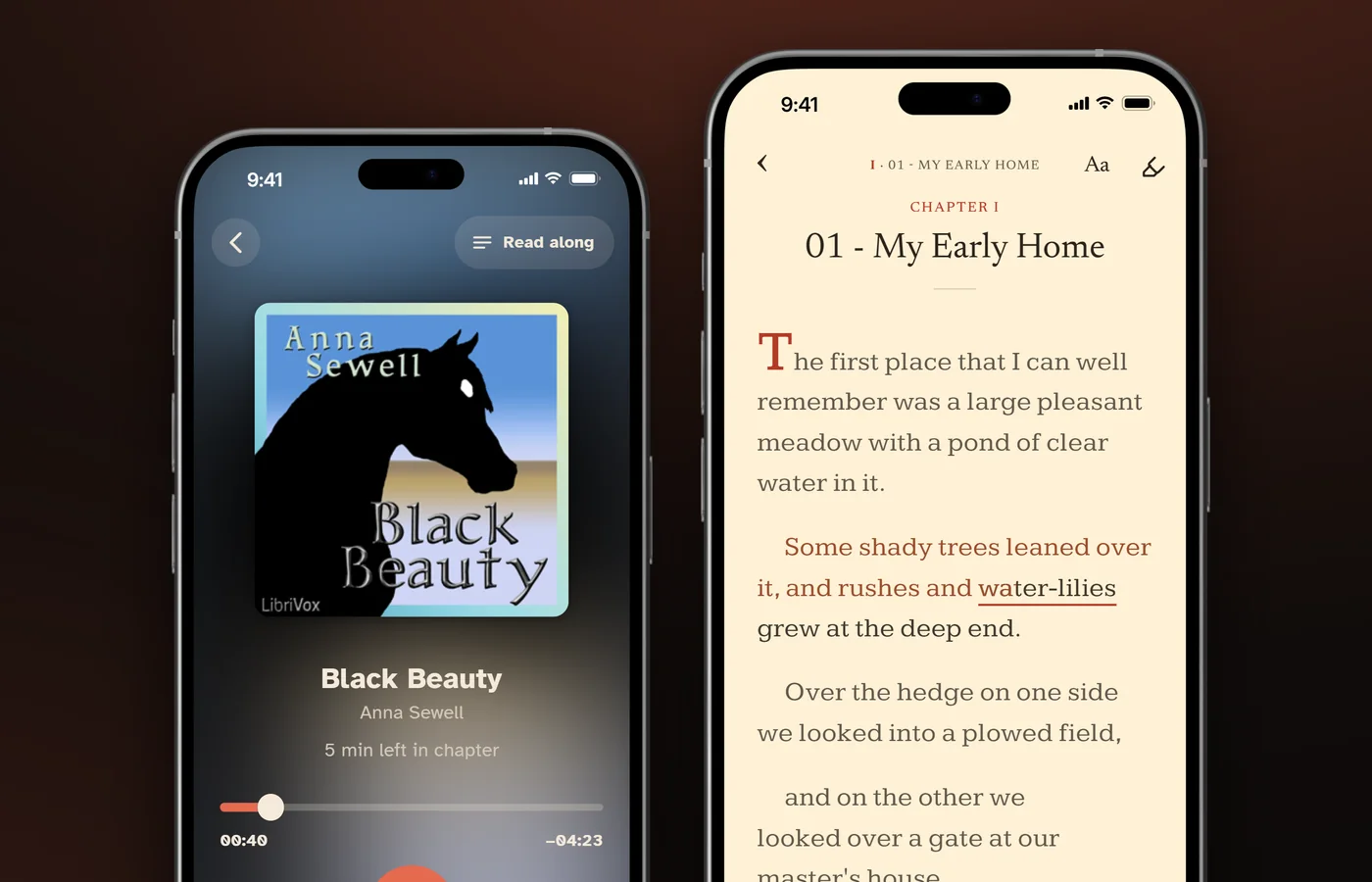
Yes: every recording on this list is public domain, its text is free on Project Gutenberg, and in HushBook the words appear on screen as the narrator says them.
On Project Gutenberg, pick the edition the narrator reads. Frankenstein here is the 1818 text, eBook #41445; our Frankenstein audiobook guide shows how to tell it from the revised 1831 text by ear. Dorian Gray is the 1890 text, eBook #4078. Anna Karenina's recording reads Dole's translation, which is on Wikisource. LibriVox and the Internet Archive offer every recording as free MP3 files.
In HushBook, the words come from a transcript of the narrator's own voice, made on your phone, so the text follows the recording you hear.
How can you read and listen to English books for free?
Download a book from the list in HushBook, let it transcribe, and read along as the narrator speaks. Here is the route with Black Beauty, rank 1 on the list; app details were checked on November 16, 2026.
- Find the book. Open Discover, which searches LibriVox and the Internet Archive together, and search "black beauty". Play a 30-second sample if you like.
- Pick the card by length. Choose "Black Beauty" that reads 5h 43m, Cori Samuel's reading, then Download for Free. A dramatic reading (5h 26m) and another solo reading (4h 59m) share the title. For Alice, search the full title.
- Let it transcribe. Transcription starts by itself after the download, on your phone.
- Read along. The current word is underlined as Cori Samuel reads it. Long-press a line to hear it again from there, and say it aloud along with the narrator for speaking practice; the shadowing step is in our English routine.
- Set the speed. Anywhere from 0.5x to 3x, in 0.05x steps; 0.85x brings Cori Samuel from 174 to about 148 words a minute. The speed is saved with your reading profile.
- Keep words. Tap Mark, then a word or a passage, to keep it as a highlight, note or quote. Everything you mark is listed, and searchable, in Quotes & notes.
- Look words up. With Pro, open Dictionary in Library and type or paste a word for its meaning, examples, similar and opposite words, and origin.
- Use the Gutenberg text. E-book sync (first sync free) aligns a DRM-free EPUB, PDF or TXT of the same edition to the narration word by word.
- Stop at a chapter's end. Set the sleep timer to End of current chapter, which suits Black Beauty's 7-minute chapters.
The same steps work with your own DRM-free MP3, M4A or M4B files, such as the audio of a graded reader you bought. On a big screen, the free Windows and Mac app has Discover too, and "every word lights up as the narrator reads it, set in pages like a printed book". More on how it works is on our read-along audiobooks page.
What the measurements do not show
- Pace includes the notices. Each LibriVox track opens and closes with a short spoken notice. Taking out an estimated 15 seconds a track would raise each pace by 1 to 5 words a minute.
- Coverage is an estimate. It counts word families, so knowing "argue" counts "argument" as known, and it counts names as known. A real learner knows some rare words and misses some common ones. Hyphenated names split into pieces, and French words in Dumas and Hugo count as unknown.
- Anna Karenina is approximate. Its pace and coverage come from Garnett's text, not the Dole translation the recording reads.
- Accent is what listeners wrote. We did not judge any accent by ear.
- No study has tested word-by-word highlighting with adult learners. The synchronised-highlighting studies we found were with young native-speaker children.
- No study has tested unsimplified classics on audio with learners. Reading-while-listening studies used graded readers, short stories or novel excerpts.
- Reading along beats listening alone, not silent reading. In a 2026 study of 86 Chinese learners of English, Hui and Godfroid found that participants understood a text less well reading while listening than reading silently, and both beat listening only.
- No speed has been tested as best. No study has tried 0.75x, 0.85x or any other setting with audiobooks.
- The thresholds rest on few studies. In a 2021 review, Webb counted three studies that measured coverage and reading comprehension precisely, and two for listening.
Every book on this list, with the words on screen
All 25 recordings are free in HushBook's Discover tab. HushBook transcribes each one on your phone and underlines every word as the narrator says it; long-press a line to hear it again, and slow it to 0.85x. No account, no ads.
Sources
- Nation (2006), "How Large a Vocabulary is Needed For Reading and Listening?", The Canadian Modern Language Review
- Laufer and Ravenhorst-Kalovski (2010), "Lexical threshold revisited: Lexical text coverage, learners' vocabulary size and reading comprehension", Reading in a Foreign Language
- Schmitt, Jiang and Grabe (2011), "The Percentage of Words Known in a Text and Reading Comprehension", The Modern Language Journal
- van Zeeland and Schmitt (2013), "Lexical Coverage in L1 and L2 Listening Comprehension: The Same or Different from Reading Comprehension?", Applied Linguistics
- Webb (2021), "Research Investigating Lexical Coverage and Lexical Profiling: What We Know, What We Don't Know, and What Needs to be Examined", Reading in a Foreign Language
- Webb and Macalister (2013), "Is Text Written for Children Useful for L2 Extensive Reading?", TESOL Quarterly
- Milton (2010), "The development of vocabulary breadth across the CEFR levels", EUROSLA Monographs Series 1
- Milton and Alexiou (2009), "Vocabulary Size and the Common European Framework of Reference for Languages", Vocabulary Studies in First and Second Language Acquisition
- Griffiths (1990), "Speech Rate and NNS Comprehension: A Preliminary Study in Time-Benefit Analysis", Language Learning
- Chiu and Chen (2023), "Speech Rate and Young EFL Learners' Listening Comprehension", English Language Teaching
- Kang (2015), "Promoting L2 Vocabulary Learning through Narrow Reading", RELC Journal
- Ockey and French (2016), "From One to Multiple Accents on a Test of L2 Listening Comprehension", Applied Linguistics
- Suzuki and Yamane (2024), "Japanese EFL learners' comprehension and perceptions of three different accents in listening assessment", International Journal of Applied Linguistics
- Mitterer and McQueen (2009), "Foreign Subtitles Help but Native-Language Subtitles Harm Foreign Speech Perception", PLoS ONE
- Hui and Godfroid (2026), "Listening, Reading, or Both? Rethinking the Comprehension Benefits of Reading-While-Listening", Language Learning
- Extensive Reading Foundation (2011), "Guide to Extensive Reading"
- Victoria University of Wellington, Paul Nation's BNC/COCA word family lists, "Vocabulary analysis programs"
- Project Gutenberg
- LibriVox, "About LibriVox"
- Internet Archive, LibriVox recording of "Pride and Prejudice (version 3)", reviews
- Internet Archive, LibriVox recording of "Jane Eyre (version 3)", reviews
- Internet Archive, LibriVox recording of "Wuthering Heights (Solo Version)", reviews
- Internet Archive, LibriVox recording of "The Count of Monte Cristo", reviews
- Internet Archive, LibriVox recording of "The Adventures of Sherlock Holmes", reviews
- Reddit r/audiobooks, "As a English learner, which audiobooks do you recommend" (2024)
Frequently asked questions
Are there free audiobooks for English learners?
Yes. All 25 on our list are free LibriVox recordings in the public domain. The Wonderful Wizard of Oz (3 h 45 min) and Black Beauty (5 h 43 min) need the fewest rare words of the 25 we measured.
What are the best audiobooks for ESL students?
Two stand out by our count: Black Beauty and The Wonderful Wizard of Oz. 98% of their words fall within the 5,000 most common word families, each has one narrator, and both run under six hours.
Can you download free English audiobooks as MP3?
Yes. LibriVox and the Internet Archive offer every recording on our list as free MP3 files. HushBook downloads them from its Discover tab and imports DRM-free MP3, M4A or M4B files you own.
Is Harry Potter a good audiobook for learning English?
Yes, if you already know the story; learners on Reddit recommend it for that reason. It is in copyright, so it is sold or borrowed, not free. For a free start, try The Wonderful Wizard of Oz.
Which audiobooks help you improve your English speaking and vocabulary?
Any book you can follow with the text. Black Beauty and Oz need the fewest rare words by our count. For speaking, long-press a line in HushBook to hear it again and say it along with the narrator.
Are there free English audiobooks for learners on YouTube?
Yes. LibriVox recordings are public domain, so anyone may copy them, and the same readings turn up on YouTube and in other apps. Search the title with the narrator's name from our table.
Are there easy English audiobooks for adults?
Yes. The Great Gatsby (5 h 38 min) is an adult novel among our first books, with the slowest narrator of the six. Black Beauty and Oz need the fewest rare words of all 25.